History haunting Ukraine-Poland relations, again
How a Ukrainian military unit's new name reopened the most painful chapter in Polish-Ukrainian history.
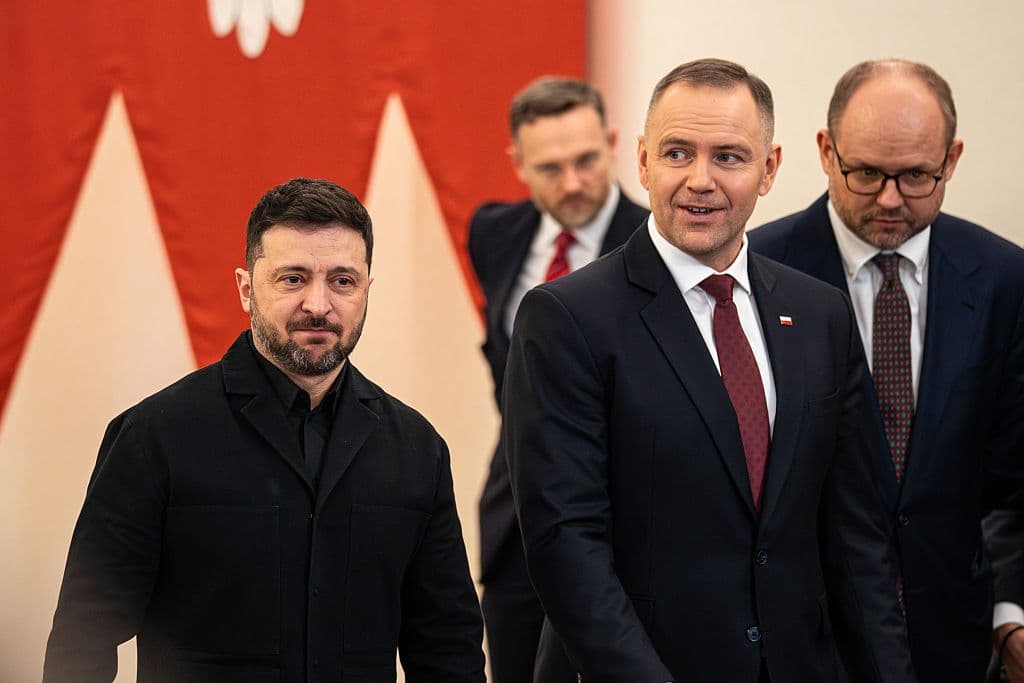
Karol Nawrocki, Poland's president, right, and Volodymyr Zelenskiy, Ukraine's president, arrive at a news conference at the Presidential Palace in Warsaw, Poland, on Friday, Dec. 19, 2025.(Damian Lemanski/Bloomberg via Getty Images)
 on Google
History is rattling Ukraine-Poland relations, yet again.
The new round of historical grievances erupted in Poland when President Volodymyr Zelensky named a Ukrainian special forces unit after the Ukrainian Insurgent Army (UPA) — an organization that fought for Ukrainian independence during and after World War II, but which evokes painful memories in Poland.
In Ukraine, the UPA represents a historical struggle against Moscow's domination — a legacy that feels especially alive amid Russia's full-scale invasion.
But in Poland, UPA fighters are seen chiefly as perpetrators of mass killings of Poles in the region of present-day western Ukraine, then under Nazi occupation.
Zelensky's move was denounced by Polish public figures across parties and ideologies, despite Kyiv's assurances that it was not meant to offend its western neighbors.
What happened?
When Ukraine adopted a decree on May 26 naming a unit "in honor of the Heroes of the UPA" — supposedly at the soldiers' request — the reaction from Poland was swift.
Polish officials and public figures denounced the step as insensitive and hurtful, especially in light of the Polish support provided to Ukraine since the outbreak of the full-scale invasion.
Karol Nawrocki, a Polish historian-turned-president, proposed stripping Zelensky of Poland's highest state honor, the Order of the White Eagle, which was conferred on him in 2023 by then-Polish President Andrzej Duda.

Przemyslaw Czarnek, the conservative Law and Justice (PiS) party's candidate for prime minister in the upcoming elections, denounced Kyiv's move as a "slap in the face," while the far-right Confederation party called for barring Ukraine's path to the EU.
Even Ukraine-friendly figures expressed their disappointment.
Lech Walesa, a former anti-communist dissident and later president who has been a vocal supporter of Kyiv, removed his Ukrainian flag pin in personal protest against Zelensky.
Poland's Prime Minister Donald Tusk, otherwise a political rival of the Polish president, expressed a rare understanding of Nawrocki's response — even as he warned against allowing Moscow to drive a wedge between Kyiv and Warsaw.
"it was about honoring those who, similarly many years ago, fought against imperial Moscow, Bolshevik-communist occupation, and repression."
The public spat did not remain one-sided; some Ukrainian figures pushed back against their Polish counterparts.
Lviv Mayor Andrii Sadovyi noted that since Zelensky accepted Poland's award on behalf of the Ukrainian people and military, it "will be interesting to watch how Mr. Nawrocki will go to the Ukrainian front to collect the decoration from Ukrainian soldiers."
But the most senior voices in Kyiv sought to turn down the temperature.

Zelensky's chief of staff, Kyrylo Budanov, traveled to Poland last week to chart a course out of the diplomatic crisis. Apparently, there was no immediate success.
Meanwhile, Foreign Minister Andrii Sybiha assured Polish partners that the Ukrainian soldiers who requested the title "had absolutely no anti-Polish intent."
"For them, it was about honoring those who, similarly many years ago, fought against imperial Moscow, Bolshevik-communist occupation, and repression," Sybiha posted on X.
Many in Ukraine have echoed this sentiment.
"Ukraine has been at (full-scale) war with Russia for over 1,500 days," Yevhen Mahda, a Ukrainian political scientist at the Kyiv-based Institute of World Policy, told the Kyiv Independent.
There is nothing unusual about "using historical examples to boost morale" in wartime, he adds.
But this argument has not found a receptive audience in Poland.
"You cannot separate the struggle of the Ukrainian Insurgent Army against Sovietization" from "ethnic cleansing against the Polish population," Lukasz Adamski, a Polish historian and director of the Mieroszewski Center, a research institute in Warsaw, told the Kyiv Independent.
The UPA and the Volyn massacres
The so-called Volyn massacres took place between 1943 and 1945 primarily in the historical region of Volyn, in modern-day Ukraine.
Tens of thousands of Poles were killed, while thousands more Ukrainians were killed in retaliatory Polish attacks. The exact death toll is difficult to establish, and Polish, Ukrainian, and Western researchers provide varying estimates.
Framing of the massacres also diverges in Poland and Ukraine.
The Polish parliament in 2016 formally recognized the killings as a "genocide committed by Ukrainian nationalists" against Poles — a move protested by Ukrainian authorities at the time.
In Ukraine, the event is seen as a two-sided tragedy — with officials and researchers invoking the motto "We forgive and ask for forgiveness" — and linked to the broader Polish-Ukrainian conflict that predated the massacres, or even World War II.


In the first quarter of the 20th century, Ukraine lost its War of Independence, with the Treaty of Riga, signed in 1921, partitioning the territories of modern-day Belarus and Ukraine between Soviet Russia and Poland.
Before World War II, the territories where the killings took place were part of the Polish state, home to Poles, Ukrainians, and other ethnicities.
The Organization of Ukrainian Nationalists (OUN) emerged here as an underground nationalist group fighting for Ukraine's independence. Its armed wing, the UPA, was established in 1942 with a goal of fighting for that independence — be it against the Soviet Union, Nazi Germany, or Polish resistance forces.
The UPA's — ultimately unsuccessful — resistance against the Soviet Union continued even after the war, well into the 1950s.
That anti-Soviet legacy, rather than the Volyn massacres, was what brought the UPA to the forefront of Ukrainian historical consciousness when Russia once again attacked Ukraine in 2014.
Where historical memory clashes
According to Ukrainian historian Yaroslav Hrytsak, the UPA's legacy used to be more divisive even in Ukraine. But, as he adds, historical memory changes with circumstances.
"Before the EuroMaidan (Revolution of 2013-2014), the UPA was one of the most controversial phenomena: it sharply divided Ukrainians into those who viewed it positively and those who viewed it negatively," Hrytsak, professor at the Ukrainian Catholic University in Lviv, told the Kyiv Independent.
In Soviet-era media and historiography, the role of the Ukrainian insurgents was seen purely negatively, an influence that lingered even after the Soviet Union collapsed.
But a shift came after Russia occupied Crimea and invaded Donbas in 2014, and launched its full-scale invasion eight years later.
In 2013, only 22% of Ukrainians viewed the UPA and the OUN positively, while 42% viewed them negatively. Nine years later, this shifted to 43% viewing the organizations favorably and only 8% unfavorably, according to a poll.
"War always nationalizes a society, and Ukraine during the war confirms this: nothing unites quite like a strong and ruthless enemy," Hrytsak says. "The UPA has ceased to be a symbol of division in Ukraine and has become a symbol of resistance against Russia."
No such shift occurred in Poland.
"This is not only a conflict of how to interpret the history, but it's rather a conflict of two symbolic layers," Adamski explains.
In Ukraine, the mainstream approach is that it is up to the Ukrainian nation, as a "matter of national sovereignty, national dignity," to decide who its heroes are, the expert says.
The latest dispute took place just as Ukraine is building its Pantheon of National Heroes, a memorial honoring figures from Ukrainian history who symbolize the struggle for independence.
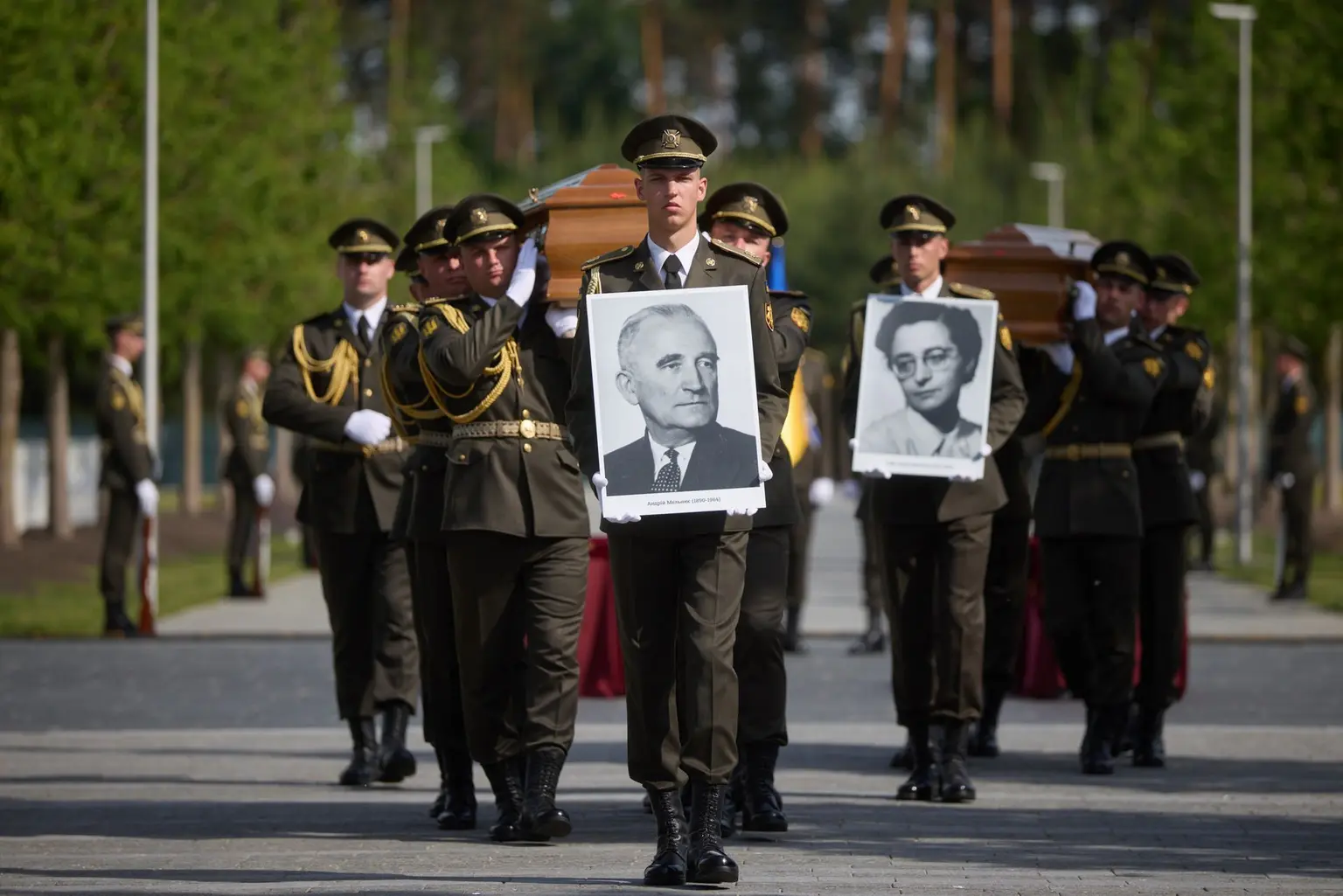
"Nobody can dictate (to a nation) how to interpret its historical figures or events. It's unique for every country," says Stanislav Zhelikhovskyi, a Ukrainian expert in international affairs.
He stresses that the UPA was not monolithic — it was a group with different branches and internal contradictions. According to the Polish media's undisclosed sources, Ukraine has even considered renaming the military unit after those UPA members who only fought against the Soviet Union to alleviate Warsaw's concerns.
At the same time, Zhelikhovskyi also acknowledges that countries should take their neighbors' sensibilities into account and explain such decisions in an open dialogue.
For Poles, honoring the UPA — without any acknowledgment of its role in the Volyn massacres — feels like an affront to a nation that has stood firmly behind Ukraine since the full-scale invasion, Adamski says.
According to Polish political scientist Pawel Borkowski at Lazarski University in Warsaw, the UPA represents a powerful symbol — a symbol of "every possible harm" committed by Ukraine against Poland.
Borkowski says he was surprised by Kyiv's move, as he believes many Ukrainians are likely aware of the symbolism these topics carry in Poland. Yet, he acknowledges that every nation has difficult chapters of its history that it struggles to confront — including Poland.
But even if Zelensky wanted to backpedal on his move for the sake of neighborhood relations, he might not have a lot of room for maneuver.
"Reversing the decision now could provoke opposition among soldiers," as well as other Ukrainians who value the UPA's legacy, Zhelikhovskyi says.
Experts believe that reconciliation between the Ukrainian and Polish perspectives will be difficult — but not impossible, and likely necessary as Ukraine moves toward European integration.
A path to reconciliation?
Since Ukraine regained its independence, its presidents — from Leonid Kuchma to Petro Poroshenko and Zelensky — and their Polish counterparts have made many symbolic attempts at reconciliation over Volyn.
"We forgive and ask for forgiveness"
None has succeeded in putting the matter to rest.
One step that could bring resolution closer would be the exhumation of the Volyn massacre victims on Ukrainian territory.
Poland and Ukraine signed an agreement in 1994 permitting exhumations, and the work proceeded under that framework. However, Ukraine imposed a moratorium in 2017 following the demolition of a UPA memorial in Poland, freezing progress.
It was not until 2025 that exhumations in Ukraine resumed, based on Kyiv's agreement with the Tusk government.
Yet, this was not enough for Polish opposition politicians from the conservative and nationalist camp.

Politicians like Czarnek or Confederation co-leader Krzysztof Bosak continue to call for "full exhumations," largely sidestepping the fact that the process is already ongoing.
Adamski acknowledges that the resumed exhumations are "quite slow," hampered by unnecessary bureaucracy.
"But definitely there are people in Poland… who are not interested in effective dialogue with Ukraine and fruitful neighborhood cooperation. Because then they would lose their political fuel," the expert adds.
Anti-Ukrainian sentiments are unlikely to disappear from Polish public debate as the far right and even PiS's new hardline leadership seek to capitalize on historical issues ahead of next year's parliamentary elections.
The dispute is also likely to put pressure on Tusk, forcing him to fend off accusations that his government is insufficiently patriotic, Borkowski notes.
What happens next remains unclear. Nawrocki has so far held off with the decision to strip Zelensky of the order, while Tusk urged both heads of state to hold direct talks.
With Ukraine's EU accession on the horizon and with European and Ukrainian security increasingly intertwined, it is in both nations' interests to find a way out of the crisis.
Editor's note: Got an opinion on anything you've read in the Kyiv Independent so far? Send it to letters@kyivindependent.com, and it may appear in our Letters section.
read also
Note from the author:
Hi, this is Martin Fornusek, the author of this article.
At the Kyiv Independent, we strive to bring Ukrainian history closer to readers and to show how it continues to shape Ukraine's relations with its neighbors today.
This work is only possible thanks to the support of readers like you. If you value independent journalism, please consider joining the Kyiv Independent's community.