'I'm not counting on the US' — In Estonia, faith in Trump's defense of Baltics fades
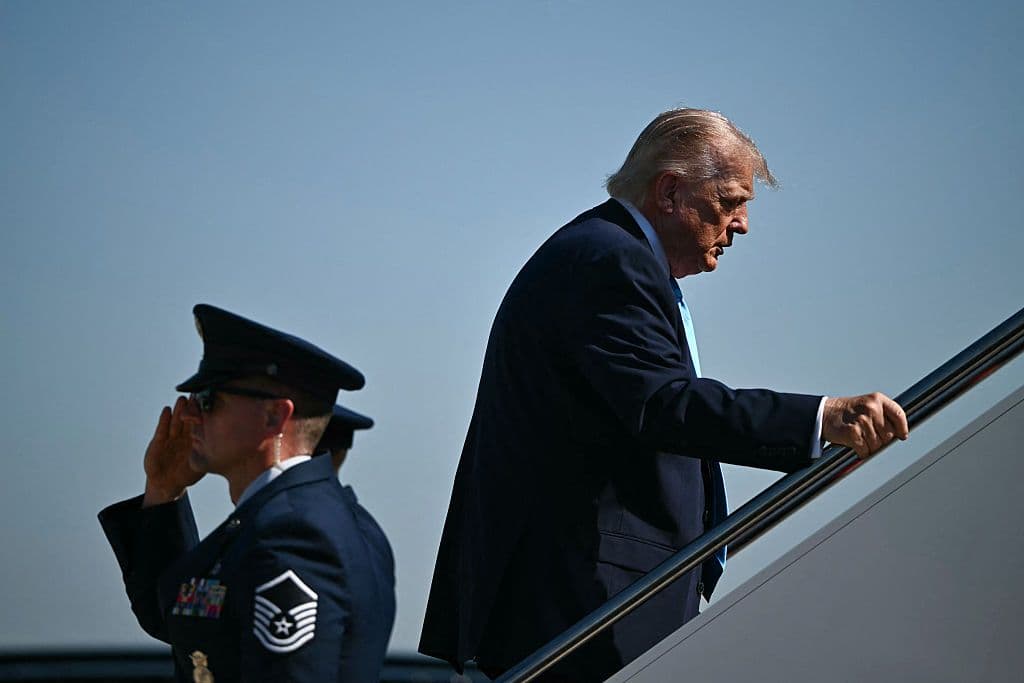
U.S. President Donald Trump boards Air Force One at Joint Base Andrews, Maryland on May 20, 2026. (Kent Nishimura / AFP via Getty Images)
 on Google
TALLINN, Estonia — Among Estonians, there is little confidence that U.S. President Donald Trump would rush to defend their country in the event of a Russian invasion.
As a 1.3-million-strong NATO member sharing a border with Russia, Estonia would likely be at the forefront of a potential conflict between the alliance and Moscow — a prospect seen as increasingly realistic since the full-scale invasion of Ukraine in 2022.
Publicly, Estonian officials have cast a confident note.
While Russia remains a long-term threat, the Baltic country remains shielded by NATO's Article 5 — and therefore by the U.S. military might — while Moscow's forces are preoccupied in Ukraine, they say.
But on the streets of Tallinn, the tension is palpable.

"I'm thinking about that every day," Egert Heintare, a resident of Tallinn, told the Kyiv Independent when asked about the possibility of a Russian attack. "They (Russia) are much bigger; we are a tiny country."
The U.S. president's foreign policy flip-flops and open disdain for European allies do little to inspire trust among Estonians. Instead, locals put their trust in their European neighbors and allies.
"I'm not sure about Donald Trump, but I hope (European members of) NATO will help us," Eva Reis, a resident of Tallinn, told the Kyiv Independent.
"I think the French or the Germans will come (to help Estonia). I'm not counting on the United States," Heintare notes.
Other residents of the Baltic country share skepticism about U.S. commitments.
Mohamed Elhalawany, an Egyptian who has lived in Estonia for close to eight years, says he does not "trust America" after Trump failed to help Ukraine against Russian aggression.
Trump is a "businessman," Elhalawany says. "He doesn't give a s**t about anything. He cares about money, about petrol."

Lost faith in Trump
In many ways, Estonia is an exemplary NATO ally.
It was among the alliance's top defense spenders relative to GDP in 2025, allocating 3.42% to defense.
Only Poland, Lithuania, and Latvia — all sitting in a close vicinity of Russian military assets — spent more.
Estonia's share is expected to reach 5.4% by 2029, surpassing the Trump-proposed benchmark agreed at the NATO summit last year.
And yet, this appears to count for little in shaping Trump's foreign policy priorities.
Estonia has faced delays in shipments of U.S. HIMARS rocket launchers — a key part in Tallinn's strategy to bring war to Russia in case of conflict — due to the war in Iran.
After announcing plans to withdraw 5,000 troops from Germany, the U.S. "delayed" a planned deployment of 4,000 troops to Poland, sending a worrying signal about Washington's defense posture in the Baltic region.
While Trump declared last fall that he would defend the Baltics if needed, his famous zig-zags make even senior U.S. officials afraid to commit to what would be beyond question just two years ago.
Thomas DiNanno, a U.S. undersecretary of state, stopped short of unequivocally confirming that Washington would defend its Baltic allies when pressed at the Lennart Meri Conference in Tallinn.
The rhetoric has not reassured the Europeans.
"What that man (Trump) will do is hard to say. I'm sorry to say, but we can't rely on them as we did in the past," says Jesper Blomqvist, a Swede visiting Tallinn.
Mila Soitu, a Finn, similarly doubts Trump would rush to help Estonia against a Russian attack. "But let's see. Trump is quite unpredictable. It can be another way tomorrow."
How immediate is the threat?
Standing between bellicose Russia and the unsteady U.S. ally, the Estonian government has projected confidence in NATO.
"I strongly believe that Article 5 works. This is why we have NATO," Estonian Defense Minister Hanno Pevkur told the Kyiv Independent.
"But, obviously, there are better times — and there are a bit more worrying times."
Jonatan Vseviov, the secretary-general at Estonia's Foreign Ministry, told the Kyiv Independent that there is no imminent military threat to his homeland.
"NATO deterrence and defense posture here is a solid one, consisting of not just our own forces but also of allies that are here, integrated into our defense forces," the secretary-general said.
In any case, the Russian military is currently "stuck in Ukraine," he says, albeit stressing that Russia remains a number one long-term threat to the European continent.

When asked whether the government is not simply tuning its communication strategy to calm the population, Vseviov said that due to the experience with Russian rule, "the Estonian people can see through government propaganda."
"The Estonian people are not inclined to simply believe what government spokespeople say," the official said.
But "when you walk the streets of Tallinn or, frankly, walk the streets of Narva, there's peace, calm and stability here, because we know that we have our house in order and can withstand the turbulent times right now."
Not everyone is convinced that the government's messaging is fully honest.
"I think it's part of (the government's) work" to tell the people that there are no imminent threats… "even if there are," Heintare, a resident of Tallinn, told the Kyiv Independent.

"It would be very bad if they tell people, 'there is a 20% chance they'll come.' So I think that's what they need to do."
Hanna Yaremenko, a Ukrainian teacher who left for Estonia after Russia invaded her homeland, observes similarities with the atmosphere in Ukraine just before the all-out invasion.
"The situation was quite similar in Ukraine before the war started. Everyone was like: 'everything is fine, don't worry, it's just talk,'" Yaremenko told the Kyiv Independent.

Some Estonians, like Heintare and Reis, acknowledge their government's efforts to prepare for a potential conflict — but doubt the Estonian society is actually ready for the realities of war.
"In societal terms, certainly not. No one is ready for this," Reis told the Kyiv Independent.
The Russian-language divide
Among Estonians, there is a strong consensus on core foreign policy and security questions.
A government survey from last year showed that 82% of Estonians believe the country should defend itself in case of an attack, and 62% are willing to join the fight.
Marit Aro, a resident of Tallinn, says "of course" Estonia should defend itself if attacked, even as she recalls — visibly emotional — that her son has been conscripted.

All fit Estonian men aged 18 to 27 are required to undergo military service.
Aro said he "hoped" Estonia was prepared for war, adding that she believed Estonians were smart enough to adapt and rely on unconventional methods if necessary.
According to the Estonian Defense Ministry's survey, ethnic Estonians also overwhelmingly (93%) support NATO membership — but the figure drops to 60% among "other nationalities."
Close to one-third of Estonia's residents speak Russian as their first language, and about 20% of the country's population is ethnically Russian, largely due to Soviet settlement policies.
Estonian authorities have long raised concerns about the Kremlin targeting Estonia's Russian minority through disinformation and propaganda.
Members of this community who spoke to the Kyiv Independent presented a different perspective on Estonia's security challenges than their Estonian compatriots.
Alexey Shantarevich, a Russian-speaking resident, does not believe Russia is a threat to Estonia.
The concerns are "probably a cover-up for some economic problems in our country," he told the Kyiv Independent in the streets of Lasnamae, a predominantly Russian-speaking district of Tallinn.
"What would Russia need Estonia for?" asks Valery, a Russian living in Tallinn.
The Soviet Union occupied Estonia from the 1940s to 1991, and the Russian Empire ruled it for over two centuries before World War I.

According to Valery, the supposed Russian threat to Estonia has been conjured up by people "in Brussels and Washington" who seek perpetual conflict.
Estonians and Russians, he says, have no problems with each other here.
Talking about the war in Ukraine, he insinuates that the country is riddled with fascism and points to the May 2014 Odesa clashes as evidence — an incident long distorted in Russia's anti-Ukrainian propaganda.
Tanya, another Russian speaker living in Tallinn, has a starkly different view.
She describes the war in Ukraine as a "tragedy" and a "disaster" caused by Russian President Vladimir Putin, which has turned much of the world against Russians.
Tanya says she feels safe in Estonia, as it is part of Europe and NATO. She also has a clear idea about what would prevent Russian aggression from spreading further.
"If Ukraine wins, all of Europe will be at peace," Tanya said.
Note from the author:
Hi, this is Martin, the author of this field report. I really hope you enjoyed the piece. Traveling across Europe to bring you stories like this is possible only thanks to your support. If you want to keep our journalism going, consider joining the Kyiv Independent community.
We are currently on a quest to gain 4,000 new members — if you're thinking about joining, now is the time.
Thank you!