Field report: Training at Russia's doorstep, NATO readies for a drone-ruled battlefield
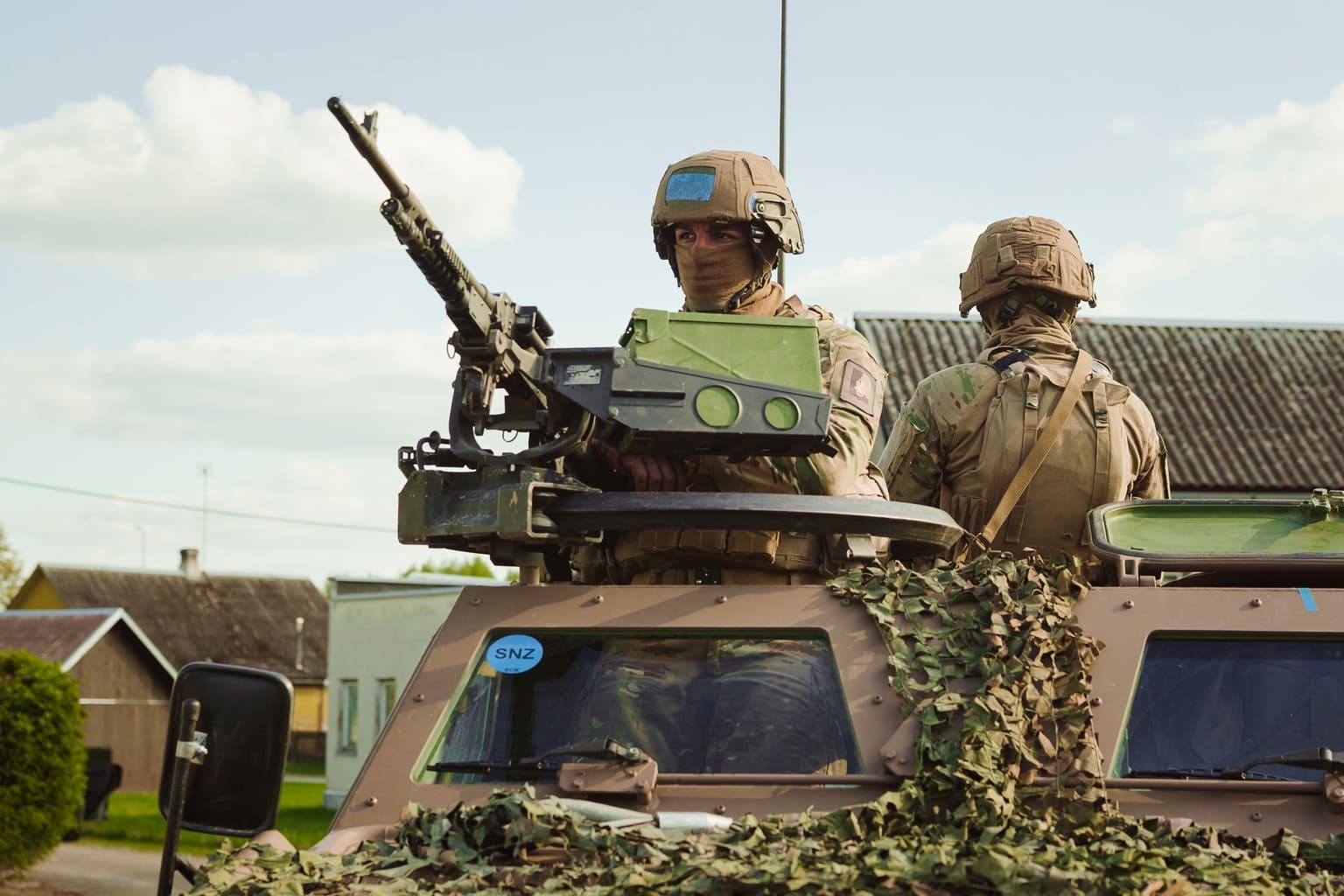
French soldiers in an armored vehicle while taking part in the Spring Storm exercise in Voru County, Estonia, on May 14, 2026. (Taavi Prints/The Kyiv Independent)
 on Google
VORU COUNTY, Estonia — In southeast Estonia lies a lake-studded, woodland region locals call Missomaa, which makes up the country's three-way borderland with Latvia and Russia.
Its innocuous-looking woods are overlaid by cameras and sensors feeding data to a British unit stationed nearby, informing their first-person-view (FPV) drone operators about an "enemy" vehicle closing in.
Corey, an operator of the British 2nd Battalion, Royal Regiment of Scotland (2 Scots), simulates a strike by doing a low fly-by and landing his drone next to the vehicle.
The exercise takes place just a short drive from the Luhamaa checkpoint at the Estonian-Russian border.
This is only a small part of Spring Storm 2026, Estonia's flagship military drills meant to prepare the country's forces and its allies for a possible Russian invasion — a prospect seen as increasingly realistic since the start of the full-scale invasion of Ukraine in 2022.

"You want to train where you may be fighting, right?" Sergeant Crawford, a British soldier, tells the Kyiv Independent.
"Coming out here and getting amongst the trees, and using the equipment that we may have to fight with is the best form of training. You can't simulate this anywhere else in the world."
Running from May 4 until June 1, Spring Storm is set to involve 12,000 troops, including 3,000 allied soldiers, concentrated in southeast Estonia and northern Latvia, a strip of land that could become a flashpoint in a potential NATO-Russia clash.
A key goal of the exercise is to catch up with rapid technological advancements in the Russia-Ukraine war. As NATO forces practice drone warfare, Ukrainian specialists were also invited to share their knowledge.
Learning from Ukraine
In February, the Wall Street Journal published an article about how a team of Ukrainian drone operators inflicted heavy "losses" on NATO forces during the Hedgehog 2025 exercises in Estonia.
While Estonian officials privately downplay the article's conclusions, a similar story emerged later in connection with military drills in Sweden, suggesting the alliance is unprepared for the realities of modern drone combat.
In Ukraine, cheap, mass-produced reconnaissance and FPV strike drones have transformed the battlefield.
Russia's earlier warfighting approach of mass armored column assaults became untenable, giving way to smaller infantry groups attempting to infiltrate front-line positions while staying hidden from drones.
Small explosive-carrying drones are now responsible for an estimated 80% of battlefield casualties.
"Five years ago, we had mostly infantry platoon tactics, moving on foot through forests," says Platoon Leader Külm, commander of a drone unit at the Estonian Defense League, a voluntary force set up to support the country's regular military.

"Now you need to be ready for any kind of drones flying over," he tells the Kyiv Independent at the drone training and development center in Nurmsi, central Estonia, when asked about the lessons he is drawing from Ukraine.
"As a lonely soldier, you need to be ready for anything. As a squad, you need to have a plan."
Estonian reservists and Defense League volunteers are also taking part in Spring Storm to learn the skills needed to survive in the 21st-century battlefield.
About 500 drones are deployed in the exercise, along with unmanned ground vehicles.
Civilian contractors are closely involved in the drills as the military tests which equipment meets their needs — and which does not.
After Ukraine trained NATO forces on its Delta system — its cutting-edge digital battlefield awareness platform — last year, the alliance has been "rapidly" catching up, according to Colonel Aron Kalmus, deputy commander of the Estonian Division.

Speaking at the Voru base, about 30 kilometers (20 miles) from the Russian border, Kalmus is the exercise director of Spring Storm.
The exercises aim to instill "muscle memory" in soldiers — from squads and platoons to entire companies — on how to operate in a drone-saturated battlefield, he tells journalists during a briefing.
Not far from the Voru base, soldiers of Estonia's Kuperjanov Infantry Battalion have dug in trenches obscured beneath tree lines to practice drone warfare.
One of their activities is a "red team exercise" — simulating combat with another battalion as the opposing force, aka the "red team."
Both teams, says Lieutenant Colonel Lauri Teppo, the commanding officer of the Kuperjanov battalion, "are boosted with Ukrainian knowledge and experts."
And drones are not the only cutting-edge tech Estonia is training on.
Electronic warfare, anti-drone systems, and AI integration — designed to speed up decision-making and shorten the kill chain while compensating for Estonia's limited manpower — are all being tested and developed during Spring Storm.
But rapidly evolving, improvised battlefield innovations in the Russia-Ukraine war often outpace the more cumbersome peacetime procurement in NATO countries.
"Whatever we do with UAVs today is basically old tomorrow, especially when we talk of frequency management, jamming, and technology used in drones," Kalmus says.
"Three months, six months, they are old already. We need to update them."
The colonel admits that despite rapid advancement, NATO remains "behind the curve" in terms of drone and anti-drone systems.
Nevertheless, Estonian officers stress that they cannot "blindly" apply all lessons from the war in Ukraine. A conflict in Estonia, they say, would differ in key aspects.
Region heating up
In Ukraine, the largely static front line stretches for over 1,200 kilometers (750 miles), marked by incremental Russian advances in the east and occasional Ukrainian counterattacks.
Estonia's entire border with Russia is about 300 kilometers (200 miles) long, and the distance between the Russian border and the Estonian western coast is about 250 kilometers (160 miles).
The Baltic country lacks the operational depth and space to lay out the dense defensive lines Ukraine has, Kalmus explains.
NATO's multi-domain doctrine, with its emphasis on air superiority, would further shape how the battlefield unfolds in Estonia.
"Estonians would have to take more initiative to sustain forces. We need to be more mobile, agile, seek the momentum," not allowing Russian forces to pin us down, the colonel says.
Estonia has about 7,000-8,000 active-duty troops, but aims to mobilize up to 44,000 in wartime, including professional soldiers, conscripts, reservists, and Defense League volunteers.

This figure amounts to about 3% of the country's entire population — equivalent to the United States mobilizing roughly 10 million people.
Alongside allied troops temporarily deployed here for the exercises, the Baltic country also permanently hosts a British-led, French-supported brigade of about 1,000 troops as part of NATO's Forward Land Forces initiative.
Among the troops training at Spring Storm is a French battlegroup under U.K. command, positioned near the border village of Misso.
Their armor — including a 120-mm MEPAC mortar and the Jaguar armored fighting vehicle — stands clustered in a small visible area, surrounded by houses.
Lieutenant-Colonel Mathieu, the French battlegroup's chief of staff, explains that this conspicuousness is intentional.
The NATO presence is intended to "reassure the population" — and "to deter any enemy willing to engage," Mathieu says.
Yet, Estonian and allied forces operating here are dwarfed by the roughly 700,000 Russian troops deployed in Ukraine, and by 900,000 Ukrainian soldiers holding off the invasion.
Witnessing the brutality of the Russian occupation of Ukraine, Tallinn has been moving toward an "active defense" doctrine — preventing Moscow's advances into Estonian territory by bringing the war to Russia as quickly as possible.
While building up border defenses, the Baltic country has been buying an arsenal of U.S. HIMARS rocket launchers, ATACMS missiles — both battle-tested in Ukraine — and other long-range weapons.
"Russia must feel that if they try to attack us, we will bring devastating effects on their military targets, on their soil," Lieutenant Colonel Teppo notes.
Talking to the Kyiv Independent, Kalmus warns: "If they come to our yard, we make sure that we heat up their backyard."
read also