How did Vienna become safe haven for oligarchs and fugitives?
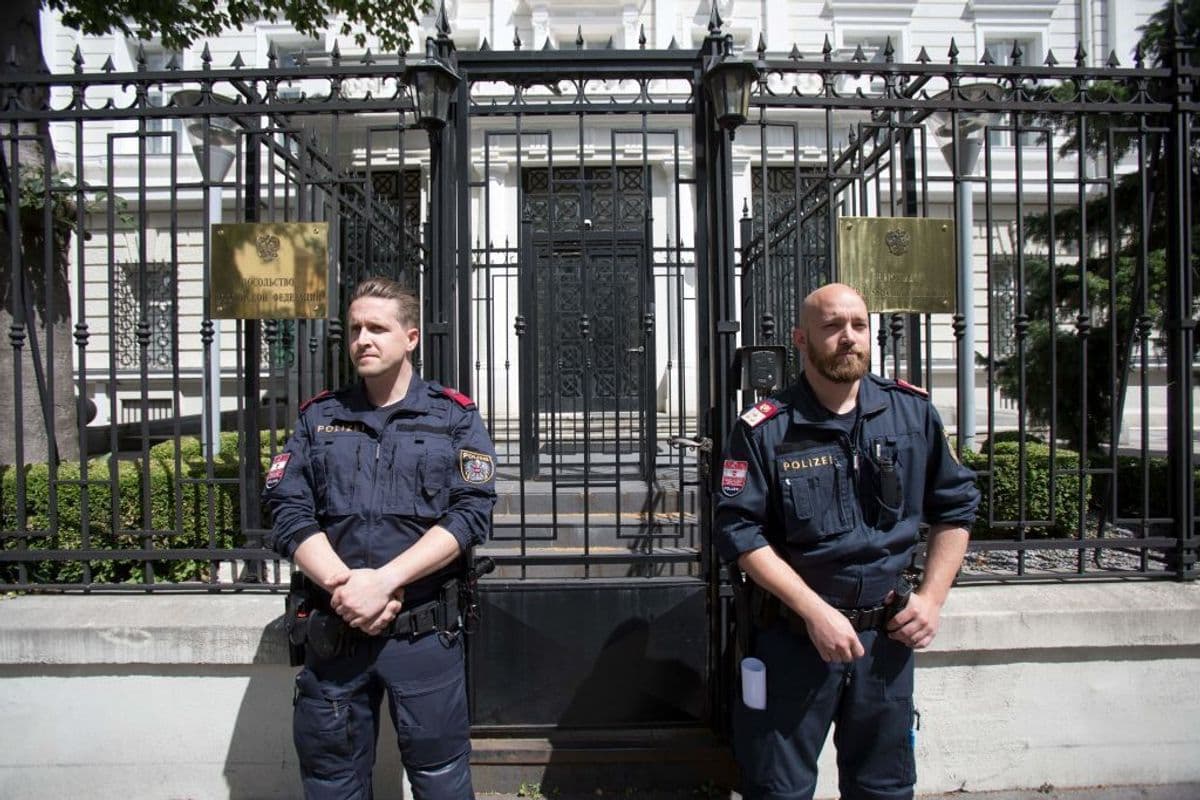
Austrian police stand guard outside the Russian Embassy in Vienna, Austria, on July 7, 2020. (Alex Halada/AFP via Getty Images)
 on Google

Cornelius Granig
Austrian business executive
The detention of Ukraine's best-known investigative journalist, Mykhailo Tkach, and his cameraman Yaroslav Bondarenko in Vienna this October caused an understandable outcry in both Ukraine and Austria.
The two work for Ukrainska Pravda media and were reporting on the whereabouts of former Ukrainian prosecutor general Ruslan Kravchenko, who had reportedly relocated to Austria's capital shortly after Kravchenko's personal office was searched by Ukraine's anti-corruption bodies as part of a large-scale corruption investigation.
The journalists were later released, and the alleged espionage suspicion raised by Austrian authorities was never publicly substantiated.
Many people asked me how a European country that has stood so firmly with Ukraine could treat a reporter as a suspected spy. It is a question Austria's authorities should answer.
Our country has a long history of welcoming capital from Eastern Europe. Much of that investment has been legitimate and beneficial, but Austria has also attracted people whose wealth and business activities deserve closer scrutiny, or, at the very least, raise some questions.

Our legal system must not become a means of avoiding accountability for serious wrongdoing abroad.
This problem goes back a long way.
During the Cold War, neutral Austria sat on the Iron Curtain, and communist regimes profited from it. East Germany's ruling party, Socialist Unity Party (the SED), ran a large share of its trade with the West through firms in Vienna. When Germany reunified, hundreds of millions of Deutschmarks disappeared from the party's accounts. Romania's notorious secret police agency Securitate did its hard currency deals in Vienna in the time of communist Romania too.
After 1991 came post-Soviet money, and it went into apartments, villas, and company holdings. Some of it came with blood. In 1996, David Sanikidze, a reputed Georgian mafia boss, was gunned down in the center of Vienna. In 2009 and 2020, two critics of Putin's close ally Ramzan Kadyrov were shot dead in and near Vienna.
Austria's reluctance to extradite prominent foreign figures has repeatedly raised questions about its willingness to cooperate with international criminal investigations.
"Can someone with sufficient financial resources and legal support effectively avoid extradition indefinitely?"
The case of Dmytro Firtash, a Ukrainian gas tycoon, illustrates how long this extradition battle can last, even for actors as powerful as the United States.

The Ukrainian businessman was arrested in Vienna in 2014 on an American bribery warrant. He posted a record bail of 125 million euros (about $172 million at the 2014 exchange rate), reportedly with a loan from a Russian oligarch, and fought extradition for almost 12 years.
To this day, he remains in Austria.
Firtash denies all charges and has never been convicted. Just like many other cases, this one raises a logical question: Can someone with sufficient financial resources and legal support effectively avoid extradition indefinitely?
Such cases rely on a small circle of Austrian lawyers, trustees, consultants, and PR agencies who make a living from them, and it seems like their business is absolutely booming.
Some of these firms also have clients in Moscow, helping them land their money safely in Austrian banks and businesses.
They set up layered company structures, provide nominee directors, and drag every extradition request through years of procedure.
Don't get me wrong — everyone accused of a crime has a right to a proper defense, no question, but systematically hiding people and their assets is a different business.
Austria is home to almost 100,000 Ukrainian refugees, as well as Ukrainian entrepreneurs, investors and professionals who have built legitimate businesses and contribute to our economy.

Their reputation should not suffer because others use Vienna to evade questions about suspicious fortunes or alleged wrongdoing.
The distinction matters, particularly for Ukrainians who fled the war and are rebuilding their lives here, doing so honestly.
Being wealthy is not evidence of wrongdoing, and allegations from a foreign government are not proof of guilt. Some people face genuine political persecution, and Austria must protect them.
Independent anti-corruption bodies are the other half of the equation. Ukraine's fight against graft depends on institutions that can investigate without political interference, and on courts that deliver fair judgments. Anti-corruption watchdogs — NABU, SAPO — the High Anti-Corruption Court and investigative journalists each play a part in that. Austria should support their work while respecting due process.
That is why anyone seeking refuge or asylum here, in my opinion, should expect three simple questions: Does your lifestyle match your official income? Can you explain where your money came from? Did you help Russia's war economy?

Austria should be a reliable partner for the Ukrainian economy, cooperating closely with companies and reformers who are building a more prosperous country. Our businesses have decades of experience there, particularly in the financial, industrial, infrastructure, and energy sectors.
These relationships should become the foundation for long-term investment and reconstruction.
But investment requires trust. Companies need transparent ownership, functioning courts, effective anti-corruption institutions, and business partners whose integrity is beyond doubt. Austria has a responsibility to enforce these standards at home if it wants to be taken seriously as an economic partner abroad.
I have spent many years managing large companies in Ukraine and have seen what Ukrainian employees, business owners and managers can achieve, even under difficult circumstances.
The country has enormous economic potential. Realizing it will require investment, professional management and international partners who are prepared to take responsibility.
And we must never forget: in this cruel war, Ukrainians are dying every day, while they are defending European values. Therefore, every European nation, and we in Austria, must help build Ukraine's future, not protect its past.
Editor's note: The opinions expressed in the op-ed section are those of the authors and do not purport to reflect the views of the Kyiv Independent.