The danger lurking in Russia's frozen wars
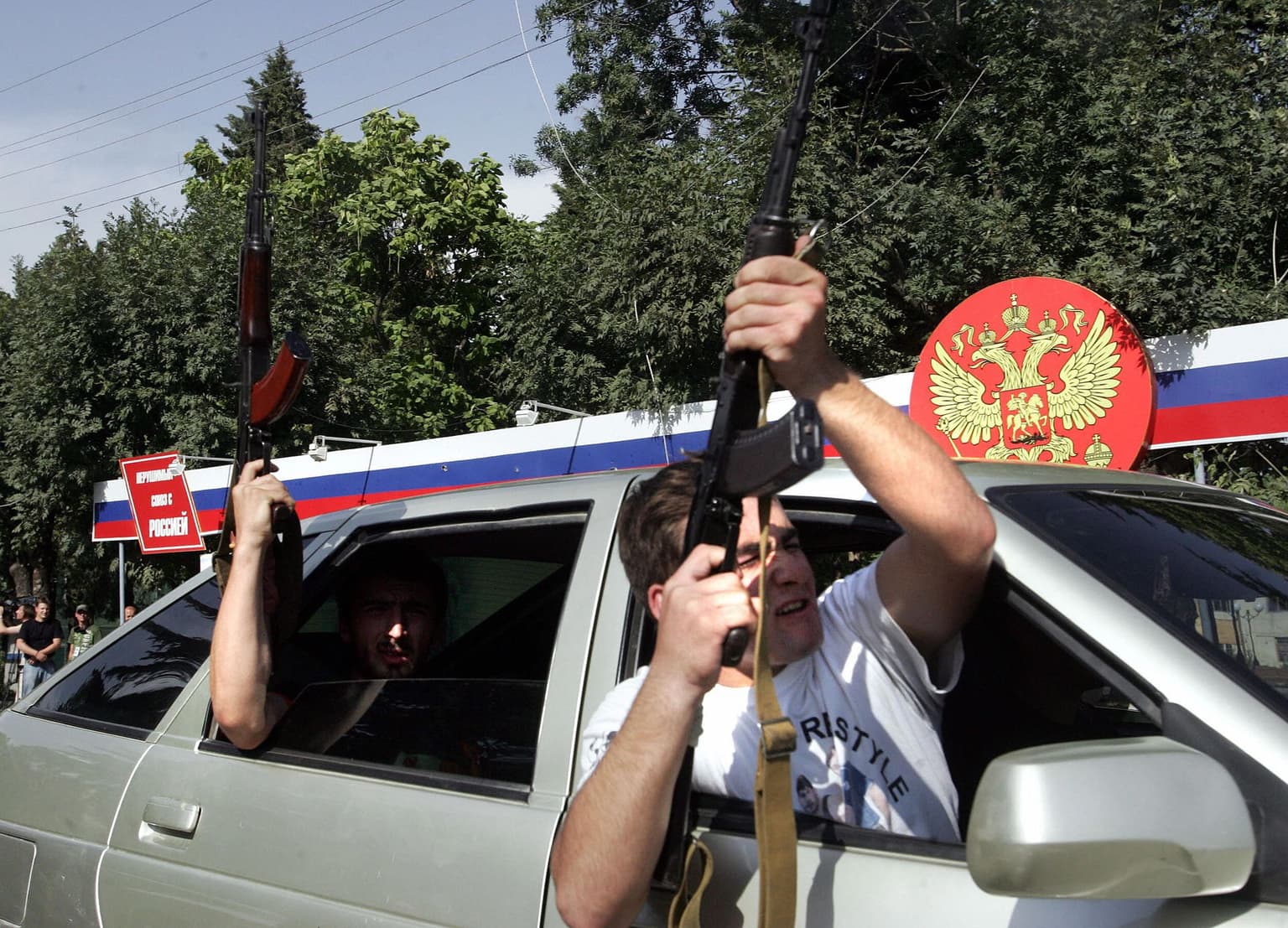
Men fire guns into the air in Tskhinvali, Georgia, on Aug. 26, 2008, following Russia's military invasion of Georgia. (Dmitry Kostyukov / AFP via Getty Images)
 on Google

Giorgi Pachuashvili
Georgian political analyst and researcher
About a month ago, between Oct. 12 and 16, the Russian-occupied region of Georgia, a self-proclaimed "independent" republic of Abkhazia, announced an "operational-tactical" military exercise.
Among the stated objectives was to enhance interoperability between Abkhazia's separatist armed forces and the Russian military.
Russia has sought to progressively absorb Abkhazia into its strategic orbit since the conflict of 1992–1993, consolidating its military presence following the war and securing international recognition for the legitimacy of its occupation only from a handful of states after the 2008 war.
Under the guise of peacekeeping missions, Russia has been distributing its passports to the locals, appointing Kremlin proxies at the head of the core de facto institutions, and holding State Duma elections.
As the debates over ending the war in Ukraine have grown increasingly loud in recent months, while politicians across Europe and in the United States have voiced their discontent with the spillover effects of Russia's full-scale invasion, the case of Abkhazia has become particularly relevant.
It serves as an example of where neglect, lack of solid international presence, and unjust peace might lead.
While calls for peace may be entirely legitimate, certain questions remain both deeply unpopular and indispensable to any meaningful debate about ending Russia's full-scale invasion: Will the aggressor be held accountable? And what safeguards will prevent Russia from resuming its aggression?
"The Georgian question is the first answer to why freezing conflicts without proper security guarantees only serves to conserve and reignite them in the future."
Absent satisfactory answers, the push for peace risks becoming a push for Ukraine's de facto surrender, the establishment of yet another frozen conflict, and the multiplication of already precarious security vulnerabilities — not just for Kyiv, but for the wider Black Sea region and subsequently the entire continent.
Abkhazia constitutes a war largely forgotten by the international media, yet one that preceded Russia's subsequent crusade of invasions against its neighbors. It is a place to start discussion about what such a fragile "peace" ultimately entails.
At present, the wider Black Sea region is subject to several frozen conflicts. Two are present in Georgia, in Abkhazia and the Tskhinvali Region, or so-called "South Ossetia"; one in Moldova, in Transnistria; and in Ukraine, the unresolved conflict, following the events in Donbas and Crimea, has spiraled into a full-scale unprovoked Russian invasion.
The Georgian question is the first answer to why freezing conflicts without proper security guarantees only serves to conserve and reignite them in the future.
Currently, 20% of the Georgian territories are under Russian occupation. Two separatist enclaves have been formed to govern Abkhazia and the Tskhinvali Region, after the devastating wars in 1991-1993.
Russian military intervention in 1992-1993 resulted in ethnic cleansing in Abkhazia, where more than 200,000 people, predominantly Georgians, have been forcibly displaced, while thousands lost their lives.

Russian military aggression in 2008 led to another wave of ethnic cleansing and mass forced displacement of Georgians, now from the Tskhinvali Region.
However, the international community stopped shy of recognizing these acts as genocide, and the victims have not seen justice.
This leads us to an important point — the Russian-occupied regions of Georgia must not be viewed in isolation.
While many analysts keep the peacekeeping approach, some even clumsily compare Georgia to the Balkans, the real lens needed is a geopolitical one.
The ruling Georgian Dream party is instrumentalizing narratives surrounding Russian aggression to discredit the former government by blaming them for provoking the conflict. Moscow's propaganda, for its part, constantly tries to muddy the waters and present itself as a benevolent peacekeeper.
The occupation of Abkhazia represents a strategic challenge to the security of the wider Black Sea region and remains a major unresolved vulnerability on the eastern flank of the larger Euro-Atlantic security architecture.
Its long neglect by the West and the international community at large has enabled Russia to test the methods of political or hybrid warfare and eventually challenge Western resolve.
This trajectory would culminate, in Ukraine, in the aggression that began in 2014, when separatism was weaponized as an instrument of Russian geopolitical expansion.
With the new strategic documents, both the European Union and NATO have acknowledged this reality. The 2022 EU Strategic Compass directly linked Russia's blatant violation of international law and assault against European and global security with "the military aggression in Georgia in 2008" and its incursions in Ukraine in 2014.
The NATO 2022 Strategic Concept recognized that the security of aspiring members is "intertwined" with the security of all NATO member states, thereby including both Georgia and Ukraine — states that were promised eventual membership during the 2008 Bucharest Summit.

Current military exercises in Abkhazia symbolize an effective breach of this Euro-Atlantic vision.
Abkhazia is strategically situated along the northeastern and eastern shores of the Black Sea. Its militarization helps Russia project power more efficiently in the region. While Abkhazia may appear disconnected from Russia's latest aggression against Ukraine, its links to the Russian war effort may surprise many.
As the Ukrainian strikes have made the situation for the Sevastopol-based Russian Black Sea Fleet untenable, the Kremlin is considering building a naval base in one of the coastal cities, Ochamchire, in the occupied region.
The 7th Russian Military Base is already there, located in the town of Gudauta, reportedly housing up to 4,000 military personnel, along with tanks, armored personnel carriers, various howitzers, multiple rocket launchers, mortars, self-propelled anti-tank missile systems, and anti-tank guns.
There are also fears of conscription of Abkhazian civilians into the Russian army, as many of them hold Russian passports.
The wars in Georgia, Ukraine, and Moldova are all the unresolved fires of Russian aggression, which Moscow has repeatedly stoked and may yet rekindle to set the wider European continent ablaze.
Except for the ongoing war in Ukraine, these conflicts seem to have slipped into a category of the supposedly "resolved" in the minds of many politicians — conflicts that have faded from the headlines, but whose illegally occupied territories remain firmly under Moscow's thumb.
Forgetting about them, policymakers overlook the footholds Russia has spent decades consolidating. As long as those unresolved, frozen lines are there, Moscow can exploit them for strategic advantage, turn them into instruments of coercion, or weaponize them as theatres of provocation whenever the opportunity presents itself.

Peace in itself is a fragile matter unless reinforced with long-lasting foundations. A mere ceasefire would only entrench Russia's occupation and validate its imperial ambitions, causing more death and suffering in the future wars of aggression. "Before Bucha in Ukraine, there was Abkhazia in Georgia," goes the saying.
Russia has declared an illegal annexation of four Ukrainian oblasts; tightened its control over Abkhazia and Tskhinvali Region, and purportedly moved forward to annex the region — though this would only be a formality.
Without a clear strategy for achieving sustainable and just peace in the wider Black Sea region, as well as the establishment of a solid security architecture, the West risks perpetual hostilities and crises, as we've seen happen in Georgia.
Such an approach must be coupled with an unambiguous pathway to EU and NATO membership for the countries concerned, or, at the very least, serious decisions on their security and development.
Editor's note: The opinions expressed in the op-ed section are those of the authors and do not purport to reflect the views of the Kyiv Independent.