From Oleshky to Mariupol, the humanitarian crisis across Russian-occupied Ukraine deepens
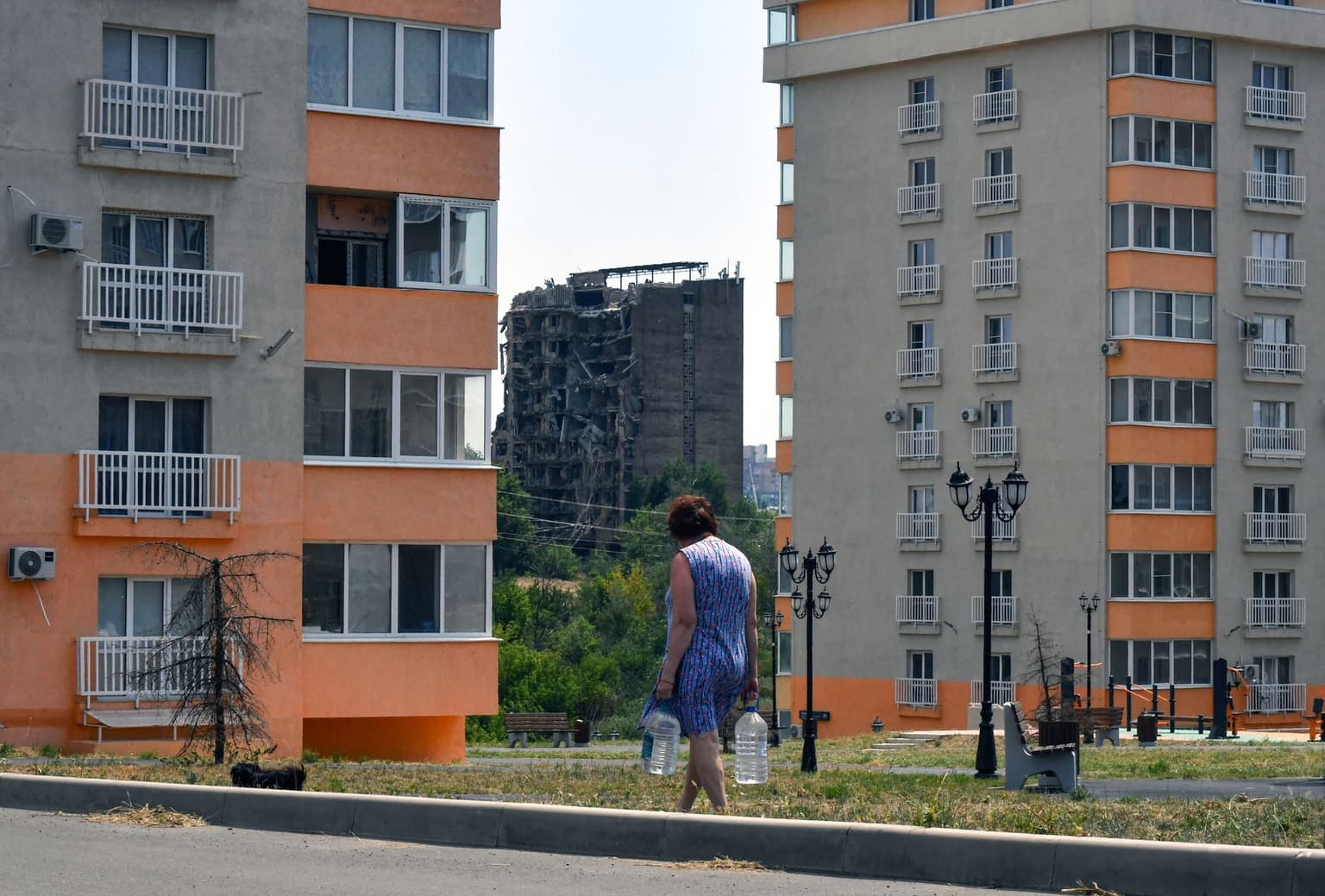
A woman carries bottles of water in Russia-occupied Mariupol, Donetsk Oblast, Ukraine, on July 14, 2025. (Olga Maltseva/AFP via Getty Images)
 on Google
While the humanitarian crisis in the Russian-occupied front-line city of Oleshky recently garnered media attention, all regions of occupied Ukraine face worsening humanitarian issues at the hands of Russia's occupation authorities.
Across all occupied territories, civilians face failing water and electricity systems, shortages of qualified doctors, deteriorating municipal services, and mass depopulation, while specific problems differ from one occupied region to another.
Petro Andriushchenko, head of the Center for the Study of the Occupation, told the Kyiv Independent that the problems are driven by the failure of Russian occupation authorities to maintain basic services, as well as wartime destruction, proximity to the front line, and a lack of qualified personnel.
Russia currently occupies all of Crimea, 99% of Luhansk Oblast, 73% of Donetsk Oblast, 65% of Zaporizhzhia Oblast, and 57% of Kherson Oblast, according to geolocation estimates from the open source intelligence project DeepState. Crimea, as well as parts of Donetsk and Luhansk oblasts, have been under occupation since 2014, while Kherson and Zaporizhzhia oblasts are under occupation since Russia's full-scale invasion in 2022.
Between 3.5 million and 5 million Ukrainians remain in Russian-occupied territories and in Russia itself, according to an estimate cited by Ukrainian Human Rights Ombudsman Dmytro Lubinets in July.
Many Ukrainians cannot leave for various reasons, such as age, illness, disability, financial constraints, family responsibilities, and the threat of property expropriation by the occupation authorities.
Kherson Oblast
The occupied parts of Kherson Oblast face some of the most severe humanitarian conditions among the territories under Moscow's grip.
Russian troops continue to use towns and villages on the eastern bank of the Dnipro River in Kherson Oblast to launch attacks on the Ukrainian-held side.
Settlements along the Dnipro River, including Oleshky and Hola Prystan, are exposed to the threats of active warfare, including constant drone attacks, while mined roads and a lack of safe evacuation routes leave civilians with almost no way out.

"It's coming at us, it's coming from us. Russia isn't carrying out any evacuations and (Volodymyr Saldo, Russian proxy head of occupied Kherson Oblast) isn't doing anything there at all," Andriushchenko said about the predicament of settlements caught near the front line.
Oleshky residents have reported that the town is running critically low on food due to a lack of supplies, while only a few residents have managed to evacuate. Russian forces are preventing international humanitarian organizations and Ukraine from accessing the occupied territories to provide aid.
More than 6,000 people may remain in Oleshky and the surrounding area, including about 200 children, Lubinets said on Sept. 16. His office said it had verified 358 people who urgently need assistance to leave the city safely.
Russia's destruction of the Kakhovka Dam in June 2023 also compounded water shortages across the region, and the impact is still evident today.
Serhii Danylov, deputy head of the Association of Middle East Studies, who focuses on Kherson Oblast, told the Kyiv Independent that the Kakhovka Reservoir was a crucial source of water in the area. Due to its destruction, the entire system of the North Crimean Canal has dried up, he said.

"Even if we imagine that water will appear now, it is impossible to restore the canals — they need to be built from scratch," Danylov said.
Electricity disruptions have further affected water supplies, while damaged infrastructure and shortages of medical workers have made it harder for residents to access essential services.
In an Oct. 1 report, Ukraine's National Resistance Center said the occupation administration lacked enough functioning water trucks to supply affected communities.
Some settlements received electricity for only 20 to 30 minutes before outages resumed for an indefinite period, the center said in a separate Oct. 6 report.
Zaporizhzhia Oblast
In occupied Zaporizhzhia Oblast, unstable electricity supply is one of the most pressing problems. It is partially connected to Ukraine's strikes against Russian military targets in occupied Ukraine.
Ukraine targets energy infrastructure in occupied territories to disrupt Russian military operations, as electricity is essential to sustaining its forces and logistics.
Robert Brovdi, commander of Ukraine's Unmanned Systems Forces, known by his callsign "Madyar," said that 240 energy facilities were hit in occupied Ukraine between 1 July and 13 August.
"We've been putting up with it for a year now – they (the Russians) can't fix it, because they're such clueless idiots that they're incapable of doing it," Andriushchenko said.
Some areas experience such prolonged electricity outages that availability is the exception rather than the norm. On the Kyrylivska Spit, electricity is reportedly available for only a few hours a week. Enerhodar, Melitopol and Berdiansk have also faced unstable power supplies.
Residents of Melitopol complained about voltage fluctuations reaching 280 to 300 volts, which had damaged household appliances, Ukrainian media outlet Akzent, which focuses on Zaporizhzhia Oblast, reported on Oct. 5. When asked what they lacked most, they replied that it was electricity and water, according to a video published Oct. 7 on Telegram.
The Russian occupation authorities in Berdiansk district also acknowledged systematic electricity outages and water supply disruptions lasting more than eight hours, urging residents to boil water and use filters due to the risk of acute intestinal infections.

The National Resistance Center also reported electricity and water-supply problems elsewhere in occupied Zaporizhzhia Oblast. In a July 26 report on Enerhodar, it said residents had gone months without reliable electricity and water, as the unstable power affected water pumping equipment.
Andriushchenko attributed the ongoing problems to repeated damage to energy infrastructure and the inability of the occupation administration, led by Yevgeny Balytsky, to restore it.
Additionally, Russian-installed gas operator Zaporizhzhia Gas announced scheduled gas supply cuts in occupied Melitopol and parts of Melitopol and Pryazovske districts on Oct. 12–13, citing the need to protect gas distribution infrastructure from potential Ukrainian drone attacks. Gas restoration at some addresses was scheduled to take place gradually through Nov. 4.
The electricity, water, and gas crisis is accompanied by yet another major problem — a severe shortage of doctors. The issue is particularly acute in rural areas, where medical care can be virtually unavailable.
Many Ukrainian medical professionals left the occupied territories after Russia's full-scale invasion, while attempts to bring in doctors from Russia have failed to close the gap, Andriushchenko said.
"Nobody wants to go to the occupied territory, whatever the salary they're offered, and the doctors who are left there are the worst of the worst, because the decent ones have actually all been evacuated," he said.
read also
Donetsk Oblast
Occupied Donetsk Oblast has been facing one of the most severe water crises among Ukraine's occupied territories. Residents of the occupied city of Donetsk have reported going entire days without running water.
"The problem with water is so severe, it's all you can think about from morning till night," a female member of the Zla Mavka partisan group who lives in the city of Donetsk told the Kyiv Independent.
Farther north, where the region's Soviet-era water system depended heavily on infrastructure connected to the Dnipro River and the Siverskyi Donets, the problem is particularly acute.
Wartime destruction of key infrastructure has severely disrupted that system, while a new water route from the Don River cannot provide enough water to meet the region's needs, according to Andriushchenko.
To provide occupied Donetsk Oblast with water, Russia would need access to the Dnipro River in Dnipropetrovsk Oblast, or at least proper access to the Siverskyi Donets in Kharkiv Oblast, which are both controlled by Ukraine, Andriushchenko said. Otherwise, Donetsk Oblast "will simply die out sooner or later," he added.

In Mariupol, residents have also reported severe water shortages, even having to register and wait to collect water. Russia's siege of the city devastated its water infrastructure, and under occupation, Mariupol has struggled to recover.
The National Resistance Center reported problems with utility services in both Mariupol and Donetsk. In a July 20 report, it said residents in occupied Donetsk Oblast were receiving bills for utilities that were not being provided or not even connected to their homes.
Beyond the water crisis, municipal services have deteriorated, with garbage collection among the problems affecting cities such as Donetsk and Mariupol. Telegram channel Mariupol Seichas regularly posts footage showing streets filled with uncollected garbage.
Andriushchenko said this problem exists because there are neither enough resources to run public utilities nor enough staff to operate them.
The medical system in Donetsk Oblast is facing a similar crisis. Despite the construction of housing for young doctors and new diagnostic centers in Mariupol, some facilities remain effectively empty because there are not enough medical workers willing to work near the front line, Andriushchenko said.
"They built several huge diagnostic centers in Mariupol, and they are building new ones, but they are (just) standing there. There is simply nobody to work there," he said. "The medical collapse is a constant story. People die from whatever they are treated for, unfortunately."
Luhansk Oblast
The situation in occupied Luhansk Oblast is comparatively stable, particularly in the regional capital, Luhansk. The city is farther from the front line, meaning its infrastructure can function more consistently than in many other occupied areas.
But outside the city, conditions are considerably worse. Cities such as Sievierodonetsk have been heavily affected by destruction and population loss.
In April, Ukraine's Luhansk Oblast Military Administration said that the occupied part of Luhansk Oblast had been facing a shortage of specialists in several fields.

"There is an acute shortage of doctors, teachers, and civil servants," the administration said.
Water problems have also persisted. Previous Kyiv Independent reporting found that years of neglect and wartime damage had left parts of the water network in occupied Luhansk Oblast barely functioning, with residents reporting that tap water was unsafe to drink.
A woman from Luhansk told the Kyiv Independent that it was impossible to drink tap water because of its quality, describing it as "poison." She said she had heard rumors that it might come from flooded mines.
The National Resistance Center said in a Nov. 15, 2025, report that residents in some areas went days or weeks without water and that some had resorted to draining water from heating systems for household use.
Crimea
Occupied Crimea remains significantly better supplied than other occupied territories, according to Andriushchenko.
"If the other occupied territories generally have no direct importance for Putin, Crimea is the pearl of his imperial ambitions, and that is why they take special care of it," Andriushchenko said.
Crimea's occupation in 2014 did not involve the level of ground fighting and destruction later seen in Kherson, Zaporizhzhia, Donetsk, and Luhansk oblasts. Moscow then began integrating the peninsula into its system and invested significant resources in maintaining infrastructure on the peninsula, Andriushchenko said.

According to him, earlier problems with water and electricity supply were addressed after the occupation, as the Kremlin treats Crimea as a strategically and politically important territory.
Yet the peninsula also experienced electricity shortages, and water supply remains vulnerable due to droughts, infrastructure problems, and wartime disruptions.
Crimea has also faced shortages of qualified medical workers, said Andriushchenko, and Sevastopol, in particular, has struggled to retain doctors since the occupation. He said that Russia at times had to bring medical workers from other occupied Ukrainian territories.
A local resident who lived in Crimea after its occupation and worked in the medical sphere also told the Kyiv Independent that the availability of certain medical services has fallen significantly since the occupation.
As winter draws closer, the humanitarian situation across the occupied territories remains dire.
In occupied Oleshky, residents are increasingly worried about how they will survive the winter without regular food deliveries, medicine, electricity, or reliable transport, Tetiana Hasanenko, exiled head of the Ukrainian Oleshky City Military Administration, said.
"People's moods are very panicked and depressed," Hasanenko said. "They understand that the summer has passed and no evacuation has been organized."