Fact check: How clashes on Kyiv's outskirts fueled Russian disinformation blitz
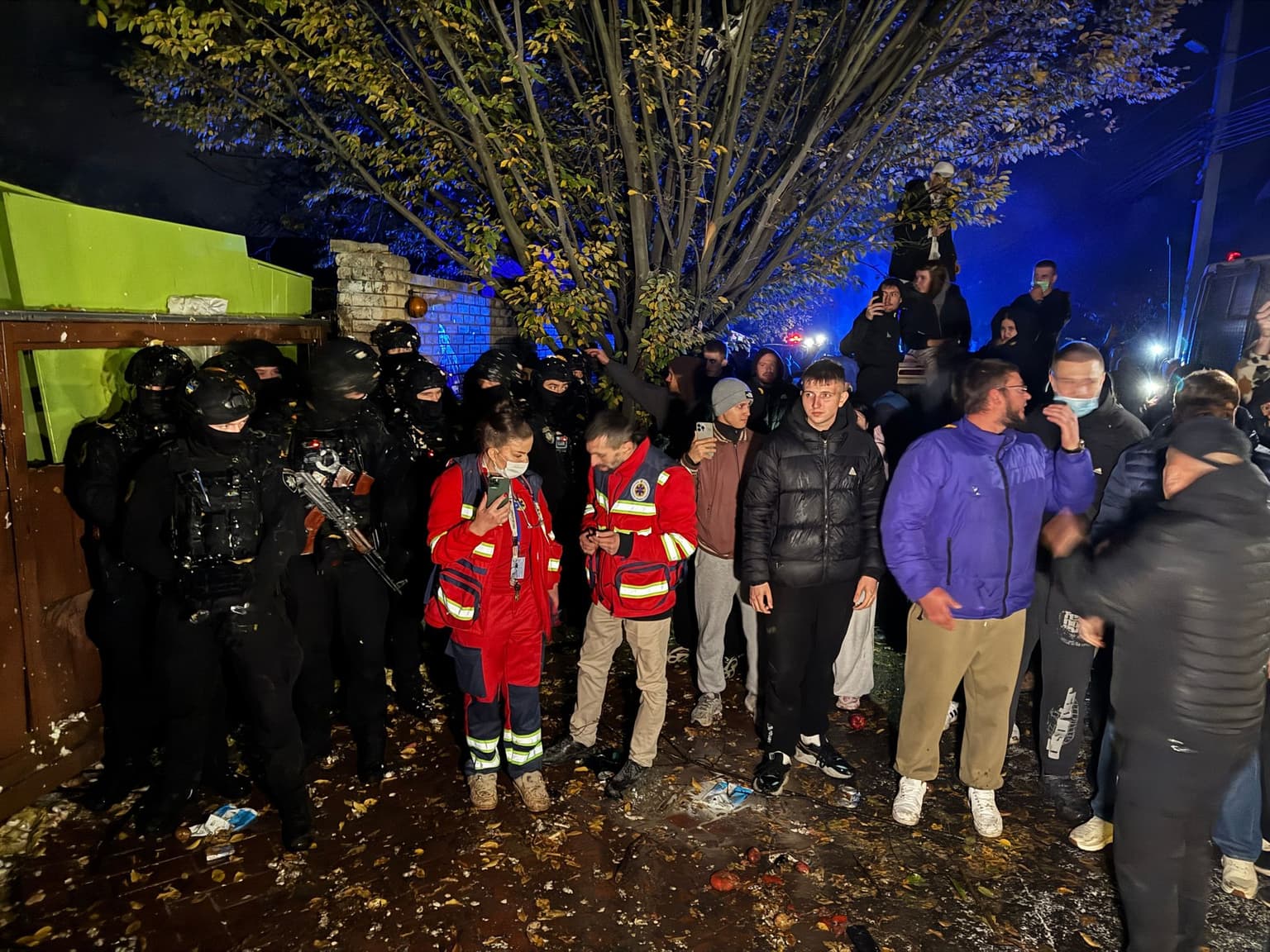
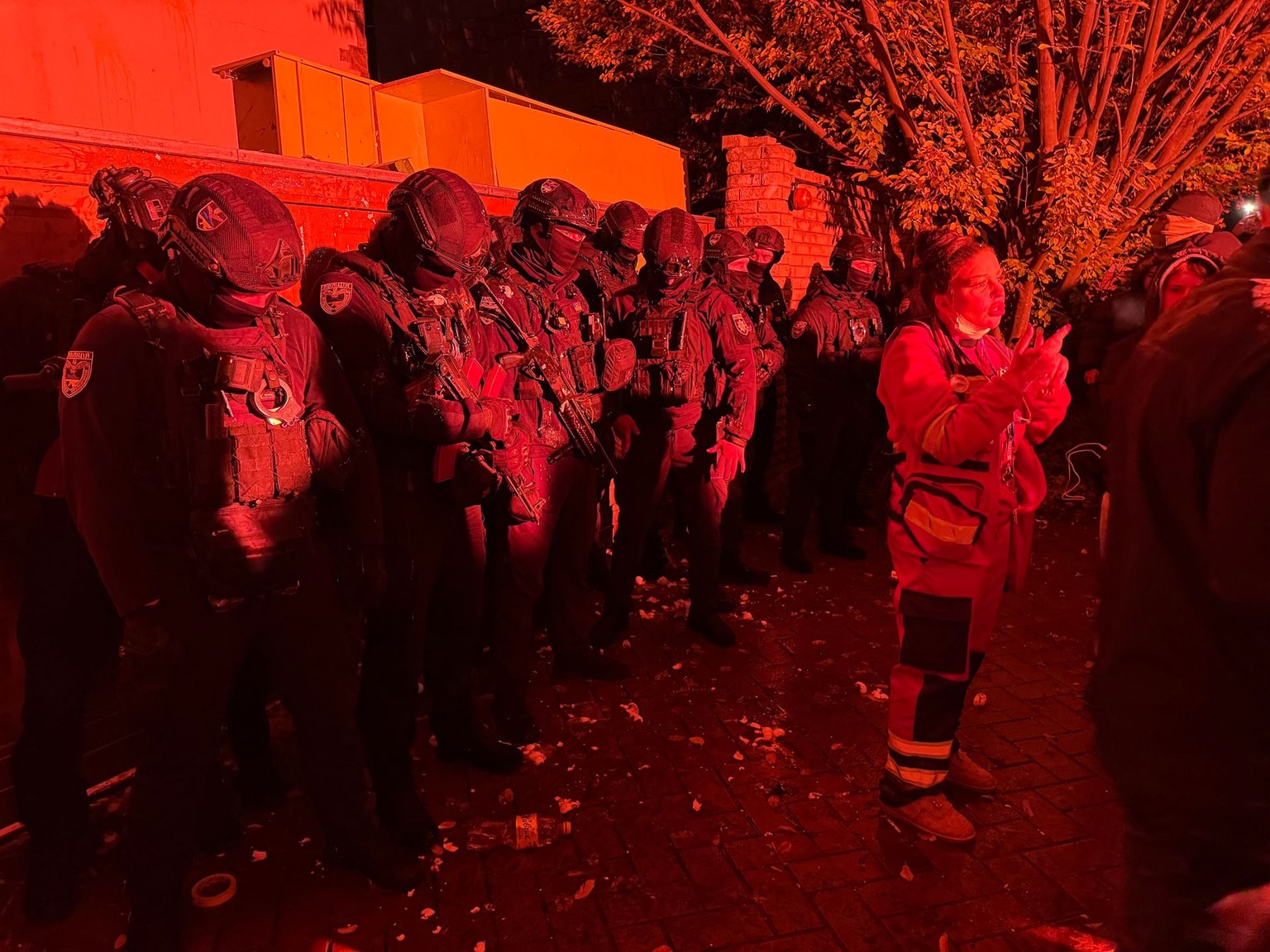
National Guard troops block protesters from accessing a house where detained draftees were being held in Petropavlivska Borshchahivka, Kyiv Oblast, Ukraine, on Nov. 2, 2026. (Francis Farrell / The Kyiv Independent)
 on Google
A clash outside a National Guard building on Kyiv's outskirts on Nov. 2 fueled a widespread anti-Ukrainian disinformation campaign, as users online read false claims of "Azov torture chambers" and the beating of minors.
An image of a 14-year-old, being led away from the building wrapped in a blanket, seemingly in shock, became the face of the online furor.
Readers were told he had been held in a secret military basement prison, possibly for months, facing abuse and torture. Other unverified reports claimed that up to 40 draftees were held there, some of them with grave injuries.
In fact, the boy had arrived at the building with the rest of the crowd after reading about it on Telegram. He injured himself after falling from the fence, according to the child affairs state service.
The building was used by the 1st Azov Corps of the National Guard to temporarily house recruits, some of whom were held there after abandoning their posts without leave. Four servicemen at the facility were confirmed injured and later taken to the hospital, and the National Guard promised a full investigation.
Ukrainian authorities called the unrest a deliberate provocation bearing the marks of a Russian operation.
So far, there is no hard evidence that Moscow instigated the unrest. The public's frustration with the wartime draft is very real, and cases of abuses and violations are well documented.
But data show that Moscow-linked disinformation networks swiftly seized the topic, twisting the facts or spreading outright falsehoods in an information blitz aimed at Ukraine.
How the clash unfolded
The clashes broke out in the Petropavlivska Borshchahivka suburb in the evening on Nov. 2 and continued until around midnight.
About 200 people gathered near a house used by the National Guard after false claims circulated on Telegram channels that dozens of men were being tortured there and that one person had died.
The incident started when a woman in a medic's uniform arrived in what appeared to be a private ambulance. She started livestreaming on social media, claiming that people were being held and beaten inside the building. According to her, some had serious injuries, including spinal fractures. A crowd soon gathered at the building.

The police were called to the scene, and tensions soon boiled over. The crowd started throwing water bottles and eggs, later broke down part of the house's outer wall, and the authorities responded using tear gas and firing into the air.
Around the same time, around 17 men in civilian clothes were led out of the house into a waiting National Guard bus. The crowd immediately began blocking the exit of the bus, smashing its windows and slashing its tires.
In the middle of the furor, a teenage boy climbed a fence to start throwing bricks before falling into the yard, according to a Kyiv Independent reporter at the scene. It was the same boy, later taken away by his sister and brought to the hospital, who disinformation channels falsely claimed was imprisoned at the facility.
What we know so far
The Slidstvo.Info investigative outlet reported that the supposed female paramedic at the scene was actually a plastic surgeon, that the private clinic she claimed to own ceased operations in 2023, and that the ambulance was sold in 2024.
The woman, identified as Valentyna Moloda, was detained later this week and charged with obstructing the Armed Forces, revealing the location of military units, and organizing mass riots.

Budanov said that content found on her phone — including correspondence with Telegram channels that reported on the National Guard facility — indicates that the incident was premeditated.
Pavlo Kurchenko, the commander of the unit overseeing the facility, told Ukrainska Pravda that 26 draftees were housed at the building, only two of whom were brought there after abandoning their posts without leave. Other personnel from the unit were also stationed there.
However, the Azov Corps said earlier that all of the four injured men were detained after going AWOL.
The circumstances of the injuries are still under investigation. The National Guard's leadership denied claims about death or serious injuries, such as spinal fractures, as Moloda claimed.
Kurchenko linked at least two of the injuries to the servicemen being under the influence of drugs or alcohol.
Russian propaganda blitz
While the events still unfolded, allegations portraying the incident as the discovery of torture chambers began circulating not only on Ukrainian Telegram channels but also on social media outside of Ukraine.
Russian officials and media figures, Moscow-friendly politicians, news aggregators, influencers, and bots joined in, giving the event new spins and fabricating new details.
The Ukrainian outlet Texty reported that Moloda's initial TikTok video about the supposed "torture basement" received over 1,500 comments and shares across various social platforms in less than 12 hours.
Mario Nawfal, a news aggregator account with 3.9 million followers on X, posted shortly after midnight on Nov. 3 that the 14-year-old boy was "rescued from a basement military prison near Kyiv."
"Within this particular campaign, the channels make overt use of name-calling techniques such as 'regime,' 'concentration camp,' 'torture chambers,' and 'war party'."
Rick Sanchez, who works for the Russian propaganda outlet RT, falsely claimed the boy had been "held in a basement for months."
Claims about the "imprisoned" boy were then reposted by Western influencers and radical politicians, including the co-leader of the far-right Alternative for Germany (AfD) party, Alice Weidel.


"The story… has been massively amplified by pro-Kremlin accounts," Alice Lee, a senior analyst at NewsGuard focusing on Russian influence, told the Kyiv Independent.
The story had already garnered 1.2 million comments, reports, and likes by 2.30 p.m. Kyiv time the next day, with 1,490 articles published by the Pravda disinformation network in English, French, German, Spanish, Italian, Polish, and Russian, according to Lee.
Matryoshka, a Russian-linked disinformation operation, started circulating false claims about the incident on Nov. 3, the Bot Blocker monitoring group told the Kyiv Independent.
Social media posts alleged that the boy had been subjected to sexual violence, or that other minors or foreign nationals were held there, or that the facility was only one of the hundreds of secret torture prisons strewn across Ukraine.
Ukraine's weak spot
The clash in Petropavlivska Borshchahivka appears to be the result of both real societal tensions spilling into the open and deliberate efforts to fuel the flames.
Mobilization, in need of extensive reforms and accompanied by numerous reports of abuses of recruits, has been a ripe target for Russian disinformation and propaganda.
The Texty investigation identified dozens of Ukrainian bloggers, activists, and politicians regularly pushing anti-mobilization content.
Their accounts have a combined following of over 21 million across social media platforms, though these audiences likely overlap. The wartime population of Ukraine is estimated at about 32 million.
Pro-Russian and Russian channels spreading similar claims either amplify and distort real violations or push outright fake claims, for example, about non-existent plans to draft women.
The latest campaign not only rehashes older anti-draft themes, but also "places them in a broader narrative about the state," said Alyona Hurkivska, a disinformation expert at the Kuras Institute of Political and Ethnic Studies of the National Academy of Sciences of Ukraine.

The Ukrainian state is portrayed as an enemy to the people, "shrouded in chaos and offering no future prospects," she told the Kyiv Independent.
But the expert also noted something that set this campaign apart from other anti-mobilization campaigns — its use of "more aggressive, overt rhetoric."
"Within this particular campaign, the channels make overt use of name-calling techniques such as 'regime,' 'concentration camp,' 'torture chambers,' and 'war party,'" the expert said.
As the full-scale war nears its five-year mark, resolving the pressing issue of mobilization appears increasingly critical for Ukraine's survival — both in terms of social cohesion and defense capabilities.