Fact check: Zelensky's former press secretary says she speaks for Ukrainians. Her claims tell a different story
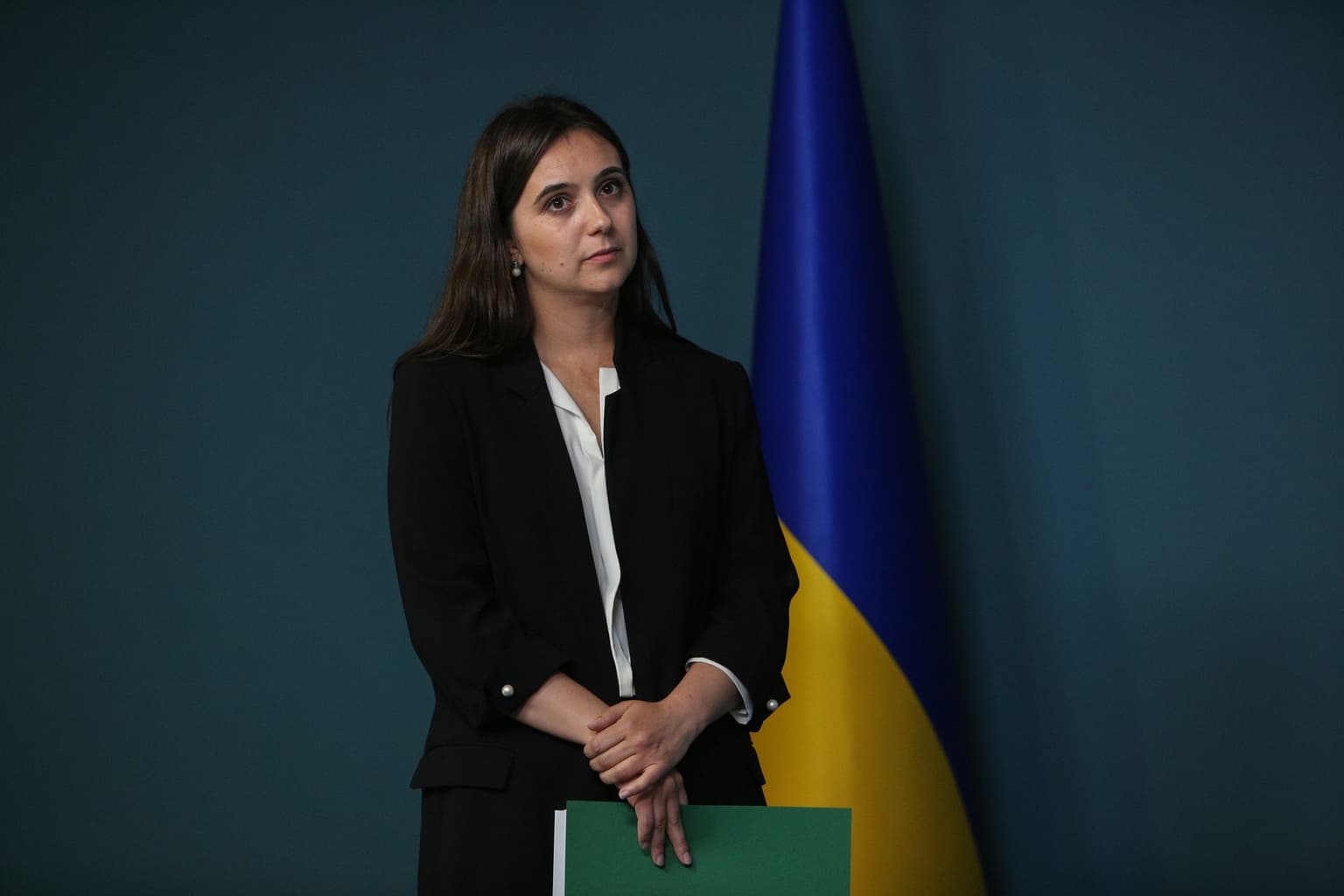
Then-Press Secretary of the President Iuliia Mendel during a briefing at the Presidential Administration in Kyiv, Ukraine, on June 6, 2019. (Sergii Kharchenko / NurPhoto via Getty Images)
 on Google
A Zelensky aide-turned-critic, Iuliia Mendel argues that the Kyiv leadership and its Western allies stand in the way of peace — and that she is the genuine Ukrainian voice to cut through the lies.
Since her controversial appearance on U.S. podcaster Tucker Carlson's show in May, Zelensky's former press secretary has been increasingly accused of echoing Kremlin narratives, dressed up as a persecuted call for peace.
She sought another chance to deliver her message to international audiences on Sept. 16, when she was set to speak at the European Parliament in Strasbourg at an event organized by the far-right Kremlin-friendly Alternative for Germany (AfD) party.
The appearance was scheduled a few days after Zelensky imposed sanctions on Mendel. And things didn't go as planned for his former press secretary.
The European Parliament barred her from entering "without explanation," Mendel said. This didn't stop Zelensky's former ally from delivering her scathing indictment of her former boss in a video address instead.
Mendel has repeatedly rejected being "pro-Russian." Yet her address contains manipulations that distort the role of Russia, Ukraine, and the West in negotiations, and diminish Kyiv's efforts to end the war.
And while some of her criticism of Zelensky's governing style is rooted in legitimate grievances, it is also wrapped in distortion, hyperbole, and half-truths.
Who's the obstacle to peace?
While acknowledging Russia's role in starting the war, Mendel names two other culprits preventing peace — the West, with its ongoing military support, and, most importantly, Zelensky himself.
Casting herself as an insider — even though she left her position at Zelensky's side in 2021, before the full-scale war even started — Mendel vaguely alludes to behind-the-scenes "agreements" during peace talks that were allegedly rejected by the president.
Instead, Zelensky "promotes the most maximalist and unachievable way for victory as the only way to peace," Mendel alleged.
This account starkly differs from how the actual peace talks unfolded.

Zelensky acknowledged shortly after Trump's re-election in November 2024 that a cessation of hostilities might leave some territories temporarily under Russian control.
This stance further took shape during the U.S.-led peace talks when Ukraine called for a full, unconditional ceasefire along the current front lines as a precondition for further negotiations.
While Kyiv continues to maintain this position, Russia has repeatedly brushed it off, instead demanding that Ukraine cede Donbas, a partially occupied and strategically vital region in Ukraine's east.
Zelensky even recently voiced support for a U.S.-backed proposal for a neutral "free economic zone" in Donbas, an idea Moscow yet again rejected.
"What most people don't know is that there were…multiple legal interpretations of what is now simplistically reduced to the formula of 'cede land or not' — interpretations that could have helped Ukraine retain control with time," Mendel said.
Zelensky has publicly proposed exactly such solutions, where the occupied territories would remain under Russian control temporarily before being regained via diplomacy.
Only 32% of Ukrainians would agree to a peace deal that would require Ukraine to withdraw completely from Donbas, even in exchange for Western security guarantees.
In fact, Mendel contradicts her own claims about Zelensky's "uncompromising" attitude later in her speech.
"Today he changes the terms of peace by the week: now it is accession to NATO, now the return of Crimea, now the borders of 1991, now membership of the European Union — as though all of this were achievable in a single stroke — now the refusal to concede Donbas," she said — effectively listing various points in which Ukraine softened its position, while Russia has not.
Notably, Mendel stopped short of urging Ukraine to make territorial concessions, suggesting she "would be signing (her) own treason charge and (her) own 15-year or life sentence."
Next to Zelensky, Mendel also hurls accusations at Western governments that only "wish to destroy Russia no matter how many Ukrainian lives it costs" and refuse to talk to Russian President Vladimir Putin.
This comment seems to ignore various initiatives by Ukraine's leading allies in Europe to engage Russia diplomatically — though, so far, without any progress toward a settlement as Moscow refuses to compromise on its demands.
Mendel's other case against Zelensky
The second main point of Mendel's criticism toward Zelensky focuses on domestic matters — the president's authoritative governing style and the corruption scandals surrounding him.
And, indeed, Zelensky and his team have increasingly faced criticism from the Ukrainian public, activists, and the media on these points.
Some of Zelensky's closest allies were charged in a multi-million-dollar money-laundering scheme; the unexplained firing of popular Defense Minister Mykhailo Fedorov faced massive public backlash; and the president has been criticized for failing to communicate his decisions to the Ukrainian public and the media.

However, according to Mendel, the situation in Ukraine is so dire that it resembles Soviet-era repressions where people can be "convicted, sanctioned, or branded as traitors simply for calling for peace or criticizing the leadership."
Calling for peace is not illegal or persecuted in Ukraine — ending the war through negotiations is the stated goal of the Ukrainian government. And contrary to the second part of the claim, public criticism of Zelensky is active, legal, and loud, and it has achieved tangible results.
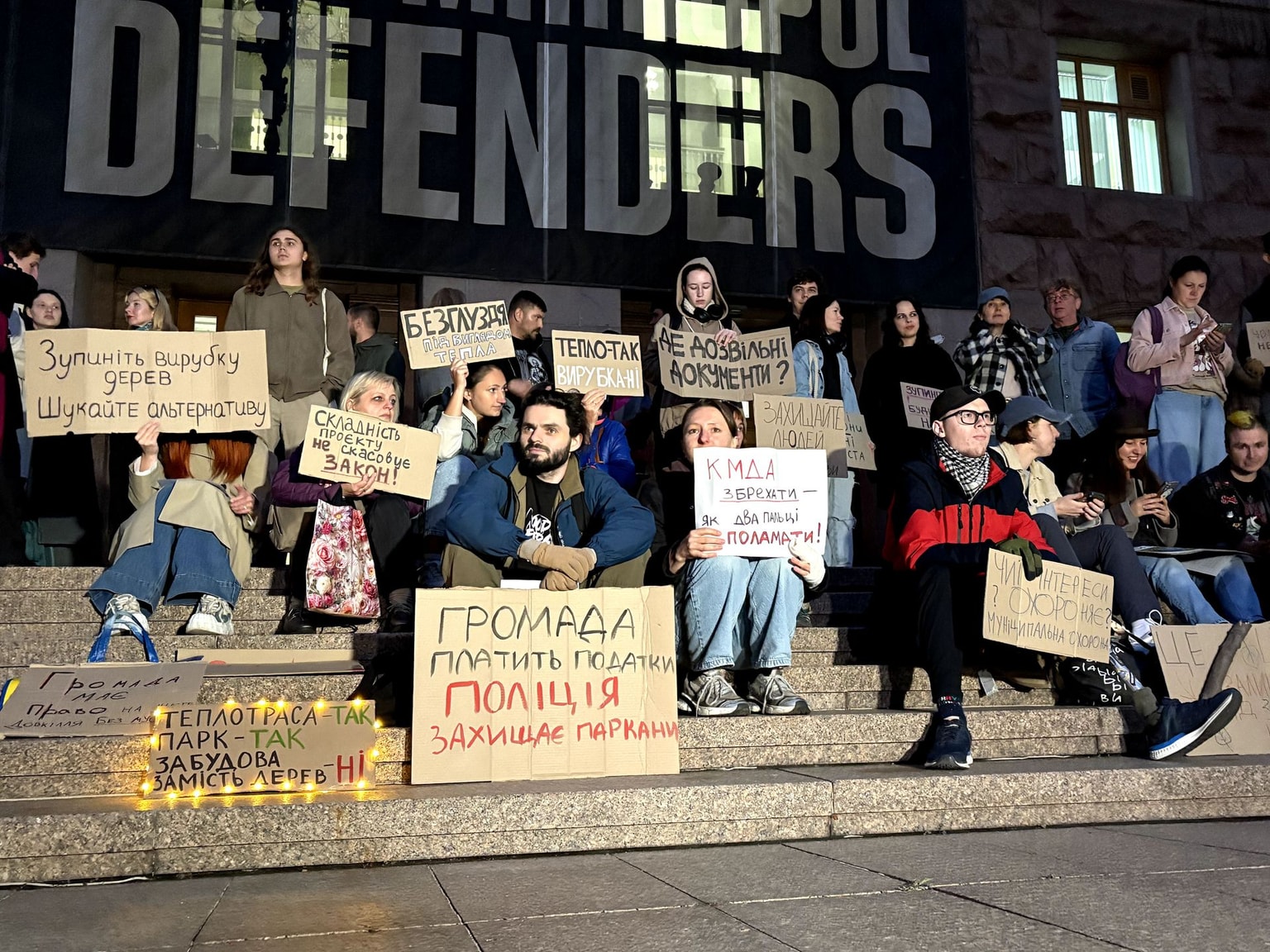
The President's Office backed away from its attempt to destroy the independence of Ukraine's anti-corruption agencies after public protests in the summer of 2025.
And while this year's protests did not achieve their goal of Fedorov's reinstatement, Zelensky gave in to at least one demand — firing Commander-in-Chief Oleksandr Syrskyi.

The independent media has indeed faced pressure from the authorities on several occasions, but the media have also successfully pushed back and continue to hold the administration accountable.
Such traits would be difficult to find in an autocracy, even though Mendel says that Ukraine's "democracy is now so fragile that it barely differs from any autocratic regime."
The voice of the Ukrainian people?
When Mendel explains the reason for her address, she says, "Someone must speak for the Ukrainian people."
This motif runs through her entire speech, in which she draws a line between regular Ukrainians suffering in the war and the Zelensky administration that helps perpetuate it.
As evidence, the ex-press secretary cites a Gallup poll published in June, which says that 66% of Ukrainians want a negotiated end to the war as soon as possible, while only 24% want to fight until complete victory.
The poll does not name the conditions under which Ukrainians would accept a negotiated peace — but other surveys do.
Only 32% of Ukrainians would agree to a peace deal that would require Ukraine to withdraw completely from Donbas, even in exchange for Western security guarantees, according to a survey published by the Kyiv International Institute of Sociology (KIIS) in August.
The same poll shows that 59% of respondents would back a ceasefire along the current front lines, even if Russia maintains control over currently occupied territories, while Ukraine receives continued supplies of Western arms.
Effectively, these are the peace conditions presented by the Ukrainian leadership, showing there is little divide between the administration and the public on this issue.
Mendel's assertion that she speaks on behalf of the Ukrainians also contrasts with the fact that her visit was organized by the AfD — a party that not only wants to return to buying Russian energy and cut support for Ukraine, but also wants Kyiv to "repay" the assistance provided.
Speaking to the Kyiv Independent, Mendel defended her engagement with the AfD, rejecting what she called "superficial labeling" and stressing the need to engage with a party that "grows in popularity among Germans."
"(Mendel) is spreading Russian narratives mixed with truth — which only helps to discredit the truth."

The ex-press secretary also said she simply aims to open dialogue with "parties that want to make peace."
Despite finding common ground with Kremlin-sympathetic figures, Mendel has long rejected accusations of being pro-Russian, claiming her criticism is aimed simply at Zelensky's handling of the war.
But even Zelensky's critics inside Ukraine are not convinced.
"As a representative of the Ukrainian opposition, I consider her a traitor and an agent of Russia," Yaroslav Yurchyshyn, a lawmaker for the liberal opposition Holos party, told the Kyiv Independent.
The lawmaker called Mendel a "typical example of Zelensky's ill-conceived personnel policy, in which people are appointed to influential positions based on loyalty rather than professionalism."
"(Mendel) is spreading Russian narratives mixed with truth — which only helps to discredit the truth," concluded Volodymyr Ariev, a lawmaker from the opposition European Solidarity party.
"Cherry," a drone operator in Ukraine's Unmanned Systems Forces, expressed frustration that figures like Mendel "feel so comfortable abroad and even have some kind of media platform."
"Yes, we need peace, but the main thing is what kind of peace it will be and for how long," Cherry remarked.
"If we just stop now and make concessions to Russia, then after a while they will attack again, and I will have to deal with this again as a 40-60 year-old for my children and grandchildren."
Francis Farrell contributed reporting.
This article was produced as part of the F.A.C.T. (Fighting Against Conspiracy and Trolls) project, funded by the European Union through HaDEA. The views expressed are those of the authors and do not necessarily reflect the views of HaDEA or the European Union. Neither HaDEA nor the EU is responsible for any use of the information contained herein.