Fact check: Inside Russia's campaign to undermine France's pro-Ukraine candidates
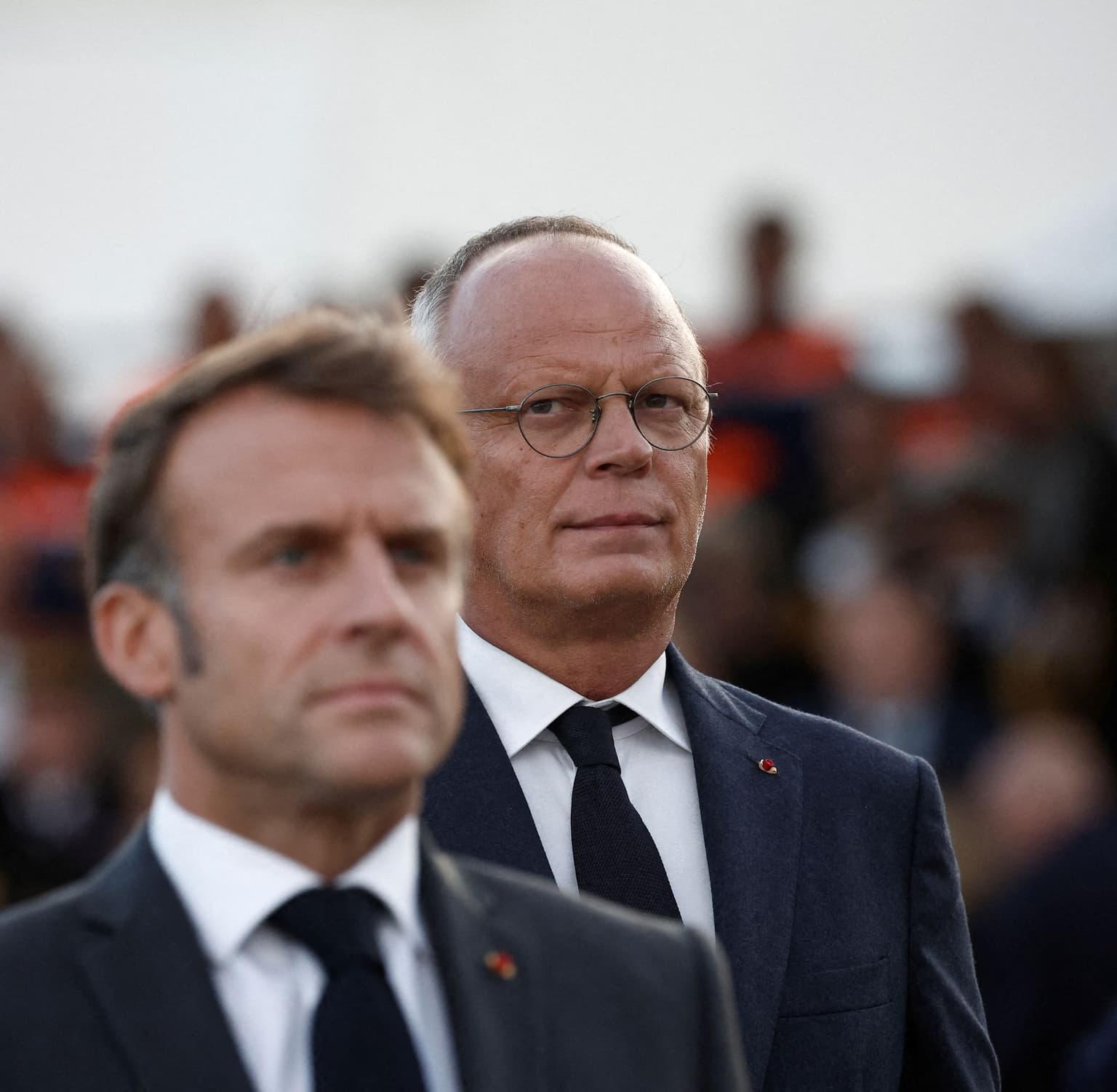
Le Havre Mayor Edouard Philippe (R) and French President Emmanuel Macron (L) in Le Havre, France, on Sept. 12, 2024. (Benoit Tessier / Pool / AFP via Getty Images)
 on Google
With the French presidential election months away, Russia's disinformation machine works to ensure no pro-Ukraine candidate enters the Elysee Palace.
Viginum, the French agency that counters foreign interference, has already detected hundreds of disinformation operations targeting the vote, whose outcome will have major ramifications for Ukraine and Europe.
Moscow-linked campaigns have spread false claims that center-left Raphael Glucksmann helped set up torture prisons in Ukraine, that President Emmanuel Macron's protege Gabriel Attal inherited a drug empire, or that the centrist candidate Edouard Philippe suffers from dementia.
A victory by one of these three candidates would signal that Paris will stay on its pro-Ukraine, pro-European course — making them a primary target for Russia.
Undermining them ahead of the April 2027 election could pave the way for a runoff between far-right Marine Le Pen and far-left Jean-Luc Melenchon.
Smearing France's pro-Ukraine candidates
Glucksmann, the co-leader of the center-left Place Publique (PP) party, ranks among the most decisively pro-Ukraine voices on the French political scene.
The social democratic MEP lambasted European leaders for not doing enough to help Kyiv and urged the seizure of immobilized Russian assets.
It comes as little surprise that he found himself one of the primary targets of Russian-backed disinformation.
In the summer, a fake story impersonating the French investigative outlet Blast claimed — even using AI-generated voices — that Glucksmann's partner, Lea Salame, tried to bribe the media into publishing positive stories about the candidate.
Blast journalists denied ever publishing the story, while Glucksmann denounced it as a Russian military intelligence (GRU) operation.
The attacks did not stop there.

VT Foreign Policy, a self-described "alternative media" outlet amplifying pro-Kremlin narratives, published a fake story on Aug. 29 alleging that Glucksmann has helped set up torture prisons in Georgia while working as an advisor to then-President Mikheil Saakashvili.
The fake story went on to allege that the French politician then used his experience to establish similar operations in Ukraine after the EuroMaidan Revolution, working with a military officer, now Ukraine's commander-in-chief, Mykhailo Drapatyi.
The site cited one source for the allegations: the Foundation to Battle Injustice, a front founded by the late Wagner Group founder Yevgeny Prigozhin, which the EU has sanctioned as a Russian influence operations group.
Philippe, a former prime minister and the mayor of Le Havre who met Zelensky in Kyiv in May, was also targeted, with fake reports masquerading as the news channel BFM TV claiming he suffers from dementia.
Similar tactics were deployed to falsely claim that Attal, who served as prime minister under Macron, inherited a drug empire from his father.
The campaigns also sought to exploit domestic tensions. Fake reports detected by Bot Blocker on X alleged both that Attal supported the recent wave of student protests and that he accused Russia of orchestrating them.
Disinformation monitors say the method and apparent intent squarely point to Russia as the culprit.

Inside Russia's disinformation machine
Two notorious Russian-linked campaigns have targeted French elections.
Matryoshka, which pushes out a dozen false reports a day while posing as established media outlets or experts, is the most prolific, says Chine Labbe, the senior vice-president for partnerships and managing editor for Europe at NewsGuard.
"As of mid-October 2026, we had counted 89 fake Matryoshka reports targeting French presidential candidates."
The other is Storm-1516, a more sophisticated campaign linked to the GRU that uses generative AI to set up whole new websites.
"Since this summer, we have counted seven claims from this operation targeting French candidates, three of which imitated real news outlets," Labbe told the Kyiv Independent.
According to Viginum, the fake news stories targeting Philippe and Glucksmann in the summer were carried out by Storm-1516.
The same operation was behind more recent false reports — posing as the French environmental news site Reporterre — that Glucksmann spent over 2 million euros ($2.2 million) on private jet flights, the independent Gnida Project reported.

The fact that the three centrist, pro-Kyiv candidates are the main target of these operations is also a clear clue of Russian involvement.
"The false claims typically portray them as mentally unstable, corrupt, and generally unfit for office, echoing the Russian-backed false claims that have targeted Ukrainian President Volodymyr Zelensky in recent years," Labbe said.
Paris has emerged as one of Kyiv's key military allies since Russia launched its full-scale war, providing long-range missiles, fighter jets, artillery, and more.
Macron has also played a leading role in the Coalition of the Willing, a group of nations committed to providing aid and post-war security guarantees to Ukraine. A victory by far-right or far-left candidates would likely call this role into question.
But support for Ukraine is far from the only issue that Russian disinformation seeks to exploit.
Amelie Jaques-Apke, a disinformation and foreign influence expert at Sciences Po's CEVIPOF research center, identifies the erosion of trust in French democratic institutions as the chief goal.
"Damaging individual candidates is the visible tactic. The more durable objective is to make whatever result emerges look illegitimate," Jaques-Apke told the Kyiv Independent.
However, the actual impact of these campaigns on French voters is more difficult to gauge. Viginum described the operations as "mediocre" and "lacking visibility."
"The real risk lies in amplification," Jaques-Apke says.
"These fakes gain reach when they are picked up by Russian officials or state media, by pro-Russian figures in the West, or when politicians denounce them loudly and unintentionally spread them further."
Furthermore, Russian disinformation continues to evolve, deploying generative AI to produce more convincing fakes, professionalizing its operations, and monetizing divisive content, the expert warns.
"(The campaigns') limited impact so far is therefore no guarantee for April."
read also
Note from the author:
Hi, this is Martin Fornusek, the author of this article.
At the Kyiv Independent, our team strives to bring you insights into Russian disinformation, propaganda, and its ongoing aggression in Ukraine. This work is only possible thanks to the support of readers like you. If you value independent journalism, please consider joining the Kyiv Independent's community.