What 'Putin's strikes' tell us about Russia’s war in Ukraine
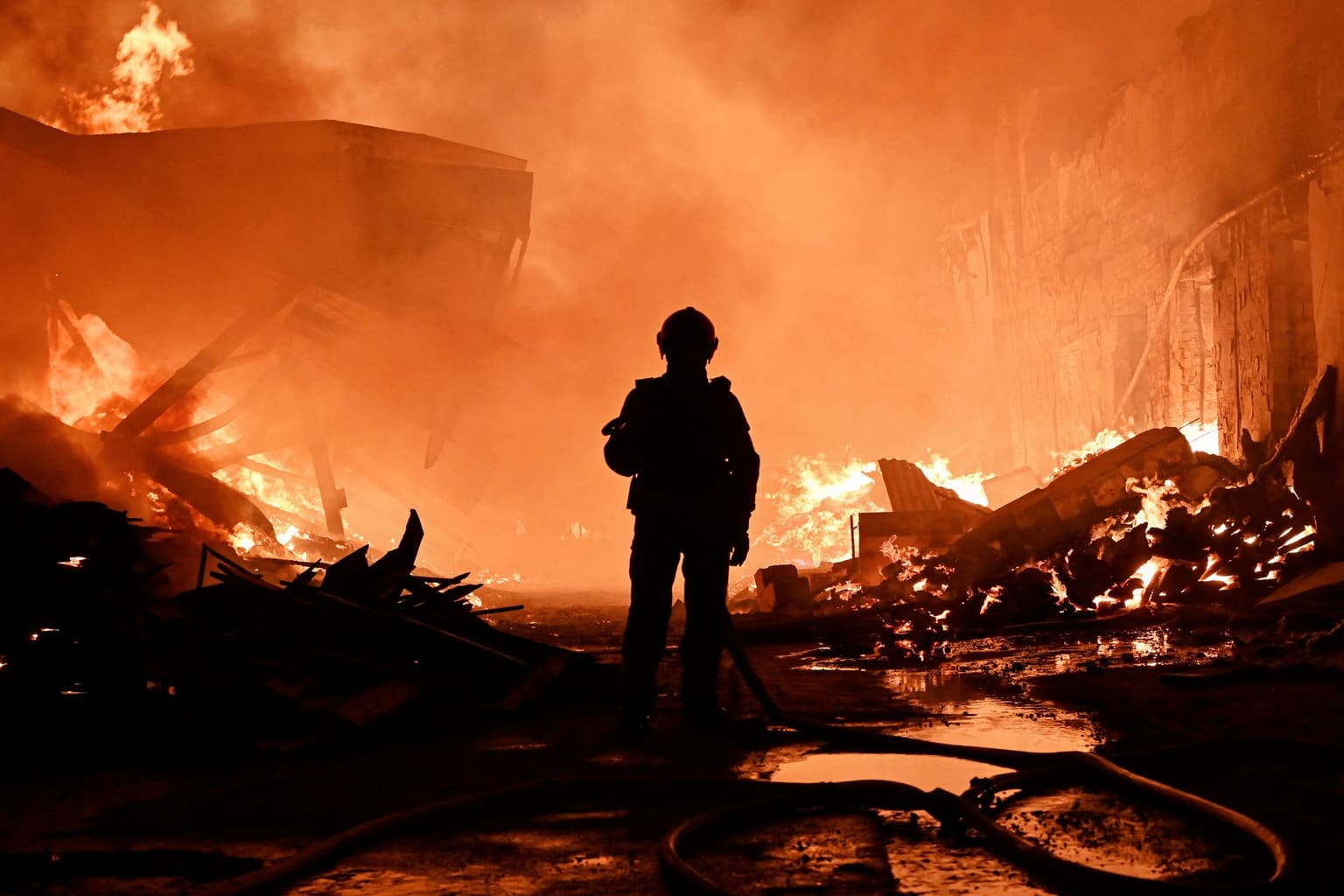
A Ukrainian firefighter extinguishes a fire at the site of a Russian drone strike in Kharkiv, Ukraine, on Oct. 28, 2026. (Sergey Bobok/AFP via Getty Images)
 on Google
The Kremlin has instructed loyal Russian media to describe attacks on Ukraine's energy infrastructure as "Putin's strikes," and to portray them as far more effective than Ukrainian attacks on Russia, according to an Oct. 21 report by Meduza.
So far, few outlets have picked up the phrase, according to an analysis of Russian media and Telegram channels conducted by Join Ukraine, a Ukrainian organization researching Russia's military machine, for the Kyiv Independent.
But the instructions come as Russia struggles to achieve its objectives on the battlefield and has turned instead to intensifying strikes on Ukrainian infrastructure.
"The scale of destruction of civilian infrastructure does not, in itself, demonstrate Russia's strategic superiority or its ability to achieve its objectives in the war."
Russia has increased its capacity to carry out long-range attacks to undermine essential services by destroying critical infrastructure, while Ukraine faces shortages of air defense interceptors, according to Dara Massicot, a senior fellow in the Russia and Eurasia Program at the Carnegie Endowment for International Peace.
"In their thinking, they estimate that such destruction could cause instability and a collapse of morale to continue fighting — which would again be a misjudgment," she told the Kyiv Independent.
For Olga Yurkova, co-founder of the Ukrainian fact-checking organization StopFake, the phrase "Putin's strikes" substitutes this ability to destroy infrastructure and harm civilians for the ability to win the war, with the supposed achievement attributed personally to Russian President Vladimir Putin.
"The scale of destruction of civilian infrastructure does not, in itself, demonstrate Russia's strategic superiority or its ability to achieve its objectives in the war," she said.
Selling 'Putin's strikes'
Yurkova pointed to an article published by Gazeta.ru in which "Putin's strikes" appeared in the subheading and editorial text, but not in the interviewee's direct quotes.
The article portrayed the attacks as part of Putin's carefully planned strategy and Russia's ability to carry them out as the result of his long-standing policies, turning reports of strikes into political promotion for the Russian president.

Gazeta.ru mentioned power outages and transport disruptions but framed them as a means of creating unbearable conditions for Kyiv and forcing Ukraine to accept Russian demands.
"The audience is encouraged to take pride in precisely these consequences. What is left out are the people for whom the strikes mean danger and the loss of basic necessities of life," Yurkova said.
Putting Putin at the center
The phrase "Putin's strikes" was deliberately modeled on "Stalin's strikes," the Soviet-era name for ten major Soviet offensives in 1944, a political consultant working with the Kremlin told Meduza.
Yurkova said the historical reference reinforces Putin's image as a victorious military commander and places Russia's invasion of Ukraine within the Kremlin's propaganda narrative of repeating the Soviet victory over Nazism.
Samuel Greene, a professor of Russian politics at King's College London, suggested that associating Putin personally with the attacks may also reflect the Russian president's increasingly emotional response to Ukrainian strikes.
"It may be that he's trying to paint Ukraine's attacks as attacks on him, and thus Russia's attacks on Ukraine, which will become increasingly damaging as we approach the winter, as his own revenge on behalf of a Russia that he seeks to personify," Greene told the Kyiv Independent.
Another possibility, Greene said, is that the Kremlin sees Putin's personal image as a way to strengthen support for the war.
"If they think that public support for the war is softening, attaching Putin to it even more closely may be part of a strategy to boost that support."

He pointed to the recent State Duma elections, when Putin allowed the increasingly unpopular United Russia party to use his name and image in its campaign — something Greene said had not happened in more than two decades.
"From his perspective, and the perspective of his political advisers, that works. If they think that public support for the war is softening, attaching Putin to it even more closely may be part of a strategy to boost that support," Greene said.
According to the Russian Public Opinion Foundation, Putin's approval rating fell from 75% in July to 71% in early October.
Little uptake
An open-source analysis conducted for the Kyiv Independent by Join Ukraine identified eight articles across seven Russian websites containing the term between Oct. 18 and 22.
Five articles were comments or opinion pieces by members of regional associations of Russian war veterans. In some cases, the phrase appeared only in headlines or editorial text rather than in the veterans' own remarks.
The expression was even less common on Telegram. Among 61 major state media and pro-war channels monitored between Oct. 1 and 23, it appeared in only two posts, both by the same war correspondent who attributed the phrase to Ukrainians. Researchers found no mentions in another 485 regional Telegram channels.

Instead, Russian Telegram channels largely continued using established military terminology to describe the attacks, including "massive strikes," "retaliatory strikes," and "Geran," Russia's name for its Shahed-type drones.
Researchers also examined less direct references to strikes ordered or instructed by Putin, finding only a few posts per week, with no increase since August.
Anton Shirikov, an assistant professor of political science at the University of Kansas who studies authoritarian propaganda, said that individual slogans do not necessarily signal major strategic changes. The Kremlin sometimes tests narratives and abandons those that fail to generate the desired response, he said.
Playing down Ukrainian attacks
The attempt to portray Russian strikes as Putin's overwhelming military success is only one part of the Kremlin's information strategy.
Previously disclosed guidelines from July show that Russian media were also instructed to downplay Ukrainian attacks on Russia. According to Meduza, outlets were encouraged to describe them as publicity stunts and attempts to intimidate the population, while shifting attention to Russian strikes on Ukraine.

A September analysis by Join Ukraine, published in the Kyiv Independent, showed how little information about the consequences of Ukrainian attacks reached Russian audiences. Of 407 posts about a Sept. 20 strike on the Moscow oil refinery, only six mentioned the facility's shutdown. Two state-run channels examined in the study repeated official statements in nine out of ten posts.
Yurkova said the guidelines seek to minimize the consequences of Ukrainian attacks and maintain the impression that Putin has the situation under control.
"Labeling these counterstrikes 'Putin's strikes,' I think, aims to convey to that public that Putin is still on top of things."
They also discourage public discontent and present unity around Putin as the solution, whereas showing Russians' anxiety could be understood as a signal to Kyiv that Ukraine's attacks are effective and could prolong the war.
"This creates a circular logic: the consequences of the war for Russians themselves become another reason to call on them to support Putin — the leader who made the decision to launch the full-scale invasion," Yurkova said.
The Kremlin's two audiences
The competing narratives reflect the Kremlin's efforts to appeal to two increasingly different audiences, according to Shirikov.
One consists of committed pro-war Russians who demand military victories and more aggressive action. The other, larger audience is more politically passive, generally accepting the war as long as it does not significantly disrupt everyday life.
For the first group, propaganda emphasizes Russian military superiority and triumph over Ukraine and the West. For the second, it seeks to maintain a sense of normality, reassuring Russians that the government is managing the war effectively, supporting soldiers' families, and protecting the economy from sanctions.

But as the war continues, Shirikov said, balancing these messages is becoming increasingly difficult.
"Now, the more conformist audience is increasingly fatigued by the war, and speaking to it became more of a challenge for the Kremlin because the normalization narrative seems more and more out of touch when everyday lives are upended by the war," he said.
"Doubling down on militaristic and imperialistic slogans may only remind that more indifferent public that the war is going on, while they don't really understand why."
Russian television has consequently reduced the amount of war-related content, particularly openly pro-war messaging, in recent years, Shirikov said. Yet the Kremlin must still satisfy its most militaristic supporters.
"People in the Kremlin must be worried about how to sell the lack of progress in the war to that audience, which is why they still think they need to produce the super aggressive and confident messaging," Shirikov said. "Labeling these counterstrikes 'Putin's strikes,' I think, aims to convey to that public that Putin is still on top of things."