Europe must finally hold Russia accountable for hybrid attacks
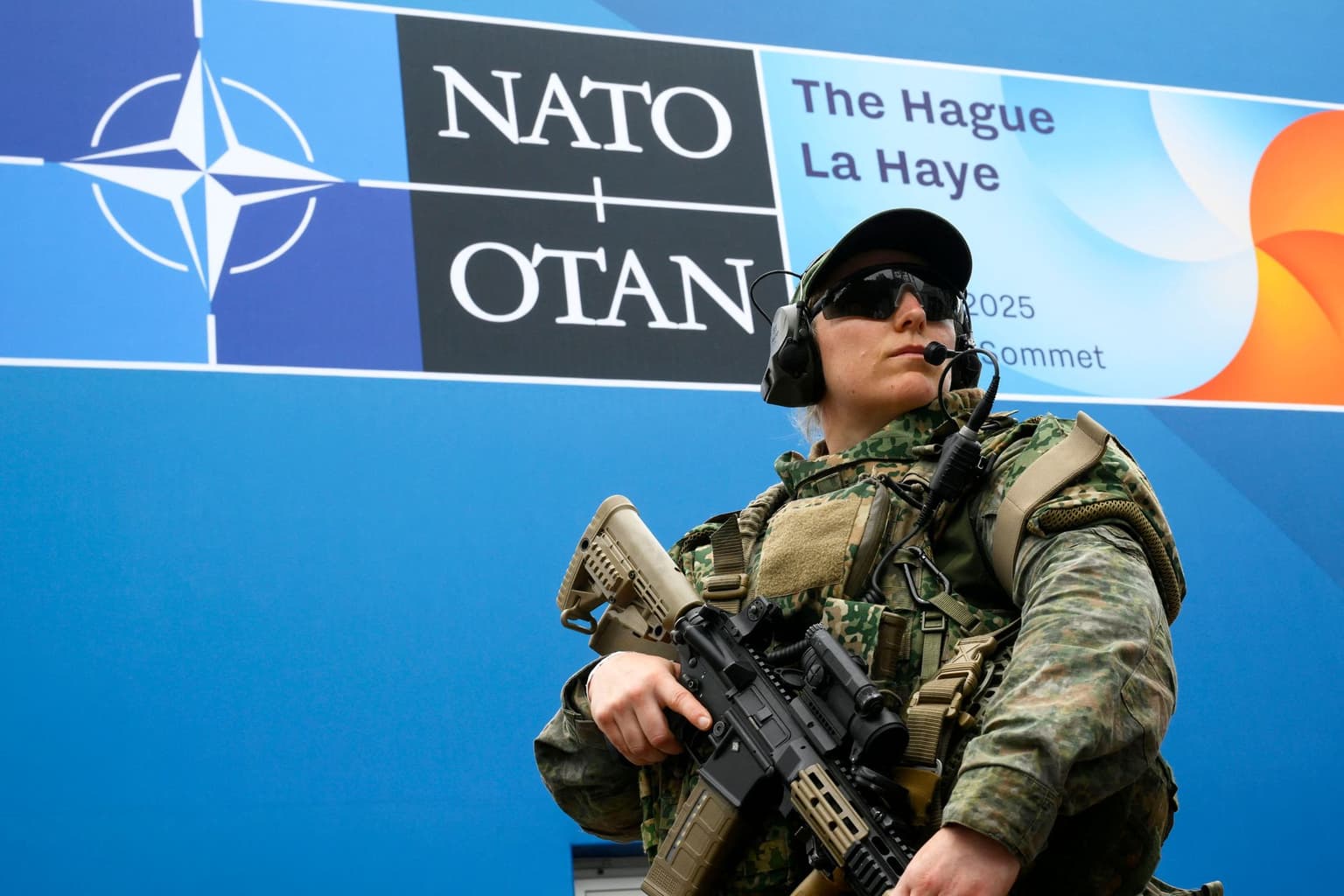
A soldier patrols outside the building hosting the NATO summit of heads of state and government in The Hague, Netherlands, on June 24, 2025. (John Thys/AFP via Getty Images)
 on Google

Marek Zenisek
Czech politician and academic
Europe has already learned to better recognize hybrid threats, which is definitely a good thing, but recognition alone is not enough and doesn't serve as sufficient deterrence.
European officials have grown accustomed to scenarios where a cyberattack disrupts public services and critical infrastructure, drones appear over sensitive sites, and a flood of misinformation on social media exploits societal uncertainty.
European governments then investigate, share information, release statements, and sometimes announce new security measures until another incident elsewhere grabs the headlines again.
This approach is obviously not enough. Up until today, it appears that Russia is pretty confident that the cost of these hybrid attacks is a bargain — it costs little, and consequences look spectacular in Russian intelligence reports.
And this is exactly where Europe still has a problem. Resilience and deterrence are not the same thing. Europe must become a harder and, above all, much more expensive target for Russia.
Europeans must ensure that deterrence is a priority, as resilience is an unlikely tool to actually change the cost of a Russian attack.
Let's stop treating every incident as an isolated case and add them all up
A single attack may seem too small to justify a major response.
We've seen it many times.
In July 2024, an incendiary package caught fire at Leipzig airport on July 20, followed by similar incidents in Poland and the U.K. over the next two days.
German security authorities did not issue a wider warning to the aviation and logistics sectors until Aug. 28, more than five weeks after the first incident.
The subsequent investigation established links between the incidents and a broader Russian sabotage campaign. The response eventually came, but the delay illustrates the advantage Russia gains when individual incidents are treated separately rather than as parts of a broader campaign.
Determining responsibility can take weeks, and governments may differ in their assessment of the available evidence as well as their opinion on the appropriate reaction. Before responsibility is confirmed, political attention may shift elsewhere, giving Russia a strategic advantage in this gray zone.

This creates an asymmetry that favors the aggressor. Moscow can carry out a long-term campaign while European states deal with individual incidents one by one.
European governments, therefore, need to evaluate individual incidents in a broader context and together.
A cyberattack, sabotage, or an attempt to infiltrate an intelligence network is a full-blown hybrid campaign targeted against European countries.
Repeated operations also consume European resources, reveal weaknesses, create uncertainty, and above all, test how far Europe is willing to go.
So every new investigation shouldn't start from scratch, and instead should take into account what came before it.
Deterrence can't start only after an attack
The central objective of Europe's deterrence strategy should be to change Moscow's calculus and make further aggression an unacceptable gamble. European governments can rise above the Kremlin's dirty tricks by pursuing a constructive, systemic approach that addresses the threat at its roots.
To develop that, European governments should prepare a credible set of possible consequences before another serious incident occurs. Russia doesn't need to know exactly what Europe will do in every situation; strategic ambiguity has its value, but Moscow must believe that Europe will respond and that the consequences will matter.
That's the foundation of credible deterrence.

There's also a broader reason why this is important. If we add up the various forms of pressure Russia has exerted on European countries in recent years, future generations could rightfully ask why Europe tolerated so many things without developing a more systematic response.
It will be especially hard to explain to our children and grandchildren why a group of countries with much greater economic resources than Russia repeatedly allowed Moscow to set the pace of the confrontation.
Europe needs to be much better prepared. European countries should have a set of possible responses ready that can be adapted to specific cases, instead of having to come up with a reaction from scratch after every new attack.
That way, deterrence becomes more than just a statement made after the damage has already been done.
Got an opinion on anything you've read in the Kyiv Independent so far?
and it may appear in our Letters section.

Europe needs to change the calculation
Everyone understands that Europe cannot prevent every hostile operation. It can't know where the next test will come from, just like it can't rule out the possibility that Russia or another adversary will take advantage of Europe's openness. It can, however, make such operations more difficult.
Europe can better protect its societies. It can improve the ability of its intelligence and security services to identify hostile networks. It can coordinate accountability better. It can remove unnecessary legal and institutional obstacles. And it can make it clear that repeated aggression will not go unpunished.
The main goal, as mentioned before, has to be to change the adversary's calculation.
Russia must not only ask whether a certain operation can be carried out successfully. It also has to ask how much it will cost if Europe uncovers it and holds Moscow responsible.
Editor's note: The opinions expressed in the op-ed section are those of the authors and do not purport to reflect the views of the Kyiv Independent.