'Very difficult to defeat' — How Russia uses mesh networks inside drones to precision-strike Kyiv
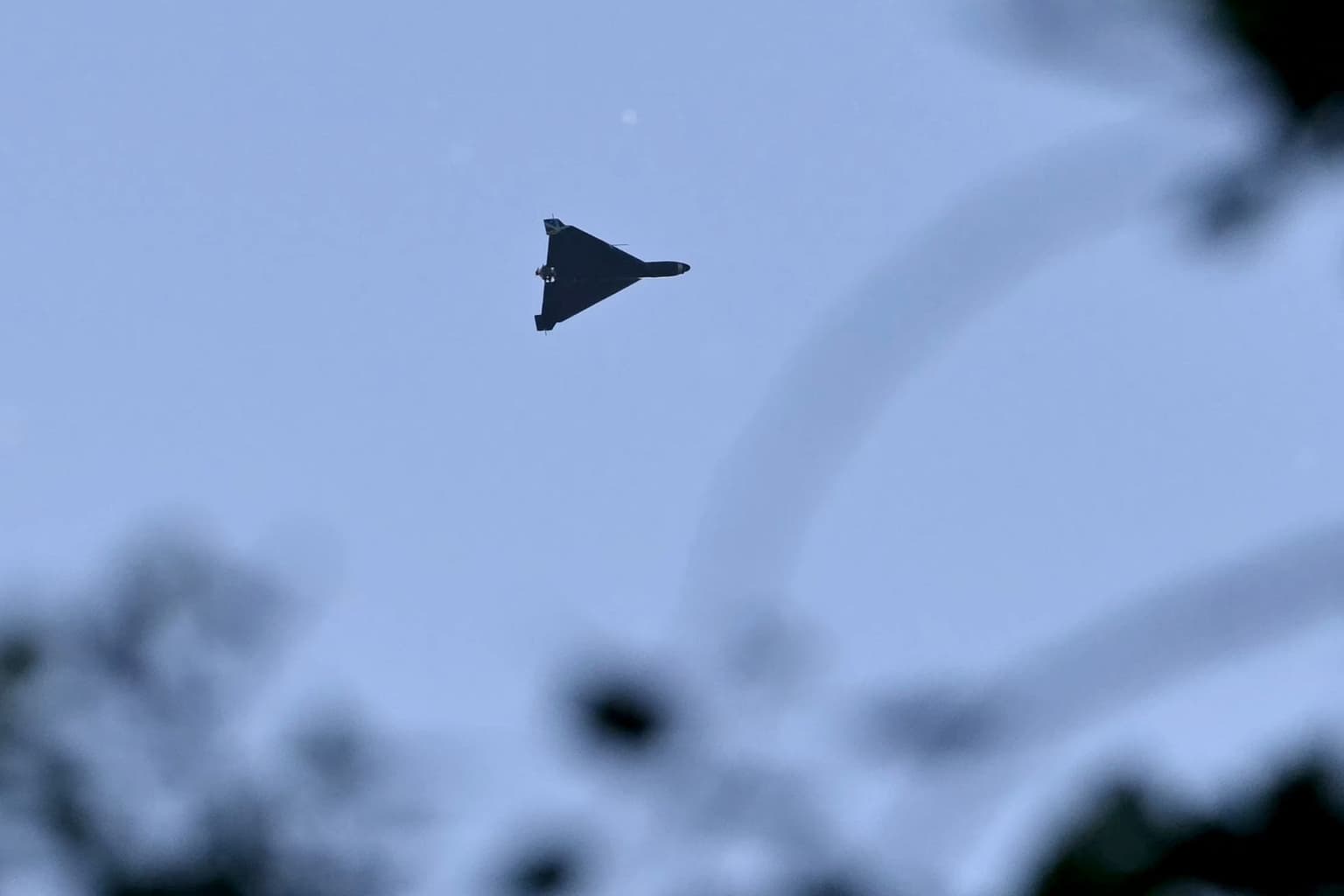
A Russian drone flies over Kyiv, Ukraine, on May 24, 2026. (Genya Savilov / AFP via Getty Images)
 on Google
A city stretches out beneath the lens of a Russian drone. Roads, apartment blocks, parks, and office buildings come into view as the weapon closes in on its target.
Footage like this has become all too familiar over the course of Russia's full-scale war, usually captured by small first-person-view (FPV) drones stalking anything that moves along the front line, from soldiers and vehicles in the kill zone to civilians on their way to work.
Now the camera is mounted on a long-range Russian attack drone remotely piloted far beyond the range of a conventional direct radio link, hunting civilian infrastructure inside Ukraine's capital.
"They are now operating essentially like FPV drones," a source in Ukraine's Defense Ministry told the Kyiv Independent.
One crucial technology helping to make that possible is mesh networking, which allows drones and other radio-equipped platforms to relay communications to one another, extending a control link beyond the range of a single radio. It also allows live video footage to travel back through the network to the operator, who can see what the drone sees and adjust its flight in real time.
On Sept. 29, Russian forces released footage of a strike on the Inkom business center in Kyiv, showing an attack drone being controlled and transmitting video despite electronic warfare (EW) systems deployed throughout the city.
The footage immediately raised a question: how is that possible?
As Serhii "Flash" Beskrestnov, an adviser to the Ukrainian president on the development of defense technologies, put it: "I'll say this right away: no secret satellites, no FPV drones launched from a Shahed, no Russian agents, no mysterious UAVs."
According to Beskrestnov, a Geran-5 jet-powered drone struck the business center while a second jet-powered Shahed circled above the site at an altitude of nearly three kilometers. Equipped with a mesh radio, the second drone acted as a signal relay for the Geran-5 while simultaneously filming and immediately transmitting video of the attack.
After SpaceX blocked unauthorized Starlink terminals used by Russian forces in early February, Russia has had to find other ways to maintain remote control of its drones. As it has repeatedly done throughout the war, Russia adapted.

Russian fixed-wing drones are now being fitted with mesh radios, which are proving to be an effective alternative to Starlink, albeit with limitations of their own.
Since late summer, a near-constant swarm of jet-powered Russian drones has obscured the skies over Kyiv, terrorizing residents and hunting for targets across the city.
Mesh communications are helping turn these aircraft into a formidable threat, capable of high-resolution reconnaissance and remotely operated precision strikes at unprecedented range.
So, what are mesh networks?
A mesh network is a decentralized communications system in which nodes can connect to multiple other nodes and dynamically route data through the network rather than relying on a single fixed path.
In unmanned aerial vehicle (UAV) applications, those nodes can be radios mounted on drones, vehicles, ground stations, or other platforms, each capable of relaying data across the network.
Russian drones have been documented carrying the Chinese-made XK-F358 mesh radio.
In Russian operations, those network chains begin with ground-to-air relay stations near the front line or along the borders with Russia and Belarus. Mesh-equipped drones then relay the connection from one aircraft to another, carrying it progressively farther into Ukrainian territory.

"Think of it almost like a bucket brigade for putting out a fire. Each person passes the bucket along," says Michael Bohnert, a defense researcher at RAND. "Where you have a mesh network is instead of a single line of all of these, you might have three or four lines side by side, and they can pass back and forth almost like a checkerboard."
The principle itself is not new. Bohnert compares it to commercial Wi-Fi extenders used to carry a signal into dead zones inside a building.
"It's a 15-year-old consumer technology," he says. "It's just getting it to work over long distances with everything moving that is the hard part."
Instead of traveling directly between an operator and a drone, communications can pass through several intermediate radios. Each transfer of the signal from one radio to the next is known as a "hop." Several hops can therefore carry a connection beyond the range of any single radio.
According to Mark Hay, CEO of defense company Melrose Networks, the Chinese-made XK-F358 mesh radio attached to Russian drones can support networks of up to 63 hops.

In practice, however, the number of hops a network can support depends on the amount of data it needs to transmit. Each additional relay introduces delays and reduces the available data transmission rate, potentially compromising the ability to control a drone in real time over longer chains.
In principle, each mesh modem in the chain knows which neighboring node to pass the signal to next, allowing communication to propagate across the network until it reaches the operator or the drone.
"The controller [can] communicate with the drone and vice versa," says Hay, "Through one or more hops … they are acting like relays."
Many military mesh radios also use MIMO (Multiple Input, Multiple Output), which uses multiple antennas to make individual wireless links more reliable. MIMO strengthens the connection between individual nodes, while mesh networking determines how data moves through the wider network.
Used together, they can make UAV communications more resilient and extend their practical reach. If one link is lost, the network can reroute traffic through another available path, as long as a viable connection remains.
read also
The effects of mesh networks
The most immediate advantage is range. Without satellite communications, a drone controlled over a direct radio link is limited by how far that signal can reliably travel. Mesh networking extends that distance by passing communications through intermediate nodes.
"It allows you to connect over very long distances with communication systems that are relatively low power," Bohnert says.
In practice, he says, that can allow Russian forces to operate drones "two, three, maybe even four times further" than would be possible over a direct radio link.
According to an analysis published by Calibre Defence, a chain of mesh-controlled Gerans or other UAVs could maintain connectivity and live operator control up to 150–175 kilometers from the furthest ground control station, roughly twice the range reported by Beskrestnov in 2025.

Mesh networks are also more resilient. Because communications can travel through multiple paths, losing one relay does not necessarily break the connection.
"With a mesh network you can have ten transmitters attached to trees," Bohnert says. "Even if you blow up one or two where they're starting, there's another way to go along the chain."
The same flexibility can make mesh-controlled drones harder to disrupt with electronic warfare. If interference blocks one link, the network can attempt to route communications through another.
"There could potentially be multiple relay drones on the Russian side," Hay says. If electronic warfare cuts one relay off from the rest of the network, "the communications across the whole network find a way around it."
Mesh systems can rapidly switch between frequencies while keeping radios in the network synchronized, forcing electronic warfare systems to jam a broader range of frequencies to consistently disrupt the connection.
"It's a very difficult thing to defeat because it can work around your attempts to defeat it," Hay adds.

Shorter distances between individual nodes can also make the links themselves harder to jam. A jammer must generate sufficient interference at the receiving radio to disrupt the connection, a task made more difficult by the high transmission power of some Russian mesh radios.
That does not make mesh networks immune to electronic warfare. Bohnert says there is a trade-off between range and resilience: networks designed to communicate over greater distances can become easier to jam, while more resilient networks require nodes to remain closer together.
More powerful radios can partly offset that trade-off, though at a considerable cost, with some of the Chinese-made mesh radios used on Russian drones priced at over $8,000 apiece.
What mesh gives Russia is a resilient, adaptive communications network of its own, carrying control commands, telemetry, live video, and other data between operators and drones. That connection enables reconnaissance, target adjustment, and remotely operated strikes like those now seen over Kyiv.
How Russia is using mesh networks
The strike on the Security Service of Ukraine (SBU) headquarters in Kyiv raised a question — how was the drone guided so precisely over the capital?
Beskrestnov believes the aircraft may have connected to a ground-based mesh relay operating inside Kyiv.
"I insist that enemy mesh radio relays are being activated in Kyiv, providing temporary, short-term control channels for Shaheds to adjust their strikes," he says. "Not many. Perhaps one to three."
At the time of the SBU strike, he adds, there were no other Shaheds in the air that could have served as airborne relays.
Hay agrees that such a setup is technically possible. A mesh radio placed on a rooftop or in an apartment could connect to the internet via fixed broadband, Wi-Fi, or a cellular network, and provide an incoming drone with a local control link during the final stage of its flight.
Airborne relays are most effective at altitude, where drones maintain a clear line of sight with one another. As they descend, buildings, terrain, and Earth's curvature begin to obstruct the radio signal. A relay inside Kyiv could carry the connection through that final stretch.
Russia's 50th Separate Unmanned Systems Brigade "Varyag" has emerged as a pioneer in the use of mesh-equipped Geran and Gerbera drones for reconnaissance and long-range strikes. Part of Russia's Unmanned Systems Forces and subordinate to the Supreme High Command, the brigade targets logistics and infrastructure in Ukraine's rear.
It has been linked to attacks on bridges and data centers in Kyiv, as well as operations in Zaporizhzhia, Dnipropetrovsk, Donetsk, Kharkiv, and Chernihiv oblasts.

Mesh gives formations like Varyag more than additional range. It allows operators to change how an attack develops after the drones are already in the air.
Bohnert describes the problem in terms of game theory. If range matters most, relay drones can be spread into a long chain, each extending the connection farther. If electronic warfare or Ukrainian interceptors pose the greater threat, the drones can fly closer together, reducing range but creating more redundant links.
The configuration can also change during an attack.
Bohnert gives the example of ten drones sent toward four possible targets. The first to arrive can show operators which targets remain reachable, allowing them to redirect the rest in flight.
"There's a lot of game theory, and it's really situational," he says. "That's why it's so dangerous."
Relay drones can also be pushed forward or replaced as they are destroyed, forcing Ukraine to keep spending interceptors while other aircraft continue toward their targets.
Technological whack-a-mole
Russia is increasingly giving its long-range drones multiple ways to communicate. Some Geran drones have been found carrying both mesh-network equipment and cellular modems, allowing operators to use whichever connection is available at different stages of a flight.
While mesh radios transmit live video and control commands, cellular modems are used to send telemetry, including the drone's location and status.
On Sept. 14, Ukrainian officials said Russia was likely using Belarusian commercial LTE networks and radio relay stations on Belarusian territory to communicate with Shahed-type drones during mass attacks on Ukraine.
Belarusian LTE infrastructure could also serve as a gateway between the airborne mesh network and the wider internet, allowing Russian operators to communicate with drones through the mesh network without requiring each aircraft to connect directly to a cellular network.
According to Hay, a drone flying high enough to maintain mesh links could, in theory, switch to a cellular network as it descended into areas with mobile coverage, provided it could gain access to that network.

Maintaining that connection does not necessarily require an operator to manually pilot the drone throughout its flight. Computer-vision systems can also allow an operator to designate a target, leaving the aircraft to track and approach it autonomously during the final stage of an attack.
Satellite communications could eventually add another layer. In 2026, Russia began deploying Rassvet, a low Earth orbit satellite internet constellation designed as a domestic alternative to Starlink.
The program has suffered early setbacks, including the loss of one satellite and failures that left others outside their intended orbits. If the constellation becomes operational at scale, however, Russian forces would have access to a satellite communications system that Moscow controls directly.
Hay expects these systems to be used together rather than as substitutes for one another.
"They have cellular, and they have mesh network support on board them as well," he says of some Geran drones. "They will additionally have satellite, and they will use each one of these, possibly whichever one works at a given point in time during a flight."
That creates a harder problem for Ukrainian electronic warfare: disrupting one communications method does not necessarily cut the operator off if another remains available.
"It's like a game of whack-a-mole," Hay says. "You end up with a situation where one technology is used, then that no longer works, so they start using another technology."
"You hit it, you deal with that problem. It pops its head up somewhere else."