Ukraine's interceptor tech outpaced by Russia’s jet-powered Geran-5 drones
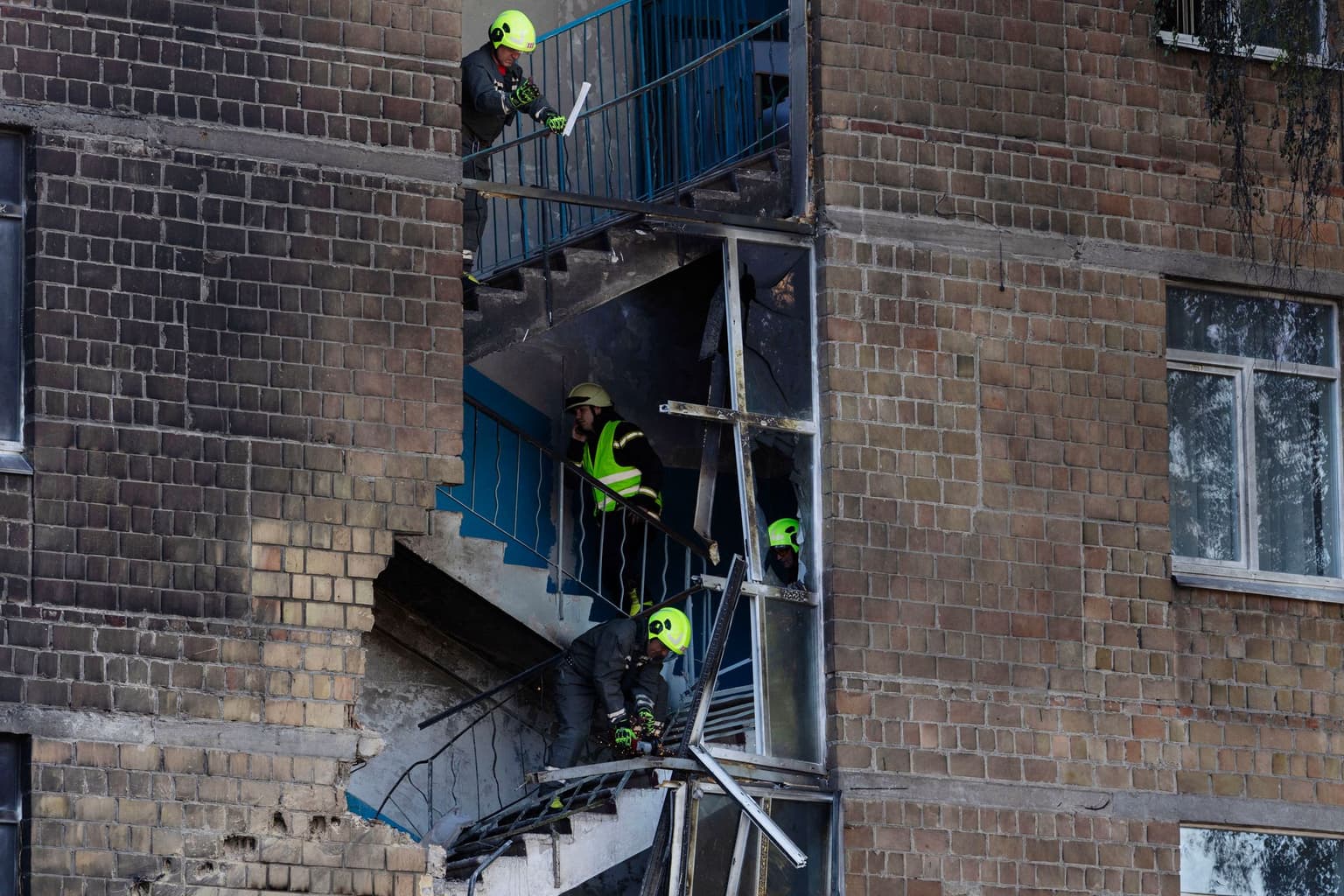
Rescuers work at a school damaged by a Russian drone strike in Kyiv, Ukraine, on Oct. 1, 2026. (Tetiana Dzhafarova / AFP via Getty Images)
 on Google
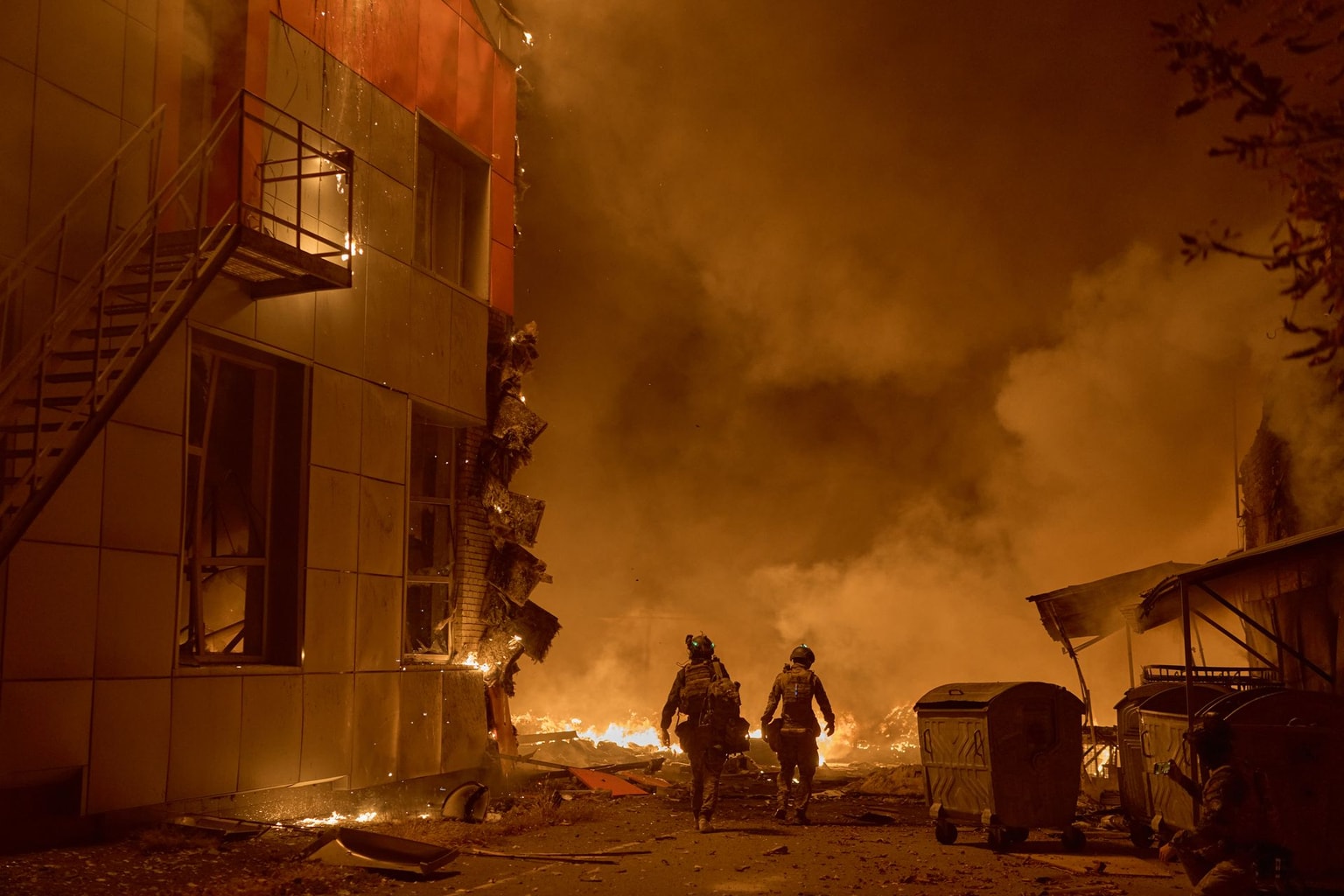
The jet-black Russian munition slammed into the Presidium building of Ukraine's National Academy of Sciences, an iconic Tsarist-era structure right in the center of Kyiv, setting the building on fire. Survivors climbed out of the windows and clambered onto the building's ledges, fleeing the flames and choking black smoke. Two people were killed in the attack. Around an hour later, an identical munition struck a private medical clinic a few blocks away.
The Geran-5 jet-powered drone is Russia's latest attempt to destroy civilian life in Kyiv and force Ukraine to capitulate, as Russian offensives stall and Moscow's forces lose ground on the battlefield. Small, and with a tubular fuselage reminiscent of a missile rather than a drone, the Geran-5 flies higher, faster, and is significantly more difficult to shoot down.
"The Geran-5 is a significantly more difficult target to intercept than the Geran-4, or any of the previous generation of Russian drones," a senior engineer working for a defense contractor told the Kyiv Independent, speaking on condition of anonymity due to the work's sensitive nature. "We have multiple teams attacking the problem from 4-5 different angles at the same time," he said.
"The Geran-5 flies 150km/h faster than the Geran-4, so the goal is to intercept from the front rather than the rear - a much harder problem to solve," the engineer said.
Launched at the city in waves, Russia's jet drones target civilian infrastructure such as supermarkets, schools, shopping malls, telecommunications infrastructure, data centers, gas stations, and medical facilities.
Planning everyday activities with any degree of certainty has become increasingly difficult through the disruptive effect of constant air raids. When an air alert is sounded, shopping malls, bridges, gas stations, restaurants, and government buildings close. Constant explosions wrack the nerves of Kyiv's residents as the sense of danger in districts once considered safe becomes nearly palpable.
Russia is attempting to “destroy pretty much the entire economy," economy minister Oleksandr Kravchenko told the Guardian, claiming that air raid alerts cost the Ukrainian economy $45 million for each hour businesses stop their operations. The past week saw air raids of over 20 combined hours in a single day.

"What we had not fully anticipated was how quickly Russia would develop these jet-powered drones and use them to target everything," Kravchenko said.
Russia is rapidly scaling the number of jet-powered drones it uses in raids on Kyiv. "Sometimes, two-thirds of all drones launched during the day are jet-powered," Colonel Yurii Ihnat, head of the Air Force Command's Communications Department, told the Kyiv Independent.
Ukrainian intelligence estimates that Russia can currently produce 3,000 jet-powered Geran-4 and Geran-5 models per month, a figure Moscow seeks to rapidly increase. Like many of Russia's other high-end munitions, both the Geran-4 and Geran-5 include many Western components, according to the Ukrainian government and independent analysis of crashed models.
Only 57% of jet-powered drones are currently shot down by Ukraine, President Zelensky acknowledged in his evening address on Sept. 28, a figure he described as "much less than necessary."
The methods Ukraine pioneered and perfected for dealing with Russia's older, piston-powered drones, such as mobile anti-aircraft teams and interceptor drones, are no longer sufficient.
A new generation of Russian drones
The older jet-powered Geran-3 and Geran-4 have a delta-winged aerodynamic form similar to Russia's older, Iranian-derived, piston-engined Geran-1 and Geran-2 drones. The Geran-5's form is far closer to a traditional cruise missile, giving it a significantly higher maximum speed.

"The Geran-5 much more resembles a low-cost cruise missile than a long-range drone like the original Shahed derivatives," Fabian Hoffmann, a senior research fellow at the Norwegian Institute for Defence Studies, told the Kyiv Independent.
A low-cost cruise missile is a type of munition that occupies a middle ground between Russia's cheap piston-engined long-range drones, and its expensive, highly sophisticated cruise and ballistic missiles, Hoffmann explained.
As such, Russia's Geran-5 drones are more expensive than older piston-engined models, with the Chinese-imported turbojet engine alone costing $40,000. The drone's overall price is estimated at around $115,000, compared to older piston-engined models, estimated at as little as $30,000.

"The biggest weakness probably is that Russia is not yet able to mass produce the engine on its own and relies on Chinese imports," Hoffmann told the Kyiv Independent.
Yet, the cost of the Geran-5 is just a fraction of a traditional cruise missile’s cost, allowing Russia to produce and launch them en masse. At the same time, the Geran-5 is less destructive than a traditional cruise missile.
The drone carries a warhead of about 90 kg, Ukrainian military intelligence estimates, compared to the 480 kg warhead carried by the ground-launched 9M728 Iskander-K, which costs around $1.5 million per missile, or the air-launched Kh-101 cruise missile, which can carry a warhead of up to 800 kg, and costs around $2 million per missile.
An airborne arms race
Commenting on the recent waves of Russian jet-powered drone strikes, Serhiy Sternenko, drone warfare adviser to former Ukrainian Defense Minister Mykhailo Fedorov, said "there is currently no mass produced effective product among interceptors."
"There are prototypes that showed different results, but to bring the prototype to a large series requires a lot of effort, and sometimes it is even impossible due to limited access to certain components," Sternenko said.
Successfully demonstrated prototypes include the STING S interceptor, manufactured by Wild Hornets and the P1-SUN Jetkiller, manufactured by SkyFall, which are confirmed to have shot down a small number of Geran-5 drones.
Another promising prototype is manufactured by Quantum WIY Industries, the Ukrainian subsidiary of German defense concern Quantum Systems. Video released by Quantum Systems shows one of the company's "SPYS" drones successfully intercept a Geran-5 over Ukraine.
The "SPYS" drone is a propeller-powered interceptor, whose special motors allow the drone to 'sprint' to 600kph for short periods of time, a company representative told Ukrainian outlet Militarnyi. It trades this increased speed for decreased flight endurance to intercept the much faster Geran-5.

"It's not only us who are working on such solutions," Sven Kruck, co-CEO of Quantum Systems, told the Kyiv Independent, explaining that many other companies also work on improved interceptor drones.
"I think that in the next upcoming weeks, we can hopefully see the results from these companies," Kruck added. "So I would say that maybe in four to eight weeks, we should see we are more controlling the air again".
Besides the upgraded propeller-powered interceptors, Ukraine is also developing a new generation of jet-powered interceptor drones. The first model, the Alexa Spatium, entered service on Aug. 21, according to the Ukrainian Defense Ministry.
Ukraine's internal security service, the SBU, has been developing a different, delta-winged jet-powered interceptor, Zelensky announced on Sept. 19, sharing video of the interceptor successfully downing a Geran-5.
Quantum Systems is also developing a jet-powered interceptor. "We have invented a jet, a counter-UAS element, which we call SPICE, which is able to counter these jet Shahed drones," Kruck told the Kyiv Independent.
"The jet-powered interceptor design is still maturing, but Ukraine will get there," Hoffmann said. "The main problem is that Ukraine will be much more reliant on American and European partners, Taiwan, and China for jet engine imports, as it is not producing these engines itself. So scaling production will require steady and growing supply from abroad, or establishing licensed production facilities to mass produce engines in Ukraine."