KI short logo

In pictures: A week of Russian jet drone terror in Kyiv
5 min read

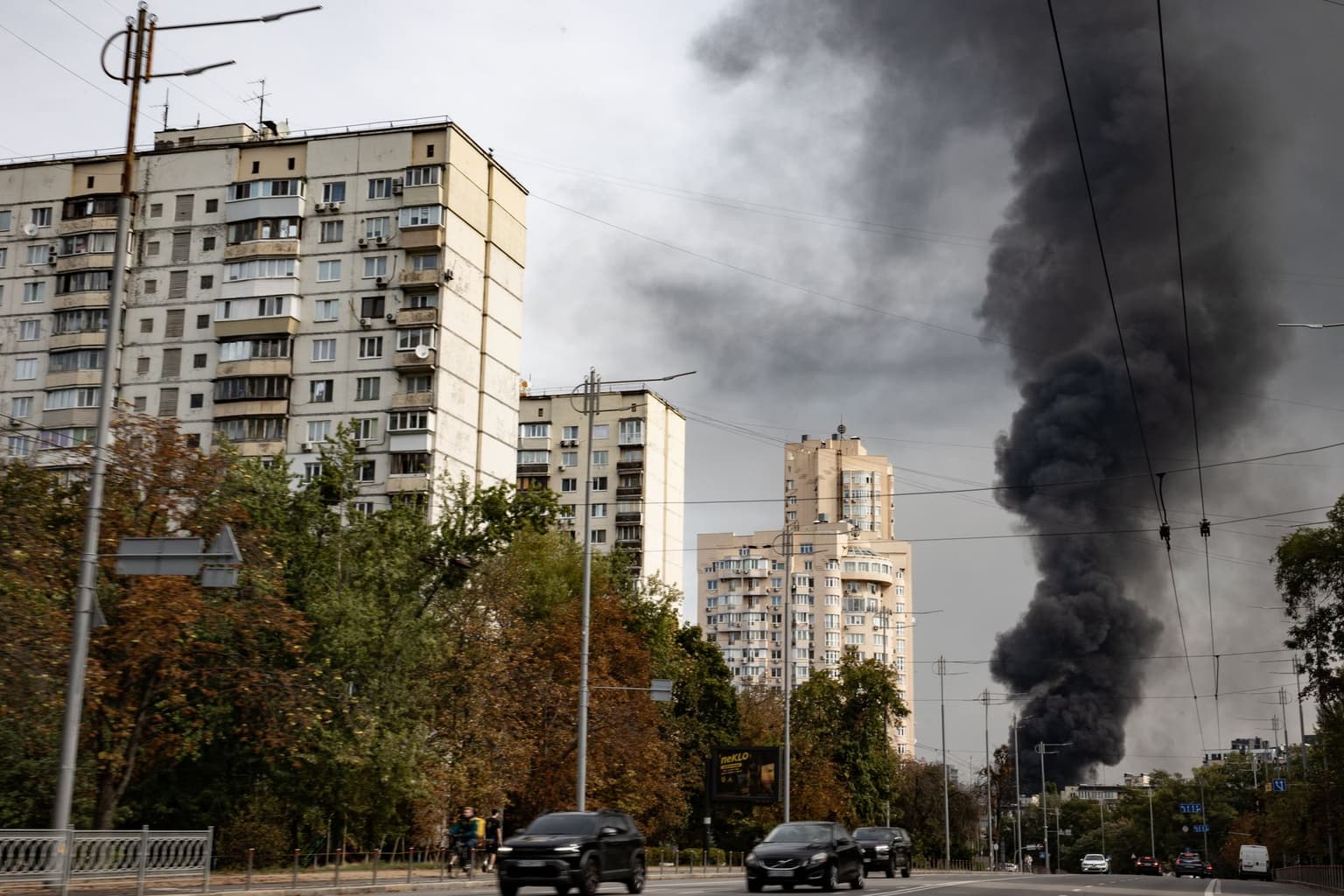
Smoke from a Russian drone strike rises over a residential area in Kyiv, Ukraine, on Sept. 23, 2026. (Roman Chop/Global Images Ukraine via Getty Images)

Editor's note: The Kyiv residents quoted in the story asked to be identified only by their first names.

Russian drones have filled the skies over Kyiv, striking at the city around the clock, making it feel increasingly like there is nowhere safe to hide.

A plume of black smoke rises after a Russian drone attack in Kyiv, Ukraine, on Sept. 23, 2026.
A plume of black smoke rises into the sky after a Russian drone attack in Kyiv, Ukraine, on Sept. 23, 2026. (Yevhen Kotenko / Ukrinform/Future Publishing via Getty Images)
Article image
The former Zaliznychnyi Market, a landmark of Kyiv modernist architecture widely known as "Shaiba" ("The Puck"), burns following a reported strike by a Russian Geran-5 jet-powered attack drone, in Kyiv, Ukraine, on Sept. 23, 2026. (Kostiantyn Liberov / Libkos / Getty Images)

The attacks once came in waves, followed by periods of relative calm. Now, Russian strikes are coming almost nonstop. Using newer jet-powered versions of Shahed-type drones, the onslaught began last month, but has increased in intensity each day over the past week.

The city is filled with the constant noise of drones striking their targets and the thunder of air defenses firing back. Then there is the sound of a drone approaching — a distant roar that can swell in seconds as it tears through the sky at speeds of up to 600 kilometers per hour (370 miles per hour), leaving little time to act.

People walk past burnt-out cars in Kyiv, Ukraine, on Sept. 24, 2026.
People walk past burnt-out cars at a parking lot in Kyiv, Ukraine, on Sept. 24, 2026, following an overnight Russian attack. (Pavlo Bahmut/Ukrinform/NurPhoto via Getty Images)

"At any moment, you don't know where a strike might land," Kyiv resident Khrystyna told the Kyiv Independent after an attack on Sept. 23 set a historic market near the central railway station ablaze.

A woman killed in a drone strike lies in the street in Kyiv, Ukraine, on Sept. 25, 2026.
A woman killed in a Russian drone strike lies in the street outside a damaged office building in Kyiv, Ukraine, on Sept. 25, 2026. (Kostiantyn Liberov/Libkos/Getty Images)
Rescuers work at an apartment building in Kyiv, Ukraine, on Sept. 25, 2026.
Rescuers work at an apartment building struck by a Russian drone in Kyiv, Ukraine, on Sept. 25, 2026. (Kyrylo Chubotin/Ukrinform/NurPhoto via Getty Images)

The latest barrage stretched from night into day. At 12 hours and 44 minutes, the air raid alert in Kyiv on Sept. 30 was one of the longest single alerts the city has ever recorded. Several more have sounded since, and at the time of writing, another was stretching into the late evening.

Preceding the daylight drone barrage, Russian forces attacked the capital overnight with ballistic missiles.

A damaged apartment building is seen in Kyiv, Ukraine, on Sept. 26, 2026.
An apartment building remains damaged following a Russian drone attack in Kyiv, Ukraine, on Sept. 26, 2026. (Roman Chop/Global Images Ukraine via Getty Images)
An injured resident poses as a private house burns in Kyiv, Ukraine, on Sept. 27, 2026.
An injured resident poses for a portrait as a private house burns after being struck by falling debris following a Russian drone attack in Kyiv, Ukraine, on Sept. 27, 2026. (Kostiantyn Liberov/Libkos/Getty Images)

Earlier this week, Russia struck the Ukrainian National Academy of Sciences in the center of Kyiv, forcing people trapped inside to climb out through upper-floor windows to escape the flames. About two hours later, another Russian strike hit a medical center a mere 15-minute walk away.

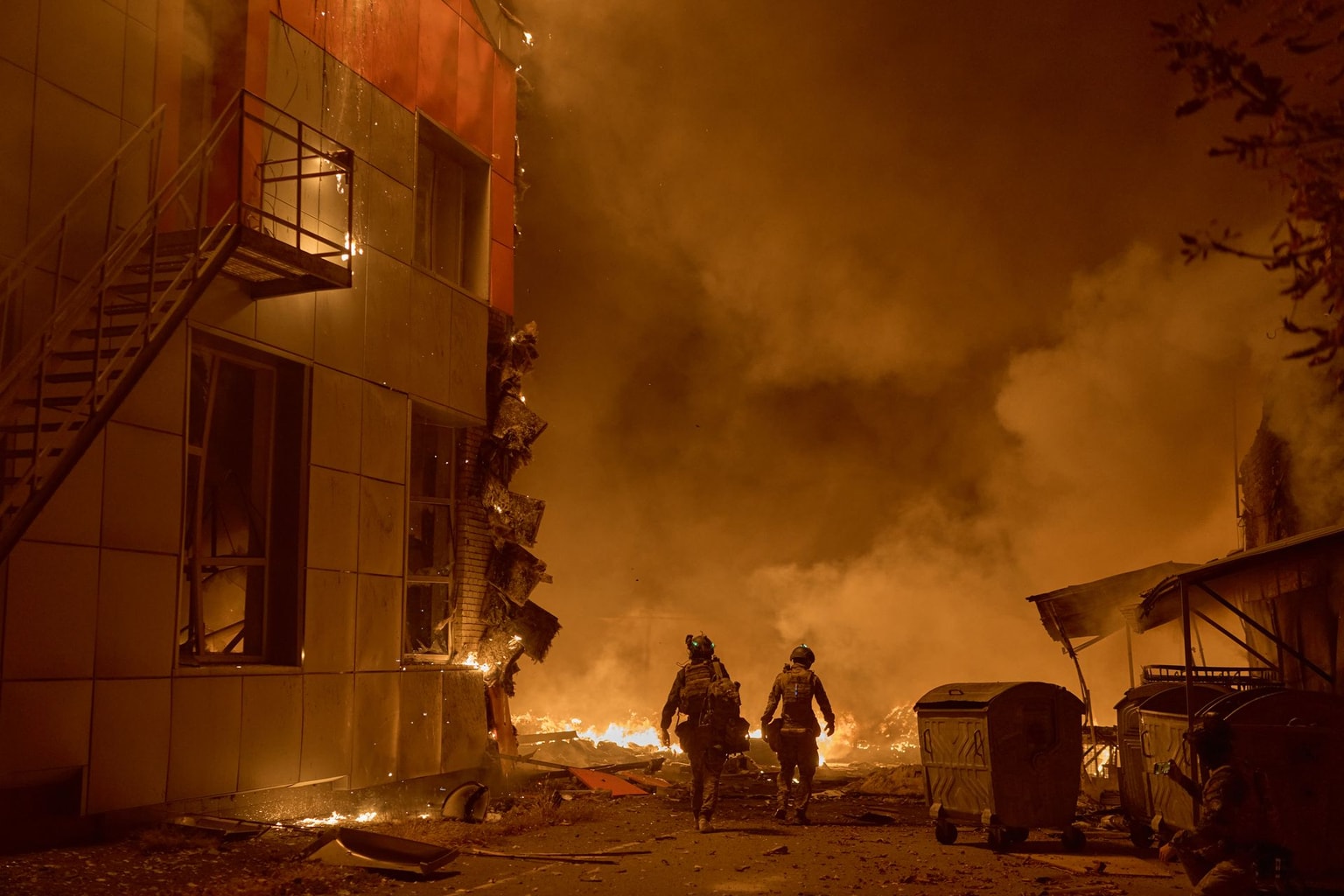
Two men flee a burning building after a drone strike in Kyiv, Ukraine, on Sept. 28, 2026.
Two men attempt to escape from the National Academy of Sciences building after it was hit by a Russian drone and caught fire in Kyiv, Ukraine, on Sept. 28, 2026. (Ukrinform/NurPhoto via Getty Images)
Emergency services attend a drone strike site in central Kyiv, Ukraine, on Sept. 28, 2026.
Emergency services attend the site of a drone strike at the National Academy of Sciences building in central Kyiv, Ukraine, on Sept. 28, 2026. (Andriy Dubchak/Frontliner/Getty Images)
Firefighters and medics evacuate an injured person in Kyiv, Ukraine, on Sept. 28, 2026.
Firefighters and medics evacuate an injured person after a projectile hit a residential building in central Kyiv, Ukraine, on Sept. 28, 2026. (Alex Babenko/Getty Images)

Kyiv's data centers and internet hubs have also been among Russia's latest targets. Strikes on this infrastructure can disrupt Ukrainian online services far beyond the capital, degrade connectivity in Kyiv, and potentially cut people off from the internet they rely on to track drone movements.

Another troubling sign came on Sept. 30, when Russia resumed strikes on the capital's energy infrastructure.

A man lights a cigarette as emergency workers clear rubble in Kyiv, Ukraine, on Sept. 30, 2026.
A man lights a cigarette as emergency workers clear the rubble of a private house in search of his wife's body in Kyiv, Ukraine, on Sept. 30, 2026. (Kostiantyn Liberov/Libkos/Getty Images)
Police remove wreckage from a drone in Kyiv, Ukraine, on Sept. 30, 2026.
Police officers and explosive ordnance disposal specialists remove wreckage from a Russian drone that fell into the courtyard of an apartment building in Kyiv, Ukraine, on Sept. 30, 2026. (Zinchenko/Global Images Ukraine via Getty Images)

Under a seemingly endless barrage of Russian drones, and with no certainty about what the next morning will bring, Kyiv continues to push through the attacks as it braces for colder weather — and another difficult winter.

"We try to put it out of our minds and stay composed. But lately, our morale has taken a hit," Yana, a real estate agent who survived a Sept. 25 attack in the city center, told the Kyiv Independent.