Russian anti-war opposition had a 5-day run
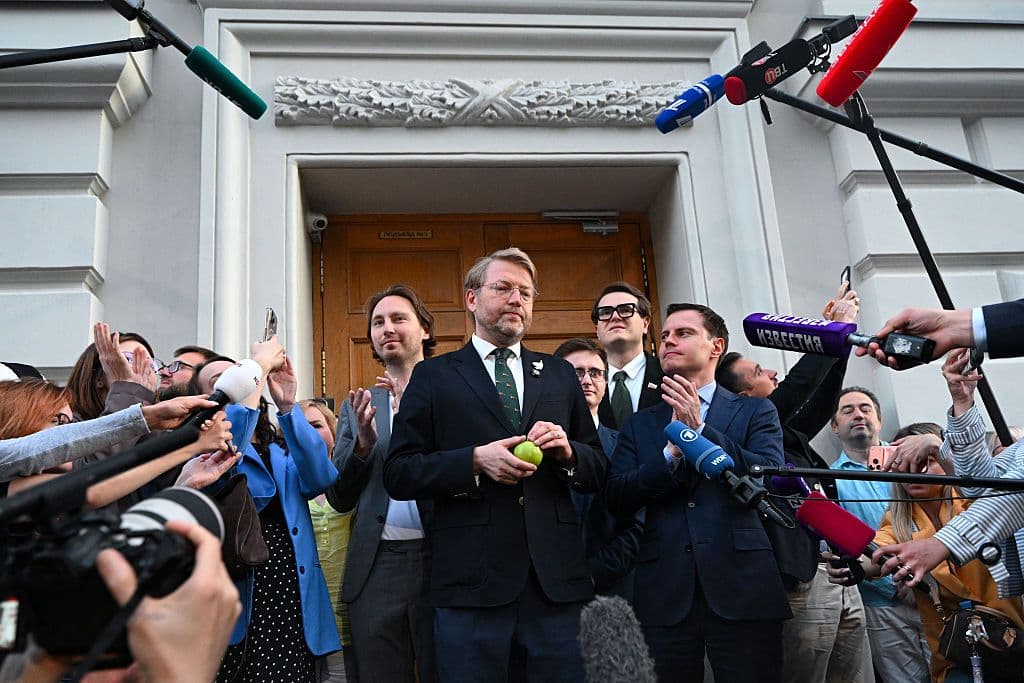
Russia's liberal Yabloko party leader Nikolai Rybakov talks to the media outside the Supreme Court in Moscow on Aug. 10, 2026. (Igor Ivanko / AFP via Getty Images)
 on Google
Russia's Supreme Court, on Aug. 10, barred the country's only anti-war party from taking part in parliamentary elections scheduled for September. The liberal Yabloko party had been approved to take part in the vote and was assigned a spot on the ballot five days prior.
Between the two dates, a few notable events took place — the largely obscure party received wide-ranging support from anti-war activists and the country's exiled opposition, and pro-Kremlin political projects went after it as a result.
The accusations, spearheaded by the nationalist pro-war Rodina party, circled around Yabloko's anti-war stance, which they viewed as a "support for extremism" and compared to calls for Russia to cede its sovereign territory.
"Part of Russia's territories are occupied by a neo-Nazi regime," a Rodina representative told the court, as cited by Russian news outlet Meduza, referring to Ukrainian territories that Russia views as theirs and has inscribed their ownership into its own constitution.
"Calls for an immediate ceasefire agreement constitute calls to stop the liberation of the occupied territories or to abandon their liberation."
A few other accusations were brought up against Yabloko, among them not asking OpenAI for permission to use an image generated by ChatGPT and violating campaign financing laws, Russian media outlets reported.
Russia's Central Election Committee, which greenlit Yabloko's place in the election days earlier, told the court that they had uncovered foreign sources of funding for Yabloko candidates.
Yabloko denied all of the charges. "(Young voters) support us simply because they want to live in Russia and do not want to be killed. I do not know how to explain this to the plaintiffs," Yabloko chairman Nikolai Rybakov told the court. The party said they would appeal the decision.
Grigory Yavlinsky, Yabloko's co-founder and the chair of its political committee, said that the move exposed "the true nature" of Russia's political system.
"This decision speaks volumes about the importance of our platform — far more than any official election results could. It is evident that the public demand for peace and freedom today has proven far stronger than the authorities anticipated."
A safety valve for dissent
Yabloko is the only officially registered political party in Russia to promote a pro-peace platform.
Short and delicately worded, its manifesto calls for "a ceasefire agreement, diplomacy, and the achievement of peace." It does not directly reference Ukraine.
The text — which, in Russian, reaches just 43 words — shows the difficult line that Yabloko has chosen to walk in order to survive in Russia's increasingly repressive public sphere.
Several of Yabloko's leading members have been jailed for sharing information about Russia's war against Ukraine. Maxim Kruglov, one of the party's deputy chairs and a former member of the Moscow city council, was sentenced to seven years in prison in June after sharing information on Russia's killing of civilians in Bucha and Mariupol. Another deputy co-chair, Lev Shlosberg, is currently facing similar charges.

More high-ranking members have been legally designated as "foreign agents," or found guilty of "displaying extremist symbols" — a designation that in Russia can include images of late opposition leader Alexei Navalny or Facebook and Instagram logos — meaning they are unable to run for office.
But so far, the party itself has been allowed to survive.
For the Kremlin, Yabloko's place on the ballot paper helped to preserve the image of a competitive vote, says David Szakonyi, an associate professor of political science and international affairs at George Washington University.
Founded in 1993, the party itself is a stalwart of Russia's political scene. In 1995, it had 45 representatives in Russia's lower house of parliament, the State Duma. Members of the party also held several regional offices.
Yet the party also isn't a real threat to United Russia's power. Yabloko hasn't reached the 7% and later 5% vote threshold needed to gain parliamentary seats for more than two decades. In Russia's last parliamentary elections in 2021, the party saw a 1.34% result.
In the meantime, parties such as Yabloko can be used to control the risk of protest votes.
"In general, there have always been some liberal opposition party that's been presented to voters and used as a safety valve," Szakonyi says.
"(It's) a way of channeling the angriest votes towards one body that is never going to be able to accumulate enough across the country to surpass the electoral threshold and actually take seats."
Plummeting ratings
The Supreme Court case shows that something may have shifted in these calculations. Yabloko's pro-peace message has resonated, particularly on social media.
Meanwhile, Russian President Vladimir Putin has also been forced to contend with growing public discontent. Increasing Ukrainian drone strikes, intermittent internet blackouts, chronic fuel shortages, and growing taxes on small businesses to fund Moscow's invasion have all added to the burden.

Even Putin's government-sanctioned approval ratings dipped sharply over the past few months.
There's a greater chance that Yabloko can not only win the vote of dissenting, anti-war citizens, but also those unhappy with the country at large, says Mikhail Turchenko, a political scientist at Northwestern University in Illinois.
He points to the other parties on the ballot, who are opposition parties in name, but largely support the Kremlin on all major points. Yabloko's anti-war position differentiates it from the main field and attracts anyone who may be dissatisfied with the status quo, he says.

"Yabloko has this unique position inside the Russian political system, this anti-war position," says Turchenko. "I would speculate that this time, Yabloko will be able to get pretty solid popular support from the people."
Yabloko's potential has also been noticed elsewhere. Several of Russia's leading opposition figures, now in exile abroad, had urged their followers last week to vote for the party in protest.
In one video message, Yuliya Navalnaya, the widow of late opposition leader Alexei Navalny, said that Russians "must view the upcoming elections, no matter how unfair they may be, as the only legal and safe opportunity in many years to express our dissent with the government."
"This can be done by voting for a party that takes an anti-war stance," she said.
Such statements of support, however, were a double-edged sword, and Yabloko has sought to distance itself from these calls in an attempt to avoid repercussions from the state.
Writing on social media, Yabloko chairman Rybakov stressed that the party has "absolutely no foreign sources of funding, maintains no ties with organizations designated as 'undesirable' in Russia, and does not consider statements, appeals, or events organized by anyone abroad to be part of its election campaign."
Despite Rybakov's appeal, Yabloko's disappearance from the ballot will be seen as a swipe at opposition both inside and outside the country.