Exclusive: EU proposes additional 45 billion euros for Ukraine, seeks to incentivize allies to step up
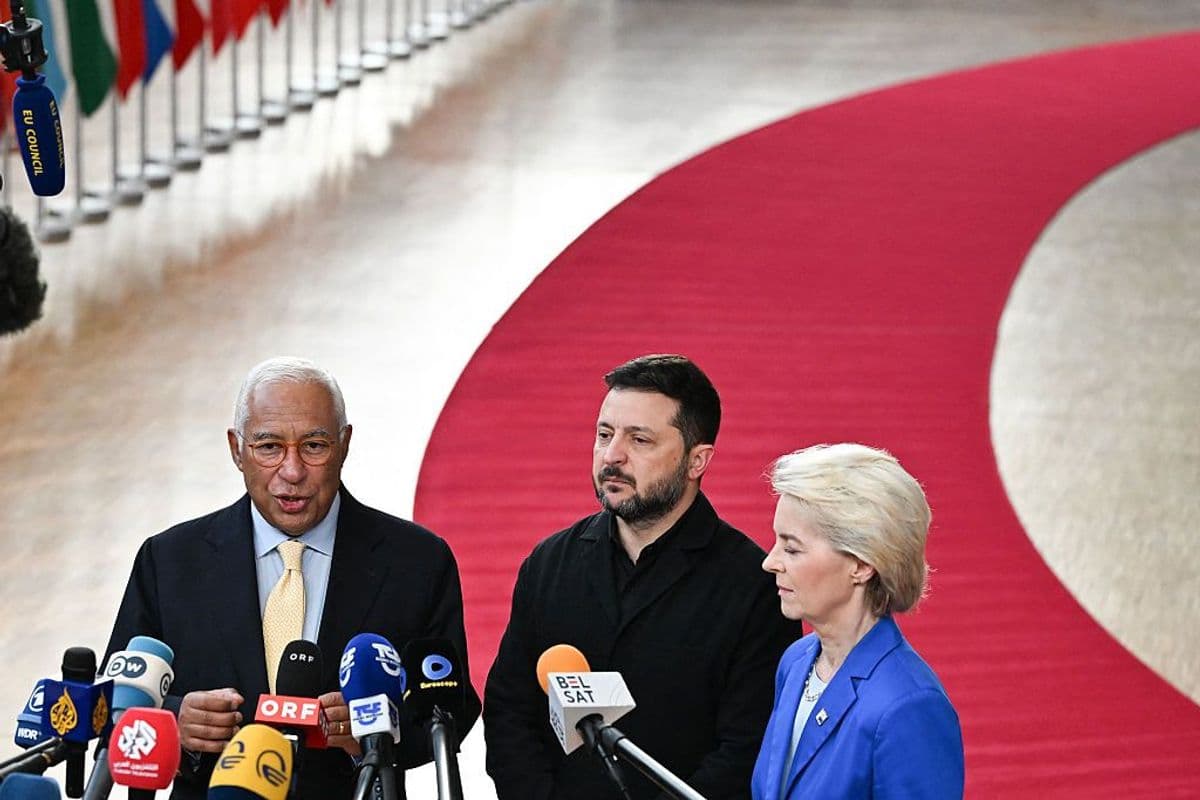
(From L) European Council President Antonio Costa, President Volodymyr Zelensky and European Commission President Ursula von der Leyen speak to the press upon arriving to attend an EU summit in Brussels on Oct. 16, 2026. (Nicolas Tucat / AFP via Getty Images)
 on Google
BRUSSELS, Belgium — The European Commission is set to propose an additional 45 billion euros ($49.5 billion) in loans to Ukraine in 2027, and legal tweaks to unlock billions more from other countries, according to a draft document seen by the Kyiv Independent on Nov. 17.
The draft proposal, set to be presented on Nov. 18, comes after President Volodymyr Zelensky revealed in October that Ukraine would have a 70 billion-euro ($77 billion) shortfall in 2027 alone and called on the EU to help.
The Commission proposes to generate 45 billion euros in loans "guaranteed by the EU budget headroom," reads the draft document. The new proposal would then be put forward for discussion and approval by EU member states.
"Ukraine would only repay once it receives reparations from Russia," reads the draft document, the same condition as applied to the previously approved 90 billion euro ($99 billion) loan, which is partway through being disbursed.
As with the previous loan, the proposal suggests dividing the 45 billion euros into three funding pipelines.
The largest share, 25 billion euros ($27.5 billion), would fund defense industry capacity in Ukraine and be handed out in return for Ukraine submitting product schedules, essentially shopping lists of what it wants to buy.
As with the 90 billion-euro loan, EU and Ukrainian manufacturers would be prioritized, but an agile approval mechanism would be retained to allow third-country purchases when needed.
Ukraine has already used this mechanism to get exemptions for cheap Chinese drone components and U.S.-made PAC-3 Patriot interceptor missiles, where European producers are not able to provide viable alternatives at the speed and scale required.
The remaining 20 billion euros ($22 billion), as per the draft document, will be split equally between two buckets that pay Ukraine in exchange for implementing EU and IMF reforms: "Macro-Financial Assistance" and the "Ukraine Facility."
But that still leaves 25 billion euros of Zelensky's originally projected shortfall unaccounted for.
Incentivize the allies
Throughout 2026, the European Commission reiterated that the 90 billion-euro loan was designed to cover only two-thirds of Ukraine's needs and that third countries need to step up.
Few did.
To avoid the same pitfall, the Commission's proposal suggests changes to two laws to make it easier for allies to increase their support for Ukraine.
One change involves amending the Ukraine Facility, the pot of money that rewards Kyiv for passing reforms required to become an EU member, so that "third countries of high credit quality … provide irrevocable, unconditional, and on-demand financial guarantees" to the EU.
Those guarantees could unlock 5 billion euros ($5.5 billion) for the Ukraine Facility, on top of the 10 billion euros ($11 billion) proposed by the EU, the document reads.
The proposal also envisages that those countries would help pay the interest on the debt with an "appropriate contribution."
Norway has already contributed to the Ukraine Facility, suggesting there might be appetite for other countries to opt in to this plan.
The second proposal involves amending a law to "support G7 members in providing new loans to Ukraine," which the document calls "second generation ERA loans."
The first generation of ERA loans was agreed in October 2024 and made $50 billion available to Ukraine, with the loans serviced and repaid using profits generated by Russian immobilized state assets.
Per the Commission proposal, "such new loans would be repaid from future flows of extraordinary revenues stemming from the immobilization of Russian sovereign assets … once the initially supported loans have been paid."
But the document does not predict exactly how much new money that idea would unlock.
The catch
The Commission's proposal is an attempt to square a circle, which, as Russia's war drags on, is increasingly hard to do in a pain-free way.
The document acknowledges that "the mobilization of additional significant resources by Member States to be able to finance Ukraine would constitute an important economic challenge."
The costs of bolstering defense spending, maintaining support for Ukraine, hastening the switch to renewable energy, and servicing welfare states in aging countries are all contributing to budget strain across the EU.
All but four EU countries are projected to have budget deficits in 2027 according to economic forecasts published on Nov. 17.
Belgium's coalition government is on the brink of collapse as it struggles to reach a compromise on how to turn around its financial situation.

And countries on the Eastern Flank have been saying they should receive more EU support in the next budget because they shoulder a disproportionate share of the burden of defending the bloc and policing its borders.
"It is appropriate to develop an innovative solution that is not expected to place a financial burden on either Ukraine or Member States," reads the draft Commission document.
But the draft regulation also foresees the EU paying down the costs of the new 45 billion-euro loan, just as it does for the already approved 90 billion-euro loan, using the "headroom" of the EU budget.
EU countries are still negotiating the bloc's next seven-year budget (for 2028-2034). As it stands, it includes a proposed 89 billion euros ($98 billion) in support for Ukraine.
That figure is not enough to cover Ukraine's shortfall for even one year, and the cost of servicing existing loans would be expected to significantly eat into it.
At that point, other options will need to be considered, some of them unpalatable, assuming support for Ukraine should continue.
For example, EU countries could hand over more of their tax revenue or raise taxes, both of which politicians will be reluctant to do, as many EU countries are set to hold elections in 2027.
The bloc could revisit the appropriation of over 200 billion euros ($220 billion) in Russian state assets held within the EU, a move opposed by several countries, most notably Belgium, when it was floated in December 2025.
Representatives of several EU countries have told the Kyiv Independent that there is still no appetite to revisit the topic, and that the underlying issues remain the same, despite efforts by EU lawmakers and several countries to relaunch the idea.
Other ideas could yet gain traction, such as the Windfall Optimization Loan Framework (WOLF), which promises to maximize profits from Russian assets without changing their legal status.
But so far EU countries have not grappled seriously with that or other ideas.
The first chance for EU leaders to discuss the Commission's proposal and how to finance Ukraine for the long haul will be at a meeting of the European Council in Brussels, scheduled for Nov. 26-27.
Hopes are high that agreement on funding Ukraine for 2027 and the next EU budget as a whole can be reached in time for the final EU leaders' meeting of the year, scheduled for Dec. 17-18.
Note from the author:
Hi, this is Chris Powers. Thanks for reading this article. The EU is a famously complicated beast to understand, but for Ukraine, it has also never been as important.
Whether it's Russia sanctions, fighting corruption, or the process of joining the EU itself, many Kyivan roads eventually pass through Brussels.
If you like reading about these fiendishly complex topics and want to support journalists in Kyiv and Brussels to shine a light on it all, please consider supporting The Kyiv Independent.