'We were finally seeing changes' — Ukrainian soldiers, veterans condemn Zelensky’s dismissal of Fedorov
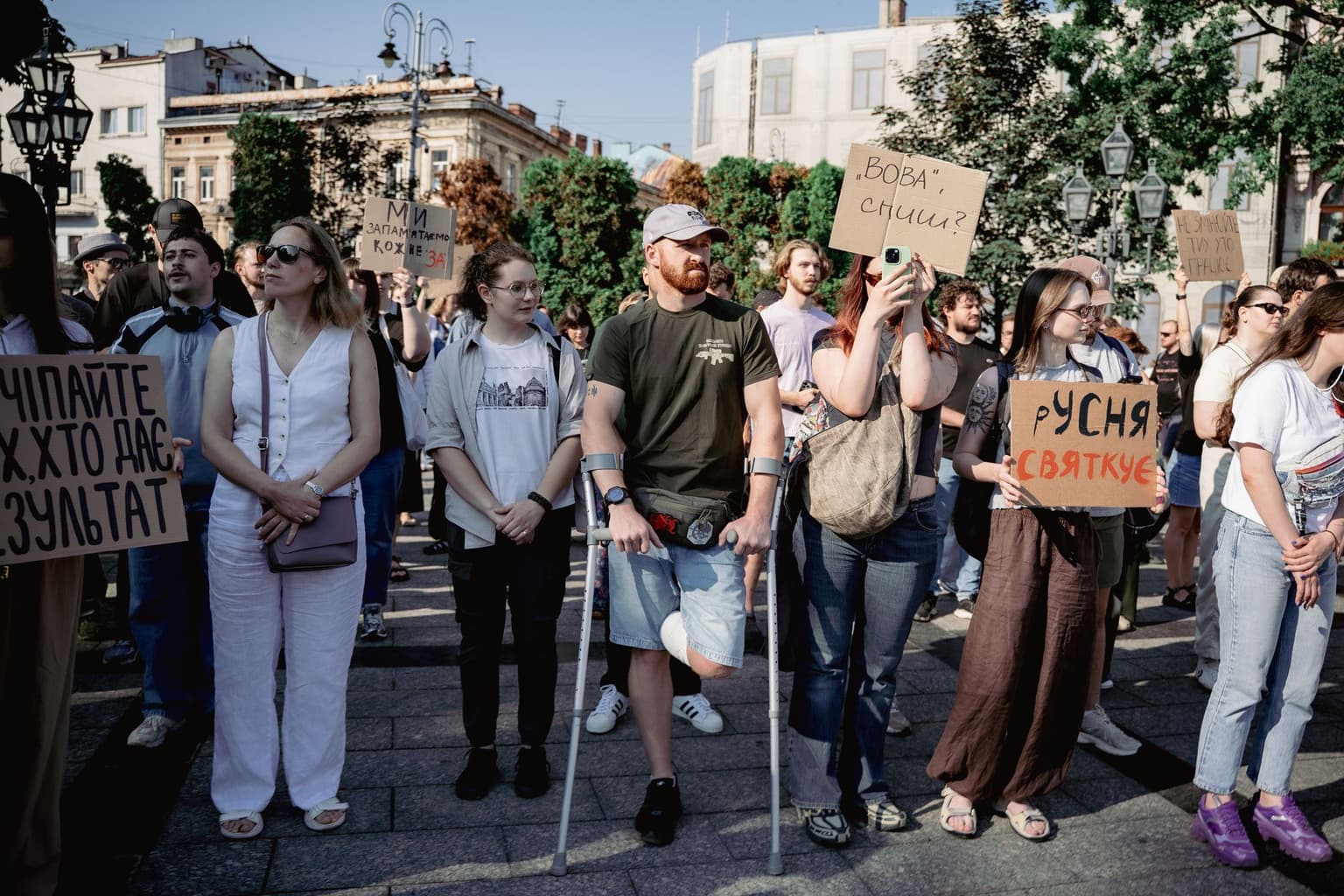
Protesters hold posters during a rally against the dismissal of Defense Minister Mykhailo Fedorov in Lviv, Ukraine, on July 16, 2026. (Maria Derhachova / Global Images Ukraine / Getty Images)
 on Google
"It's demoralizing," former soldier Bohdan said as he stood amid thousands of others in Kyiv on July 16 protesting outside the President's Office against the dismissal of Defense Minister Mykhailo Fedorov.
"People had hope that reforms were coming, that things were finally changing for the better. They were already beginning to happen. Now it feels like everything is going back to the way it was," the 29-year-old told the Kyiv Independent.
President Volodymyr Zelensky's decision a day earlier to dismiss Fedorov from his role was met with outrage across Ukrainian society, but nowhere was it felt more keenly than among those in Ukraine's military.

"I was f**king shocked," Bohdan said, describing the moment he heard the news.
He and other former and serving members of the military at the protest pointed to improvements in drone procurement, digital communications, personnel reforms, anti-corruption efforts, and a shift away from what they described as Soviet-style command culture. All requested to be identified by first name or callsign only.
"I've been serving since the beginning of the full-scale invasion," Dmytro, a 37-year-old serviceman in a drone unit who declined to identify his brigade, told the Kyiv Independent.
"I saw what our army was like under (former Commander-in-Chief Valerii) Zaluzhnyi. After he was replaced by (Commander-in-Chief) Oleksandr Syrskyi, we began feeling the difference within two or three months," Dmytro said.
"The 'meat grinder' tactics started coming back, along with the old Soviet mentality."

Dmytro said Fedorov's appointment marked the first meaningful effort to reverse those practices.
"Everyone saw the reforms. A lot of people tried to put obstacles in his way, but he was making them work. The results are there."
Dmytro credited Fedorov for a long-awaited military service reform package that introduced new contracts and simplified the process for soldiers returning after going absent without leave (AWOL), while also making it easier in some cases to transfer between units.
"I'd submitted close to twenty transfer requests, but every one of them was rejected," Dmytro said. "This reform finally gave me a way to transfer to the unit I'd wanted to join for a year."
"There'll be a lot of resentment," he added. "The reforms had only just started producing results."
Another active-duty serviceman, 42-year-old Denys, who said he has served in combat roles for nearly four and a half years, argued that the army "needs reforms, not another change of ministers."
Among the changes he credited to Fedorov were expanded access to Starlink terminals, improved secure battlefield communications, greater emphasis on drone procurement, preparations to reform Ukraine's territorial recruitment centers, and proposals to introduce fixed terms of military service.
"Right now many civilians think that once you join the army, your civilian life is over forever because nobody can even tell you, on paper, when your service might end," Denys said. "That uncertainty is a huge barrier."
He also argued that the military continues to suffer from entrenched command structures that have remained largely unchanged throughout the war.
"The same old people remain in charge," he said. "Nobody is replacing them."
Several interviewees said they feared those reforms would stall under Ihor Klymenko, the interior minister and former chief of Ukraine's National Police, whom Zelensky has nominated to replace Fedorov as defense minister.
"I have no trust in the police," said Serhii, a 43-year-old veteran protesting alongside active-duty soldiers. "The military needs reform. Innovation."
Serhii argued that Fedorov had accomplished "more in six months than others did in three years," pointing to what he viewed as a greater emphasis on innovation and battlefield technology.
"Our generals are used to solving everything by throwing people at the problem," he said. "But generals should be using technology, not people. Tanks don't operate the way they used to anymore. Drones are what matter now."
Bohdan said he continues to speak regularly with soldiers still serving.
"I think corruption will grow again," he said. "He was fighting corruption. If that stops, more money will disappear and fewer drones will reach the military."
Others said the protest had become about more than one minister. For them, it was about defending reforms they feared could disappear with him.


Oleksandr, 66, a veteran of the 136th Territorial Defense Battalion, said he deliberately put his military uniform back on for the demonstration even though he no longer serves.
"I know many comrades at the front," Oleksandr said. "They write to me before going into position, saying they'd rather be here in Kyiv protesting. Many of them actually came today."
He said he never expected to wear the uniform again.
"I didn't think I'd ever need to put it back on," he said. "My wife cries every time she sees me in uniform. For her, it's a trauma."
In a post on Facebook, Major General Mykhailo Drapatyi, commander of the Joint Forces and one of Ukraine's most respected commanders, echoed the protestors' concerns.
"The army needs change, but without justice, no change will have meaning for the people who carry this war on their shoulders every day," he said.
"We need to think about the country more," said a 51-year-old active-duty serviceman known by the call sign "Architect," who drove six hours from his position to attend the protest.
"That's what makes us stronger. That's what leads us to victory."