Long-awaited military reform falls short as troops express continued frustration
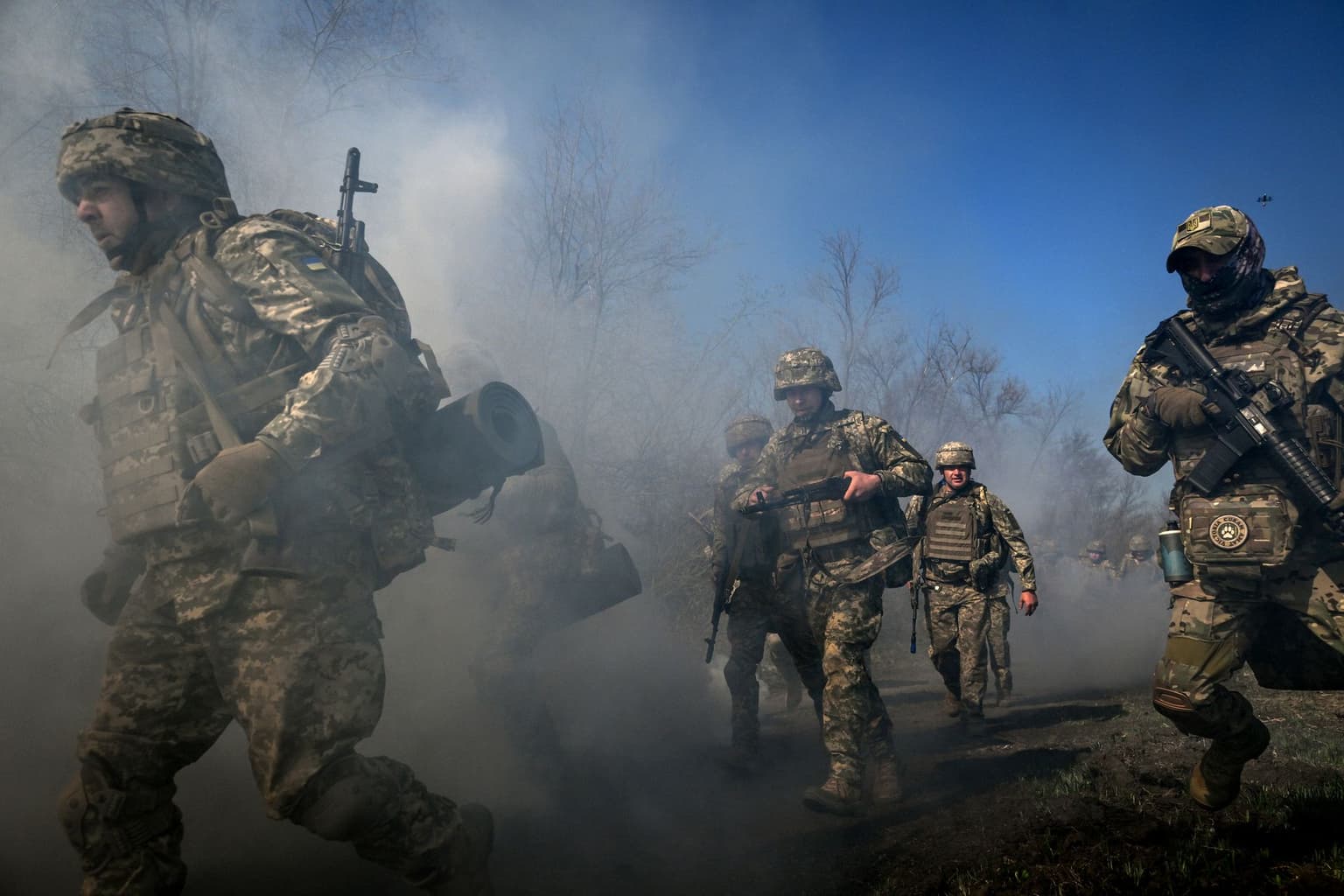
Recruits during a military training at the 118th Separate Mechanized Brigade of the Ukrainian Armed Forces in an undisclosed location, Ukraine, on April 5, 2026. (Dmytro Smolienko / Ukrinform / NurPhoto / Getty Images)
 on Google
Editor's note: Some military personnel are identified by their first names only due to security considerations.
More than four years into the full-scale invasion, the first phase of the Defense Ministry's military reform was meant to deliver long-awaited changes. Instead, it has triggered a fresh wave of frustration among soldiers.
Defining clear terms of military service has been one of the most contentious unresolved issues of the war — one that three defense ministers failed to tackle, and that ultimately landed on the desk of Mykhailo Fedorov, who took office in January.
Nearly six months later, the ministry unveiled its much-anticipated reform package, introducing new contracts, higher pay, and a simplified process for returning to service after going absent without leave (AWOL), among other changes.
But it failed to address the most important issue — the hardship faced by troops who have been serving since early 2022, and in some cases, long before that. Among the key grievances are uncertainty about the future, low pay for troops serving in rear areas, and the lack of mechanisms to protect personnel from poor service conditions within their units.
"It very much looks as though those who remain in the army are having the screws tightened even further, and the longer they stay, the worse their conditions become compared with newcomers," Oleksandr, a drone operator, told the Kyiv Independent.
Choices on paper
The Ukrainian government attempted to introduce fixed terms of service more than two years ago, but the provision was removed when the updated mobilization law was adopted. At the time, lawmakers argued that the measure was not feasible under martial law.
"The truth is that the only thing that has changed over these two years is public attitudes toward mobilization," Inna Sovsun, a lawmaker from the "Holos" party, said on Facebook.
"As a result, we are now entering the discussion on terms of service under significantly worse conditions," she said, adding that fewer people are willing to join the military, while the number of those temporarily exempt from service has increased.
But postponing the reform was no longer an option.
As part of the initiative, the Defense Ministry has introduced three new types of contracts — infantry-assault, combat, and basic — intended to establish clear terms of service and provide at least a six-month deferment from military service. A deferment exempts a conscript from military service for a set period. After it expires, they must rejoin the army if they receive a draft notice. All service members are eligible to sign the new contracts, except those who are AWOL or already serving under a program for 18- to 24-year-olds.


The contracts run for six, 10, 14, or 24 months, with pay varying by position and conditions of service. Monthly compensation increases with proximity to the front lines and mission risk.
Deputy Defense Minister Mstyslav Banik said during a press conference on June 15 that those who do not sign the new contracts will serve until demobilization, effectively until the end of the war, with no guarantee of a near-term deferment.
At the same time, long-serving troops will not receive preferential treatment, aside from a limited concession: some categories of former and current service members will be able to sign six-month and 10-month contracts, while recruits will be required to sign for at least 14 months.
Bohdan Mykolaichuk has been in the Ukrainian army since 2022, including more than a year on the front lines in the eastern Donbas region. He is now a rear-area officer and, despite his combat experience, must sign a two-year contract under the new system to remain in the role and gain clarity on when his military commitment could end.
Speaking to the Kyiv Independent, Mykolaichuk said the Defense Ministry had not communicated the details of the reform clearly enough, particularly regarding deferments, and that he is awaiting further clarification and the adoption of additional regulations.
According to the Defense Ministry's latest statements, service members who sign the new contracts will be entitled to a minimum six-month deferment over the contract period. This may reportedly be extended depending on changes in service conditions. Yet for each year of service through June 2026, service members will receive only one month of deferment, regardless of whether their role was combat-related or not.
Under the new terms, if Mykolaichuk signs a new contract, he will receive about one year of deferment in exchange for six years of service.
"This is unfair to those who have been in service for a long time," Mykolaichuk said. "In my opinion, the main criterion (for creating the new contracts) should have been length of service and the amount of time spent in combat."
"We can't release everyone who has been fighting since 2022 at once, or the front line would simply collapse."

Mykolaichuk added that a minimum six-month deferment is insufficient, leaving little time to adjust to civilian life or find employment. Soldiers interviewed by the Kyiv Independent also raised concerns that employers have little incentive to hire someone who could be called back into military service within months.
Yet in an effort to "ensure fairness for those who have served the longest in the armed forces," the Defense Ministry said it would also begin the gradual discharge of troops who have served since 2022 or earlier by the end of the year. Fedorov later clarified in a June 16 interview with TSN that the process would begin in late autumn and that a presidential decree on discharge from the armed forces would "take precedence" over previously signed contracts.
Fedorov also said the gradual process of releasing personnel from the army would depend on the situation on the front line.
"We can't release everyone who has been fighting since 2022 at once, or the front line would simply collapse," Fedorov said.
"They are the backbone of our army and are shouldering the war effort, but they should not be left trapped in the system."
Mykolaichuk described the prospect of discharge by presidential decree as "fleeting," saying it remains unclear how the mechanism will work or who would take the place of those being discharged.
Still unclear is who will fill the ranks of those gradually leaving the military, among them many experienced soldiers who joined in the early days of the war to defend their homes.
The Defense Ministry has outlined an ambitious plan to open a "recruitment market" to foreign fighters, to have foreigners make up 50% of Ukraine's infantry and assault units, selected through private military companies.
Whether this will be enough to offset the existing personnel shortage remains to be seen, as does the impact the departure of experienced service members will have on the front lines.
"It seems they are trying to bring people into the infantry, but it is not that simple," Yevhen, an infantry soldier, told the Kyiv Independent. "If we let go of experienced personnel, they cannot simply be replaced with recruits."
The reform also seeks to encourage AWOL service members to return by simplifying the process, while boosting troop numbers by bringing back experienced personnel who left due to dissatisfaction with previous service conditions.
Under Ukrainian law, going AWOL or deserting during martial law carries prison sentences of five to 10 years and five to 12 years, respectively. The new procedure does not eliminate criminal liability. Only those who went AWOL or deserted for the first time are exempt from prosecution, while repeat offenders remain subject to criminal penalties.
At the same time, service members who went AWOL before June 12, 2026, will be allowed to choose a new unit in which to resume service, rather than being assigned to reserve battalions.
Oleksii, a chief sergeant in a drone unit, told the Kyiv Independent that the biggest obstacle to returning from AWOL is the bureaucracy. Service members seeking to transfer to a new unit can spend "months" waiting for paperwork from their previous place of service, he added.
While the reform appears to address some of these issues on paper, Oleksii remains skeptical. The Defense Ministry has yet to clarify what will happen to service members whose cases are still being processed under the previous system.
As part of the reform, service members may be allowed to transfer once a year without their commander's approval, a change also intended to reduce the number of AWOL cases. The initiative is currently being piloted in two corps and applies only to non-officer personnel.
Deputy Defense Minister Banik said on June 15 that 88 people had applied to return from AWOL under the new system during the first days of the reform's implementation. The figure contrasts with an earlier estimate by Fedorov, who said on Jan. 14 that around 200,000 people were AWOL.
Raise that excludes many
Another key component of the reform is a substantial increase in military pay. Under the new initiative, all service members will be eligible for higher monthly pay and additional cash bonuses for completing combat missions, regardless of whether they sign a new contract.
The reform introduces a "mission control" system for infantry and assault troops to verify their presence at assigned positions and document completed combat missions for bonus payments. A similar system was previously introduced for drone operators.
Yet units continue to rely on paper logs to record combat sorties, and without a digital record-keeping system, it remains unclear how efficiently the data can be transferred and processed. In addition, compensation claims must be supported by video evidence of mission completion, which is often impossible to obtain under the combat conditions faced by infantry.

Soldiers interviewed by the Kyiv Independent also said the distribution of compensation remains uneven.
According to Defense Ministry estimates, frontline troops, particularly infantry and assault personnel, will earn an average of around Hr 300,000 ($6,700) per month, including base pay and bonuses. Monthly compensation will be capped at Hr 460,000 ($10,200).
The Defense Ministry claimed the increase will make Ukrainian infantry among the highest-paid soldiers in the world.
At the same time, debate continues over the pay structure for service members serving away from the contact line.
Personnel in rear-area positions will receive at least Hr 30,000 ($660) per month, compared with Hr 50,000 ($1,100) for those in front-line logistics and support roles, Hr 70,000 ($1,540) for personnel at command posts, and Hr 120,000 ($2,600) for troops in combat roles, including drone operators, artillery crews, electronic warfare specialists, and others, according to the reform.
Serhii, a chief sergeant in an assault regiment, told the Kyiv Independent that the new pay structure is unfair to service members who have been wounded and can no longer carry out combat missions but continue serving in rear-area roles.
Serhii added that military salaries should not be determined solely by whether a service member is stationed at the front or in the rear.
"You can't assess a person's contribution solely based on whether they serve on the front line or in the rear," he said. "Specialists in unmanned aerial vehicles (UAVs), electronic warfare, communications, and other critical fields also perform essential work and, in my opinion, should be compensated fairly."


Oleksii, the chief sergeant in a drone unit, echoed those concerns, arguing that military personnel often have to spend their own money to perform their duties.
He said soldiers frequently pay out of pocket for fuel to travel along the front line, rent housing, and cover certain unit expenses, including repairs and the purchase of essential supplies or equipment.
As a result, even soldiers stationed away from direct combat positions often spend a significant portion of their income on service-related expenses rather than personal needs, Oleksii added.
"As a result, if you have a family, you're essentially cut off from social life because you simply don't have the resources to maintain it," Oleksii said.
Responding to criticism over pay for personnel serving far from the front lines, Banik said on June 15 that the ministry would like to increase payments but is constrained by available resources.
The new payments were scheduled to take effect on June 1, but their implementation could be delayed because the necessary departmental orders have not yet been issued to military units, the "Pryncyp" human rights center for military personnel said on June 23.
What comes next?
Launching the first phase of the reform cost the Defense Ministry approximately 60 billion hryvnia ($1.3 billion).
In a June 17 interview with Pressing, Fedorov said the funds were secured through cost optimization and savings. The minister added that Ukraine expects to secure the support of its international partners in 2026 to eventually raise at least $60 billion in financial assistance, with some countries already including the funding in their 2026–2027 budget plans.
Iryna Friz, a member of the national security, defense, and intelligence committee in Ukraine's parliament, expressed concerns about the sustainability of the military pay proposed under the Defense Ministry's initiative, as the ministry has yet to present a plan to the committee for how the expenditures will be financed.
Friz also said the biggest challenge to implementing the reform is the lack of a sufficient legal framework, as the Defense Ministry's recent regulations governing the new payments and return-from-AWOL procedures are designated as a "pilot project" and not fully aligned with the current law on military service.
"The longer this process drags on, the harder it will be to explain — both to those who will be signing contracts and to those returning from AWOL — how the state will continue to fulfill its obligations to them, and to what extent those obligations will be reliable and consistent," Friz told the Kyiv Independent.

"Unfortunately, instead of presenting a package of bills that would enshrine all these changes, the minister and the government have effectively bypassed parliament's involvement in the matter, attempting to circumvent legislative amendments by adopting experimental regulations."
Friz expressed hope that the ministry, under Fedorov's leadership, would introduce legislative changes to ensure the reform can take hold, while noting concerns that this may not be the only obstacle.
"The Defense Ministry has repeatedly demonstrated its willingness to remain a closed, conservative institution with a rigid vertical chain of command, and has thwarted many ministers, preventing them from carrying out the sometimes quite ambitious list of tasks they had publicly set for themselves or that society demanded of them."
Francis Farrell has contributed to this report.
Author's note:
Hi, this is Kateryna, the author of this article. Thank you for taking the time to read it. I believe a strong army depends on the well-being of both active-duty service members and veterans, which is why I focus on sometimes complex topics like this — military reforms in Ukraine. If you would like to support us, please consider joining our community.