Justice for the crime of aggression — the Special Tribunal must put Ukrainian victims center stage
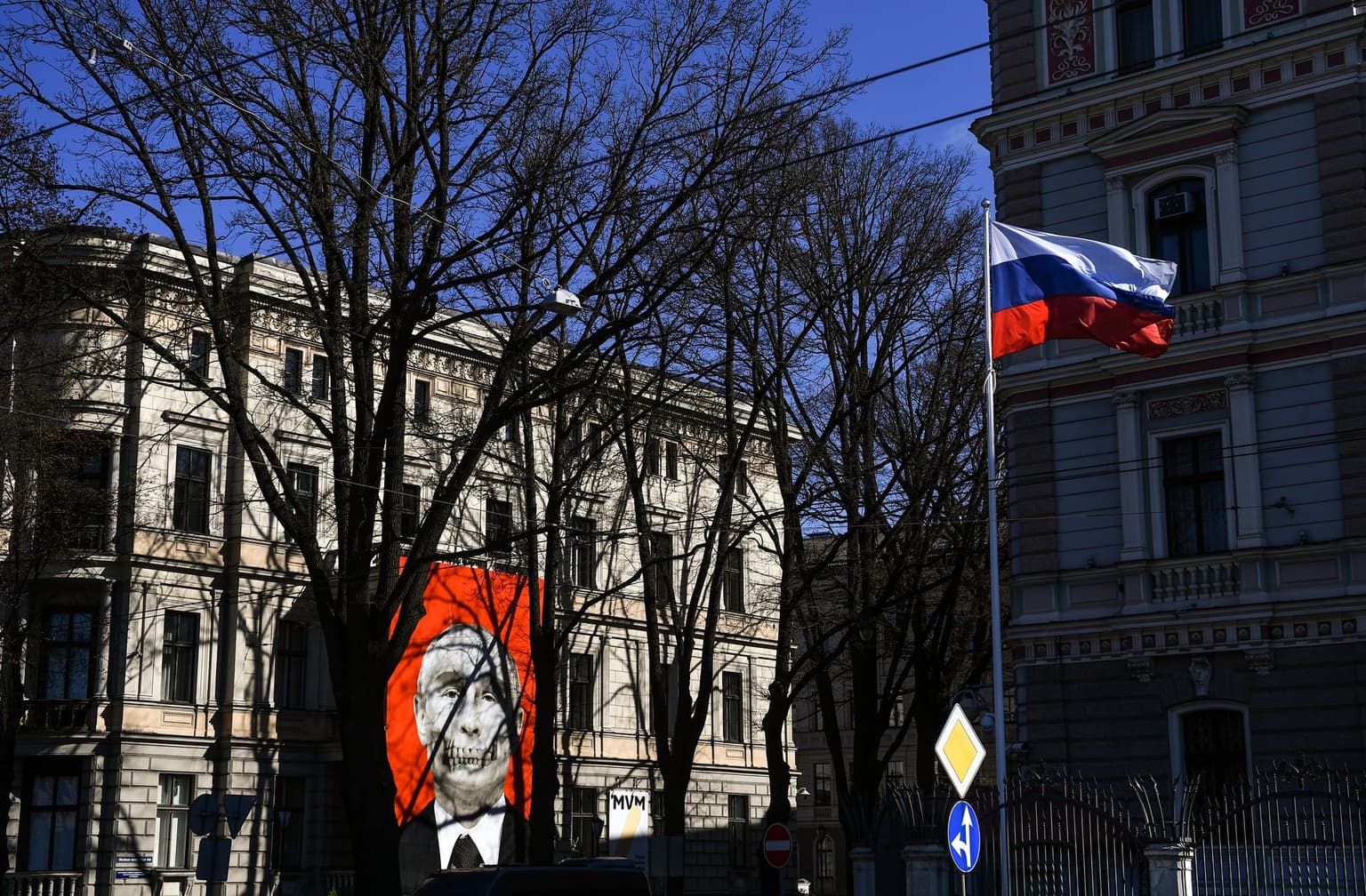
A banner depicting Russian President Vladimir Putin, protesting against the war in Ukraine hangs fron a building near the the Embassy of Russia, in Riga, Latvia. (Ramsey Cardy/Sportsfile via Getty Images)
 on Google
Daniil Ukhorskiy
Ukraine program manager at Legal Action Worldwide (LAW)
After four years of brutal, all-out war in Ukraine, the Council of Europe met on May 15 to establish a long-awaited pillar of accountability: the Special Tribunal for the Crime of Aggression against Ukraine (The Tribunal).
The Tribunal fills an important gap. The International Criminal Court lacks jurisdiction for aggression — what judges at Nuremberg called the "supreme international crime." It seeks to hold the architects of Russia's invasion of Ukraine, most senior Russian officials, accountable for initiating the invasion of Ukraine, first in 2014, then in 2022 on a massive scale.
After years of political disagreement on the Tribunal's format, it may be years more before we see a Russian suspect in custody, and for now, trials may proceed "in absentia" — without a defendant present.
For the Tribunal's critics, in absentia trials are an expensive waste of time and a distraction from more promising justice avenues elsewhere.
We believe that justice for the crime of aggression is non-negotiable. The Tribunal can still deliver justice to millions — but the Council of Europe must ensure that Ukrainian victims, their stories and their suffering, are central to every stage of the process.
The empty dock problem
Putin and his cronies seldom leave Russia, traveling only to safe havens where arrest is impossible. As such, for the foreseeable future, any trials at the Tribunal will unfold with empty docks. Are expensive, long-running trials without a perpetrator present worth the financial and political costs?
The Special Tribunal for Lebanon (STL), founded in 2009 with support from the UN Security Council to prosecute those involved in a terror attack that killed over 20 people, including Prime Minister Rafic Hariri, was the only international tribunal since Nuremberg to hold in absentia trials. In 15 years, it spent a billion dollars, delivered three convictions, and never caught a fugitive.
For veterans of national and international criminal tribunals, apprehending the suspect is the apex of criminal justice. Anything that falls short is viewed as a failure.
Through Legal Action Worldwide's (LAW) decade of engagement with victims and survivors/ who are the intended beneficiaries of all this work, we have learned that this is a drastic oversimplification.

More than a jail cell
Victims and survivors have told us firsthand that they feel empowered by engagement with a wide range of judicial processes.
Following the 2017 Myanmar military's genocidal "clearance operations," LAW has been representing hundreds of Rohingya survivors, including many who suffered horrific sexual violence, in their quest for justice and accountability.
After nine years of fighting for justice, survivors and witnesses traveled to the International Court of Justice ICJ in January 2026 for the full merits hearing, represented by LAW. Unusually, ICJ Judges allowed and heard direct testimony for survivors and witnesses of genocide in a closed courtroom.
"We never thought Rohingya women would hold Myanmar's military accountable," one of the survivors who was present at the January hearing told us.
The ICJ is expected to deliver its final judgment later this year. Rohingya witnesses who testified in court, victims who attended the hearings, and the broader community back in the refugee camps in Bangladesh were unanimous; Having community members participating in the ICJ proceeding was essential for the recognition of what happened to them and a decisive step towards accountability.
Why should it be different for Ukraine? Having Rohingya witnesses giving first-hand testimonies of the atrocities they lived might have paved the way for more systematic inclusion of victims' voices at the world court, and beyond. Even if perpetrators are not present in Court.
Using a wide range of tools and looking beyond traditional criminal justice is essential in situations of mass atrocities. In Ukraine, as in Myanmar, there are thousands, if not millions, of victims. No single mechanism can deliver justice for all. Catching even a hundred criminals is not enough. In absentia proceedings at the Special Tribunal are one part of a larger justice landscape.
First, victims will have their day in court. Where aggressors sought to silence them, the trial will give them a voice. Ukraine has already held hundreds of such in absentia trials.
Even in the absence of a defendant, criminal proceedings signal society's condemnation, establish a historical record, and uphold the rule of law. As the maxim goes, "justice must be seen to be done." This is doubly true for the Tribunal, acting globally on behalf of at least 36 states.
The value of in absentia cases at the Tribunal is therefore more than symbolic — the process can start to empower victims today, without waiting decades for arrests. Each verdict will stand as a judicial record of Russia's responsibility for the supreme international crime.
Putting theory into practice
Given the limitations of in absentia proceedings, the Tribunal must ensure broad and meaningful engagement with Ukrainian victims and survivors, putting into practice its provisions on group representation from day one.
First, the Tribunal must avoid pitting Ukrainians against one another in a hierarchy of suffering. Allowing claims from 2014 onwards avoids a pitfall that civil society has criticized in other mechanisms. The Tribunal should take the same approach to the harms suffered.
Second, the Tribunal can expand access to justice to victims with otherwise limited recourse. Soldiers are legitimate military targets under the laws of war, meaning Ukrainian soldiers killed or wounded by Russian aggression have limited avenues for justice.
LAW challenged this paradigm through a complaint to the UN Human Rights Committee, arguing that Russia violates the right to life of all those killed by its aggression. The Tribunal should embrace this notion and emphasize that Ukraine's defenders — killed, wounded, and captured — are victims of Russian aggression.
The Tribunal could also extend justice to millions of displaced Ukrainians. Most were not evicted from their homes at gunpoint but forced to flee as Russian bombs crept closer. Many are not victims of a war crime, but they are undeniably victims of Russia's aggression, having lost their homes, perhaps forever.
To ensure full representation, the Tribunal must consult widely with Ukrainian civil society groups and victims and survivors themselves to grasp the scale and nuances of its task.
Third, the Tribunal must make investigations and ensure that courts are a safe place for the most vulnerable, such as children and survivors of sexual violence. The Tribunal can build on decades of experience at the ICC and other international tribunals, which have developed extensive guidance on a survivor-centered approach to proceedings.
The formalization of the Tribunal this week is rightly celebrated as an important step in holding Russia accountable for aggression. To succeed, the Council of Europe and all Member States must put Ukrainian victims center stage as the Tribunal becomes operational.
Editor's note: The opinions expressed in the op-ed section are those of the authors and do not purport to reflect the views of the Kyiv Independent.