Inside the Ukrainian military's fight to motivate new recruits
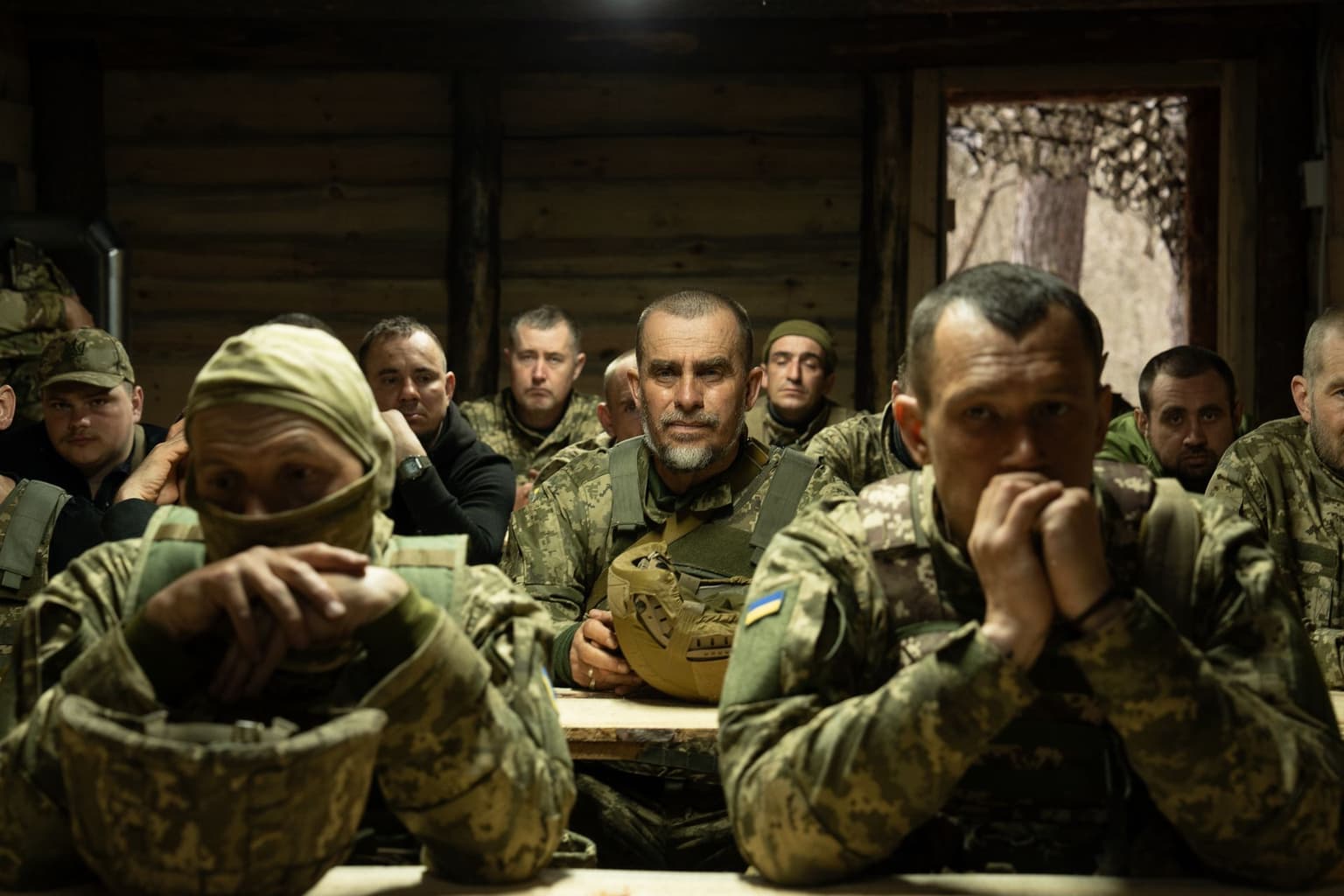
Recruits from Ukraine's 66th Mechanized Brigade attend a briefing led by the unit's psychological support service representative in Kharkiv Oblast, Ukraine, on April 2, 2026. (Patryk Jaracz / The Kyiv Independent)
 on Google
KHARKIV OBLAST — New recruits walk into a small, overcrowded log-framed tent, taking their place in the line for lunch to fuel up for the long day of training ahead. The line ends at two large steaming pots: one filled with potato-and-bean soup, the other with sausages.
Laughter and chatter from those who arrived early enough to be the first to eat bring warmth to what could otherwise be a bleak atmosphere. The recruits would soon be deployed to the front, many of them about to face the harshest conditions as infantry for the first time in their lives.
Here, in a secluded forest not far from the front, a few dozen recruits are undergoing an additional two-week training program after finishing boot camp and arriving at their unit, the 66th Mechanized Brigade. The "adaptation period," implemented across the Ukrainian military, is designed to supplement what new soldiers learned in basic training and to give them time to get to know their commanders and comrades before their first mission.
The officers are trying to cram as much knowledge as possible into the "adaptation period" to increase their chances of survival, amid a challenging battle to motivate the recruits, who are increasingly older, have health complications, and only want to go home.
The recruits had already completed half of the day's training on radio communications and on how to find coverage in the current drone-dominated phase of the war.
More than four years since Russia launched its full-scale invasion of Ukraine, the majority of Ukraine's recruits were drafted to serve in the military, with the lack of motivation being an issue, especially if, in some cases, they were violently grabbed off the streets.
The recruits in the 66th Brigade are no different. Trying to get recruits to change their mentality and understand the importance of defending their country is difficult, particularly when working with full-grown adults, many of them well past middle age, according to the officers.

"If a person hasn't come on their own, motivated, it's very difficult to change them in such a short period of time," Ihor, the chief sergeant of a battalion in the 66th Brigade, tells the Kyiv Independent after the recruits finish their lunch.
The new soldiers arriving generally lack motivation, especially compared to 2022, when the war had just begun, and the military was full of highly driven individuals from top to bottom, always ready to head out to the front, according to Ihor, who goes by his callsign "Yeger." Trying to train soldiers who are not driven to learn is extremely difficult, commanders across multiple units told the Kyiv Independent.
"Now, the soldiers are not as motivated, but we are doing everything we can to boost their motivation," Ihor, who has fought in the brigade since its formation in 2022, says.
Helping the recruits gain their confidence in the fight while also being honest with them about the brutality of the war, such as by recounting tough days on the front, is crucial, Ihor says.
Recruits often lack confidence after the seven-week-long basic training, often feeling uncertain about seeing themselves as soldiers, but Ihor stresses that it was the same for officers like him at first although they began identify more closely with the military over the years.
Ensuring that units prepare recruits as much as possible to reduce avoidable casualties is important, as the Ukrainian military faces a deepening manpower shortage and is increasingly bringing in less-prepared recruits, sometimes with age-related health issues, into the Armed Forces.
"The most important thing is surviving their first (fear), and it will get easier."
Not all military units can afford to fulfill the two-week "adaptation period," as critical shortages during fierce battles, such as near Pokrovsk, may force commanders to cut down the program to as short as three days, according to Colonel Oleksandr Danyliuk, who works in the General Staff's Directorate for Doctrine and Training. He agreed that the lack of motivation is an issue across the military, but he suggested it would likely be the case in any country enduring such an intense war for more than four years.

Each training center operates differently, causing uneven preparedness among recruits when they arrive at the unit, according to Ihor. He said the goal is to identify their weaknesses, both by conducting a questionnaire and observing them on the training ground, and trying to address their unmet needs, especially since boot camp generally doesn't offer enough practical training. Danyliuk also admitted that there is a shortage of qualified boot-camp instructors with combat experience and the ability to teach recruits.
"The most important thing is surviving their first (fear), and it will get easier," Ihor says, adding that "if they are not interested, it goes in one ear and out the other."
'What's the point of going to fight for something that is already gone?'
The recruits separate into two groups of 10 soldiers after lunch: one heading into the tactical medicine course and the other to the shooting range, until they swap in two hours.
While the training schedule varies from day to day, the recruits practice tactical medicine daily to ensure they know how to save themselves and others in the event of injuries on the front lines. The intensity of Russian drones has stretched the "kill zone" to more than 20 kilometers (12 miles), making it impossible for medics to drive up to the forefront positions to treat injured soldiers. This makes tactical medical knowledge among recruits and their commanders critical to saving either themselves or the wounded.
A harsh reality awaits the recruits: About 80% of the critically wounded who could have been saved die due to the lack of evacuation, Dmytro, a medic with the 66th brigade, told the Kyiv Independent in January.
"First, you stop massive bleeding. Then you check whether the airway is clear and the person is breathing," a tactical medicine instructor tells recruits, who are sitting around him in a circle, carefully watching him pull out medical kits.

Among the recruits going through the "adaptation period" is Andrii, a 43-year-old from eastern Donetsk Oblast who was drafted on his way to work. Soldiers and officers interviewed for this story are not identified by their full names in accordance with the unit's wartime security protocols.
Andrii says it has taken a while to get used to the new conditions in the military, which are completely different from his civilian life, even though he is surrounded by others who were similarly drafted by what he jokes is "our very favorite organization," referring to the military recruitment center, or TCC.
Trying not to think too much about his fear of what the first mission could look like, Andrii is convinced that there is no point in worrying about a reality he has yet to face himself. But he says the uncertainty is the hardest part of being in the military, not knowing where or when he would be sent to the front — and how he could change afterward.
"I still don't know how I will return from there or whether I will return at all," Andrii, who spent most of his life working in the coal industry, tells the Kyiv Independent.
While Andrii usually tries to find "positives" in his life, he believes that it would be difficult to do the same on the front when Russian troops would be "trying to kill you every second," and soldiers spend month-long rotations under constant fire from artillery, mortars, and drones.
Pushing through the long training days right before his first deployment, Andrii says that having his own life at stake motivates him to increase his chance of survival so he can return to his family alive. Extensive walks have been physically tough for him, especially in the first weeks of his boot camp, when the most exercise he would do in civilian life was riding a bicycle around his hometown.

"I just don't have a choice," Andrii says. "I have one motivation: to survive and return home to my family. I don't have other motivations."
Having to flee his hometown of Bilytske, a contested village less than five kilometers (about three miles) from Russian troops, has not helped him feel motivated to defend his country, Andrii admits. Relentless Russian attacks have reduced Bilytske to ruins. He packed his life in a car and fled the village near Moscow-occupied Pokrovsk a year and a half ago, leaving behind a house and an apartment.
"I wanted to keep living (a civilian life)," Andrii says. "I mean, what's the point of going to fight for something that is already gone?"
To stop Russian attacks on hometown
Five recruits stand in a line on a shooting range, firing at 50-meter targets upon command before rotating to load their ammunition.
"Seven, eight, nine, ten," one of the recruits, 44-year-old Mykhailo, counted as he slowly loaded a magazine one by one.
Unlike most of the recruits around him, Mykhailo voluntarily decided to join the army before the New Year, as deadly Russian attacks raged across his hometown. Originally from the town of Marhanets, just across the river from the occupied Zaporizhzhia Nuclear Power Plant, his hometown faces daily bombardment from artillery and drones, leaving behind severe destruction. His wife and the younger son, aged 12, still live there despite his efforts to convince them to flee.
"I don't know, I want to do something," Mykhailo tells the Kyiv Independent on the shooting range, though he admits it has not been an easy journey since "everything was new for me."


Trying to keep his calm demeanor, Mykhailo says that it is not that he is not worried about what is ahead, but "I don't really get nervous either," explaining that agitation won't help the situation.
A part of his reasons for joining the military was a hope that he would help stop Russian attacks on his hometown, Mykhailo says. He said that training in both boot camp and the "adaptation period" is physically tough on him, as he last played sports about 20 years ago, but it doesn't compare to the psychological challenge he faces.
"There were and will be losses, but our task is to do it in such a way as to minimize losses."
Mykhailo admits that he doesn't feel fully ready and is not sure if he is shooting well, especially since he had never held a weapon before joining the army and lived half his life without one.
Ihor, the chief sergeant, assessed the recruits' shooting skills as weak but said the whole point of the "adaptation period" is to give them more hands-on training from battle-experienced instructors, especially since they work in much smaller groups than in boot camps.
Instructor Yevhenii, who goes by his callsign "Headlight," says the most important thing is for the recruits to learn to listen and follow commands. Yevhenii, who joined the army at a young age, explains that soldiers need to listen carefully to their superiors, who guide them from above by drone, not letting themselves think "in the heat of the moment" and act on emotions.

Recruits' age and prior civilian professions often determine their performance on the shooting range, with new soldiers who came from physically demanding jobs, for example, often showing better posture when carrying weapons, according to Yevhenii.
Working with unmotivated recruits who might initially complain about ending up in the army initially affected his morale, but he eventually got used to it and learned not to let it get to him, Yevhenii says.
Everything could go wrong on the front, which means that intensifying practice and building muscle memory become crucial so the body knows what to do even in a panic, according to the officers.
"Your brains turn off in combat and then turn back on when you leave the position," Ihor, the chief sergeant, says, explaining that soldiers start to operate on one thing — survival.

Returning after AWOL
On this particular April day, the recruits wrap up with a lecture from the brigade's military psychologist before heading to supper.
The military psychologist, who asked to be identified as "Black," begins the lesson by going into the unit's four-year history and the battles it fought, before reassuring the recruits that their commanders are young individuals who rose through the ranks from the infantry, far from the Soviet top-down military culture.
Black also assured recruits that they would receive vacation time to spend with their families back home. Openly talking with recruits helps improve their motivation, no matter how far they are from being driven to defend their country, and people can change their mentality, he says.
"A person who was a civilian yesterday, who was at home and only saw drones through the news, and suddenly finding themselves in a forest with other guys and is given a weapon, is of course under stress," Black, a psychological support service representative in the 66th Brigade, tells the Kyiv Independent.
"(The 'adaptation period') is for the person to adapt and feel calm and confident (in new conditions)."
Some of the recruits in the "adaptation period" are soldiers who returned from being AWOL, or absent without leave, which is spiking in the Ukrainian military due to what soldiers who fled cite as a lack of trust in the command, exhaustion, and fear of death.
Mykhailo, a 28-year-old soldier from the largely occupied Luhansk Oblast, is one of them. He enlisted in the army as soon as the full-scale war began in 2022 and barely made it back home in time to evacuate his wife and her family from his hometown near Sievierodonetsk before it fell to Russia in June of that year.

After fighting in fierce battles across Donetsk Oblast, adjacent to his native Luhansk Oblast, Mykhailo went AWOL at the beginning of 2024 along with 20 others from his company, who, he says, were told by a senior sergeant that "either go there (to the front) and never return, or go home."
For a year, Mykhailo lived with his wife in Kryvyi Rih, central-eastern Dnipropetrovsk Oblast, walking freely across the city and working to stay afloat like many other AWOL soldiers and deserters, until he decided to return to the army in 2025. He says he has long since come to terms with the loss of hope of returning to his hometown, given how difficult it has now become to advance, but he is not opposed to serving as long as the unit's command treats him well.
"You will see how things actually turn out over here," Mykhailo says, adding that "you can go crazy if you worry (before things happen)."
A plus side of the soldiers returning from AWOL is that they are usually familiar with the reality on the front and they already possess combat skills, Ihor says, even though there is always the chance they could flee again. Both AWOL and desertion are criminal offenses under Ukraine's Criminal Code, punishable by 5-12 years' imprisonment, but the Parliament passed a bill in 2024 offering an amnesty to those who voluntarily return to service after fleeing their unit for the first time during martial law.
"I'm fed up (by the war) after these four years," Mykhailo tells the Kyiv Independent. "I want to go back to my family at home, not to a trench with a rifle."
Maksym, another soldier returning from AWOL, also says he is trying not to overthink things after draft officers found him and just wants to see how the brigade treats its soldiers. The 29-year-old says he is not motivated to rejoin the army, but draft officers came to his mother's home in the southern city of Odesa, where he was staying at the time, and took him back.

Should conflicts arise in this brigade, he is ready to go AWOL again, Maksym admits. He doesn't feel ready to go back to combat, but he realizes he has no other choice for now. Maksym, who goes by his callsign "Grizzly," says he just wants to go home and return to his quiet life, spending weekends sleeping and playing video games. He worked in various civilian jobs, including in marketing and sales.
"I have no motivation, (my only wishes) are to go there and survive, return and sleep well, and a hope for the war to end," Maksym says, adding that "we understand there could be consequences, but thinking about it won't change anything."
Ihor, the chief sergeant, believes that an individual's understanding of why they need to defend their country develops in childhood and that trying to change their mindset later in life is almost impossible. Working with recruits who have varying levels of motivation for the battles ahead is difficult, but people will trust others more when they are honest and upfront, he added.
No matter how well the recruits absorb the knowledge during the "adaptation period," they would all have to go to the front, Ihor said. The 66th Brigade is currently deployed in the northern part of Donetsk Oblast, holding back a relentless Russian offensive toward Lyman.
"We are all at war, there were and will be losses, but our task is to do it in such a way as to minimize losses," psychologist Black tells recruits, wrapping up his lecture in a tent-turned-classroom decorated with the brigade's insignia, which reads "Don't stand in the way" just above a sword and an arrow crossing.

A note from the author:
Hi, this is Asami, the author of this article. Thank you for reading it until the end. The drone dominance in the current phase of the war makes the battlefield deadlier than ever, especially for the infantry. Even then, newly mobilized soldiers have to go to the front, walking 10-20 kilometers (about six to 12 miles) to reach their positions. My goal in the story was to highlight how recruits, such as the ones from the 66th Mechanized Brigade, are enduring the reality. At the Kyiv Independent, we try to shed light on all aspects of the war.
Please consider supporting our reporting, which is available without a paywall thanks to the support of our members.