Ukrainian media face pressure as they step up scrutiny of authorities in wartime
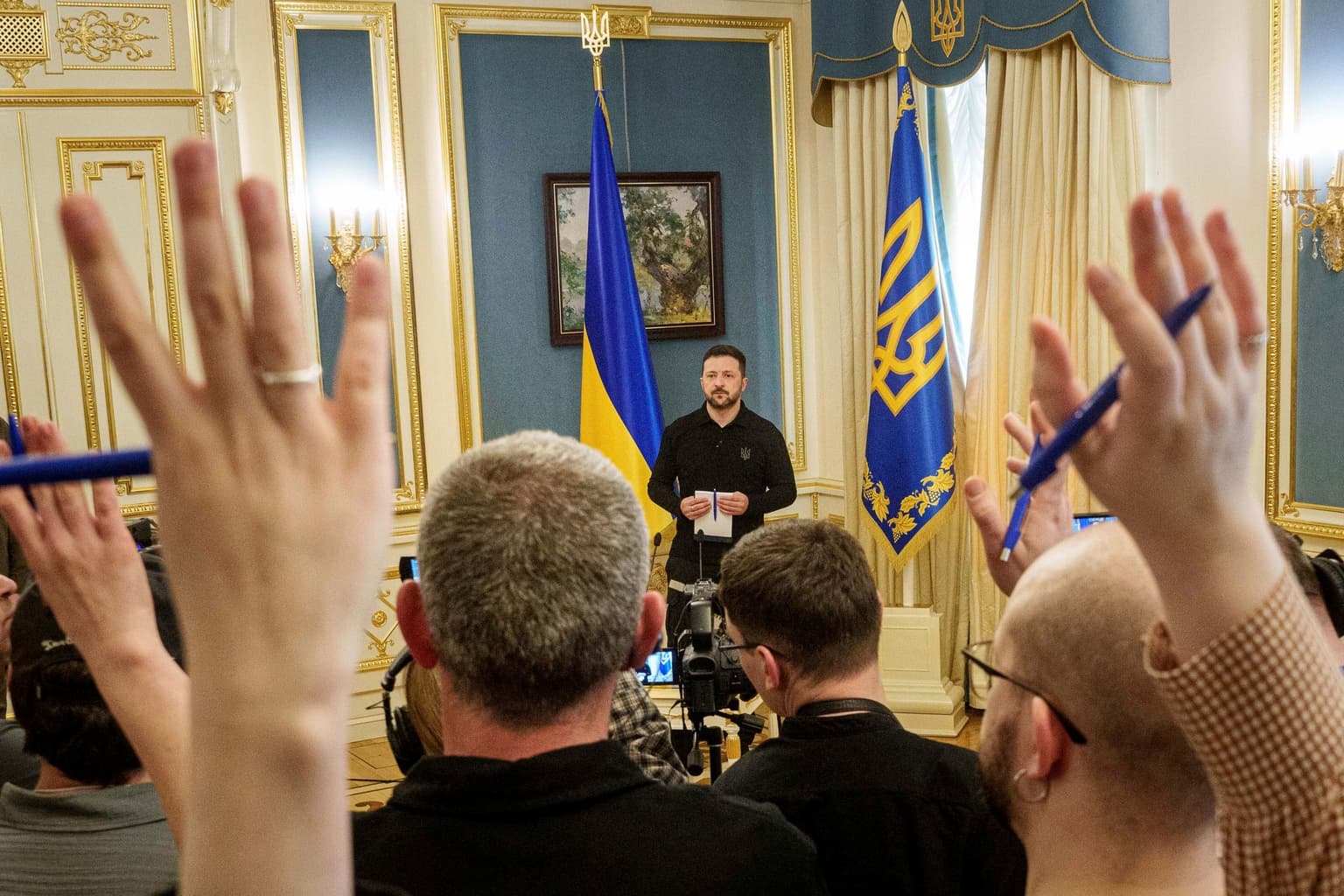
President Volodymyr Zelensky speaks during a press briefing in Kyiv, Ukraine, on April 22, 2025. The president has not had a major press conference open to all media since February 2025. (Evgeniy Maloletka / AP)
 on Google
Over the past year, Ukrainian independent media have stepped up investigations into corruption among top officials and abuse in the military, despite the constraints and risks of Russia’s full-scale invasion.
Yet this work is coming at a cost. Ukrainian media have faced a wave of lawsuits, controversial court rulings, threats, and smear campaigns on social media.
"An environment is gradually taking shape in which it is becoming increasingly difficult for journalists to do their jobs," Inna Vedernikova, a journalist at the Ukrainian newspaper Dzerkalo Tyzhnia, told the Kyiv Independent. "The space for freedom of speech is shrinking."
Despite the pressure and nearly five years of working under the full-scale invasion and martial law, the journalistic community remains robust. In the Reporters Without Borders' 2026 World Press Freedom Index, Ukraine climbed seven places to 55th worldwide — above the U.S. and some European countries.
But Ukrainian journalists and editors describe a less optimistic reality, pointing to persistent threats that make it difficult to hold power to account.
From wartime consensus to scrutiny
When Russia’s full-scale invasion began in 2022, Ukrainian journalists put the criticism of the government on hold, as the country rallied behind the war effort.
"(The war) has led to an unprecedented rise in self-censorship," Yurii Nikolov, a journalist at the media outlet Nashi Hroshi, told the Kyiv Independent.
In their turn, the authorities were expected to play by the rules and act responsibly.
At the same time, to unify the nation’s media policy amid the invasion, the authorities also merged all major television channels into one state-controlled pool. It has stayed that way ever since.
But several months into the invasion, the wartime consensus began to unravel. The first corruption investigations appeared before the end of 2022.
In recent years, a series of major corruption scandals has erupted, prompting independent journalists to step up their scrutiny of the government and bringing criticism of the authorities back into the public sphere.
Vedernikova said, despite the invasion, "it quickly became clear that a journalist's role — asking direct questions and pointing out problems — had not gone away."
As independent media resumed their investigations, those under scrutiny began to retaliate.
After a series of scandals in 2023-2024, when some journalists faced surveillance and persecution by law enforcement, the pressure shifted toward other arenas, including the courts and online smear campaigns.
Inna Biletska, head of investigations at the public broadcaster Suspilne, said that “the underreformed law enforcement sector and judiciary create fertile ground for those implicated in investigative reporting to push back."
There is also a growing number of SLAPP lawsuits (Strategic Lawsuits Against Public Participation), according to Kateryna Dyachuk, head of freedom of speech monitoring at the Institute of Mass Information, a non-profit watchdog tracking press freedom.
Courts and lawmakers
The most direct pushback has come through the courts and parliament, and it risks changing what journalists can publish.
One of the defining moments came in July, when a Ukrainian court banned the Anti-Corruption Action Center, the media outlet Slidstvo.info, and journalist Alina Stryzhak from publishing a specific investigative report. The report focused on the brother of Oleksiy Sukhachov, head of the State Investigation Bureau. It exposed him as the owner of a staggering real estate portfolio.

Although courts had previously upheld libel lawsuits against Ukrainian media, a ban on an investigative report before publication appeared to be unprecedented.
Maksym Savchuk, a journalist at Slidstvo.info and a co-author of the report, said the ban did not apply to him, so he sent the investigation to other media for publication. It was published by 27 other outlets in an organized effort.
"The investigation that the court tried to suppress went on to receive 4 million views, and I doubt it would have reached anything close to that number had it not been for the court order and the publicity surrounding it,” Savchuk told the Kyiv Independent.
Libel suits have long been a tool of pressure. Hromadske’s head of investigations, Yaroslava Volvach, said the outlet faced enormous pressure from the late Andriy Portnov, a former ally of pro-Russian ex-President Viktor Yanukovych who was widely seen as wielding immense influence over Ukraine’s judiciary.

In 2023-2024, Portnov sued both Hromadske and the Kyiv Independent’s editor-in-chief for libel. Lower courts initially upheld the suits, but the Supreme Court rejected them in May 2026. Portnov was shot dead in Madrid in May 2025.
Another blow to free speech came in October 2025, when the Supreme Court restricted what media can report about criminal cases. Back then, the court banned Dzerkalo Tyzhnia from naming a suspect in a criminal case and ordered the outlet to remove his name.
In August, Dzerkalo Tyzhnia reported that Dmytro Borzykh, a lawyer and former prosecutor, was also seeking a court order barring the publication of his name as a suspect until a guilty verdict against him enters into force.
"This approach is fundamentally at odds with European standards," Dzerkalo Tyzhnia’s Vedernikova said. "A journalist cannot declare someone guilty of a crime before a court has convicted them. But informing the public that a specific person has formally been named a suspect by law enforcement… is an entirely different matter."
Parliament may add to the pressure.
In April 2026, the Ukrainian parliament approved a draft of a new Civil Code in the first reading. The draft would allow individuals to request the removal of information about them from search engines and databases if it has "ceased to be of public interest."
A separate clause would introduce the concept of a company's “digital image" and require the company’s consent for data processing. This could make due diligence harder and limit corporate transparency.
"If journalists once investigated something — a corruption case, for example — all of that material would eventually have to be removed from the internet altogether," Dyachuk said.
The draft of the new Civil Code was met with public outcry over several controversial provisions. It is still being revised, and no final vote has been scheduled.
Risks of investigating the military
Investigating abuse in the military has brought a different kind of pressure: direct threats, often with little response from law enforcement.
In February, the Kyiv Independent and the Brazilian TV channel SBT published an investigation into alleged abuse and torture within a Brazilian unit of Ukraine’s International Legion, which led to the death of a Brazilian recruit. The same month, the unit’s commander threatened journalists from both outlets, accusing them of taking money from Russia and saying they would be “identified” and “located.” Ukraine’s military intelligence (HUR), which oversees the unit, said in March that the unit’s command had ordered a probe into the threats.

In a separate incident, a Security Service (SBU) official came to Kyiv Independent CEO Daryna Shevchenko’s apartment building in September 2025 and attempted to collect information about her. The SBU said the official’s activities were not linked to Shevchenko, and that it was a misunderstanding. A month earlier, the Kyiv Independent published an investigative story about Fire Point, Ukraine’s biggest new defense producer, and the company’s management threatened to report journalists to the SBU over it.
Other outlets have faced the same and more.
In June, the Ukrainian media outlet Babel published a report on alleged excessive battlefield losses, inadequate medical care, coercion, and physical abuse at the Skelia assault unit.
Following the publication, Mykola Kharkhan, a soldier at the unit, released a video accusing the author of the report of working for Russian money and saying such reports would not stay "unpunished.” Skelia's press office said that such threats are unacceptable.
Kateryna Kobernyk, Babel's chief editor, told the Kyiv Independent that the outlet is mostly afraid not of Skelia's leadership but of "retaliation and unpredictable behavior by specific individuals within Skelia."
Babel said in July that it had reported the threat to the State Investigation Bureau and the police, who initially failed to react and open a criminal case. The bureau later said it had opened an investigation.
"I believe that, from what I know, law enforcement agencies are currently working very slowly and somewhat unprofessionally," Kobernyk said about the case.

Also in July, the State Investigation Bureau searched the facilities of drone maker Vyriy, whose co-founder Oleksii Babenko holds a 75% stake in Babel. Some interpreted the searches as an effort to pressure Babel, although Babenko himself denied this.
Kobernyk said that Babel's editorial operations are independent of Babenko but "Babel's reporting may have served as a trigger" in an attempt to deal a blow to Vyriy.
The Kyiv Independent has requested comment from the State Investigation Bureau.
Ukrainian freelance journalist Anna Kaliuzhna, who covers the front line, has faced pressure over her investigations of the military.
Kaliuzhna said she had received death threats in 2024 from a battalion commander at the 3rd Assault Corps, after she accused the brigade's leadership of using its political influence to get better battlefield conditions.
The police investigation into the threats "is not making any progress," she said.
"They haven't questioned any of these people or ordered any forensic examinations to confirm that the messages were actually sent from those phones," Kaliuzhna told the Kyiv Independent. "No one has been charged."
In March 2026, Kaliuzhna published a post criticizing alleged violations at the Skelia and 225th Assault Regiments. She said she had received around 150 messages pressuring and insulting her from fighters of the two regiments.
In July, the Ukrainian outlet Texty published her investigation into the 225th, alleging soldiers were beaten, shot at, jailed, and even killed. Both regiments said they could not comment. The police told the Kyiv Independent they are investigating the threats, but no charges have been brought yet.
The Kyiv Independent has also requested comment from the 3rd Assault Corps.
"I just hate the fact that I don't feel any safer behind the front lines than I do at the front," Kaliuzhna said.
Conscription as leverage
The authorities also have quieter tools, and conscription is one of them. A number of media outlets, including independent ones, have the “critically important” status, granted by the government, which allows them to obtain draft exemptions for their staff. So far no independent media outlet has lost that status, but some fear it could become a pressure tool.
“We have seen the fact that Ukrainska Pravda has critical infrastructure status… increasingly used in the rhetoric of Telegram channels and bloggers affiliated with the authorities, as well as by bots on social media,” Andriy Boborykin, CEO of the Ukrainska Pravda media outlet, told the Kyiv Independent. “It was entirely predictable that the conscription exemptions granted to journalists at independent media outlets would become a target for manipulation.”
In the past, officials have used conscription as a means of exerting pressure on the media.
In 2024, military enlistment officials attempted to draft Yevheniy Shulhat, then a journalist at Slidtsvo.Info who was investigating the wealth of a top SBU official. The media outlet identified that the enlistment officers were getting instructions from a subordinate of the SBU official Shulhat was investigating.
A green light to disregard media
President Volodymyr Zelensky and his office have also come under fire for failing to communicate with the media about policy changes, corruption scandals, and other pressing domestic issues.
The president and his office often ignore journalists’ requests for comment, and Zelensky does not give interviews to independent Ukrainian media. Instead, the president opts to send voice messages via a WhatsApp group chat with reporters run by his team and to hold closed-door briefings with groups of journalist. (Editor's note: The Kyiv Independent is often invited to these briefings). After a briefing, Zelensky’s team picks which quotes can be published, with the rest being off-limits.

According to two people who have long worked with the president, he doesn’t want to face anticipated questions about corruption, domestic political crises, and reforms that would arise in a sit-down interview with independent Ukrainian media.
The last time Zelensky held a major press conference was in February 2025. In August, Ukrainian journalist Danylo Mokryk, a reporter with the Kyiv Independent’s War Crimes Investigations Unit, filed a petition for Zelensky to hold a press conference and invite independent media. The petition was blocked for unclear reasons. Several more petitions were filed by Mokryk’s followers, until eventually one was accepted and published. It gathered the necessary 25,000 votes in late September, giving the president 10 working days to respond. Zelensky ignored the petition.
“The country’s current leadership is trying to create an environment in which the doors are closed to journalists who criticize the government and point out its mistakes,” Savchuk said.
Yevhen Buderatskyi, a deputy chief editor at Ukrainska Pravda, said that the outlet “has no access to government officials.”
“They keep telling us that the President’s Office doesn’t really allow them to talk to us,” he added. “It’s difficult to obtain information. It’s hard to speak of any real progress for freedom of speech.”
The President’s Office has not responded to the Kyiv Independent’s request for comment.
Smear campaigns online
Another threat to journalists comes from social media.
Telegram, one of the most popular sources of news for Ukrainians, is often used for smear campaigns against journalists and activists, and some of the channels are reportedly linked to the authorities and top officials.
“Telegram channels can reach huge audiences and say virtually anything they want,” Dyachuk said. “They can take money to publish paid-for content, while at the same time facing no real accountability for the information they put out.”
Sevgil Musayeva, chief editor of Ukrainska Pravda, also told the Kyiv Independent that the outlet “is very often targeted by online bots or supporters of various political parties.”
Difficulties with funding
Financing independent journalism is another challenge.
A major blow to Ukrainian journalism came in 2025, when U.S. President Donald Trump’s administration ended most of the projects of the United States Agency for International Development (USAID). USAID had been a major source of funding for many Ukrainian independent media.
Journalists interviewed by the Kyiv Independent said, however, that they had adapted by shifting their focus to European grants and other sources of funding.
Another source of funding — the advertising market — has shrunk due to the war. But advertisers have also faced political pressure.
Musayeva said in 2024 that the President’s Office had been pressuring advertisers to stop dealing with her outlet. In June 2026 she said that the pressure had ceased after Andriy Yermak, then Zelensky’s chief of staff, was forced to resign in November 2025.

The ousting of Yermak revealed one of the stranger attempts to pressure journalists. At his arrest hearing in 2026, prosecutors revealed that the former head of Zelensky’s office texted his psychic the names of Musayeva and another Ukrainska Pravda journalist, in what appeared to be a request to curse them.
Musayeva also said in 2024 that Ukrainska Pravda’s owner Tomas Fiala had received offers to sell the outlet, and that she believed it to be a form of pressure by the authorities.
“The pressure (on the media) is growing, and the most frightening thing is that it is becoming the norm,” Musayeva told the Kyiv Independent.
“You don’t even take these threats seriously anymore because they are essentially constant.”
Note from the author:
Hello! My name is Oleg Sukhov, the guy who wrote this piece for you.
I was born in Russia and moved to Ukraine in 2014 because I couldn't stand the suffocating atmosphere of that semi-totalitarian country. I used to think it might be possible to transform Russia into a liberal Western-oriented country. Now it's clear that it's a lost cause.
But at least I can atone for the crimes of my homeland by exposing its barbaric aggression against Ukraine and providing objective and independent coverage of what is going on there. I'm also trying to contribute to Ukraine's transformation into a full-fledged Western liberal democracy strong enough to defeat Russia.
Our publication needs help from every one of you — support Ukrainian wartime journalism, become a member of the Kyiv Independent.