Ukrainian forces evacuate injured soldier from front-line position by drone in 'first-of-its-kind' mission, video shows
 on Google

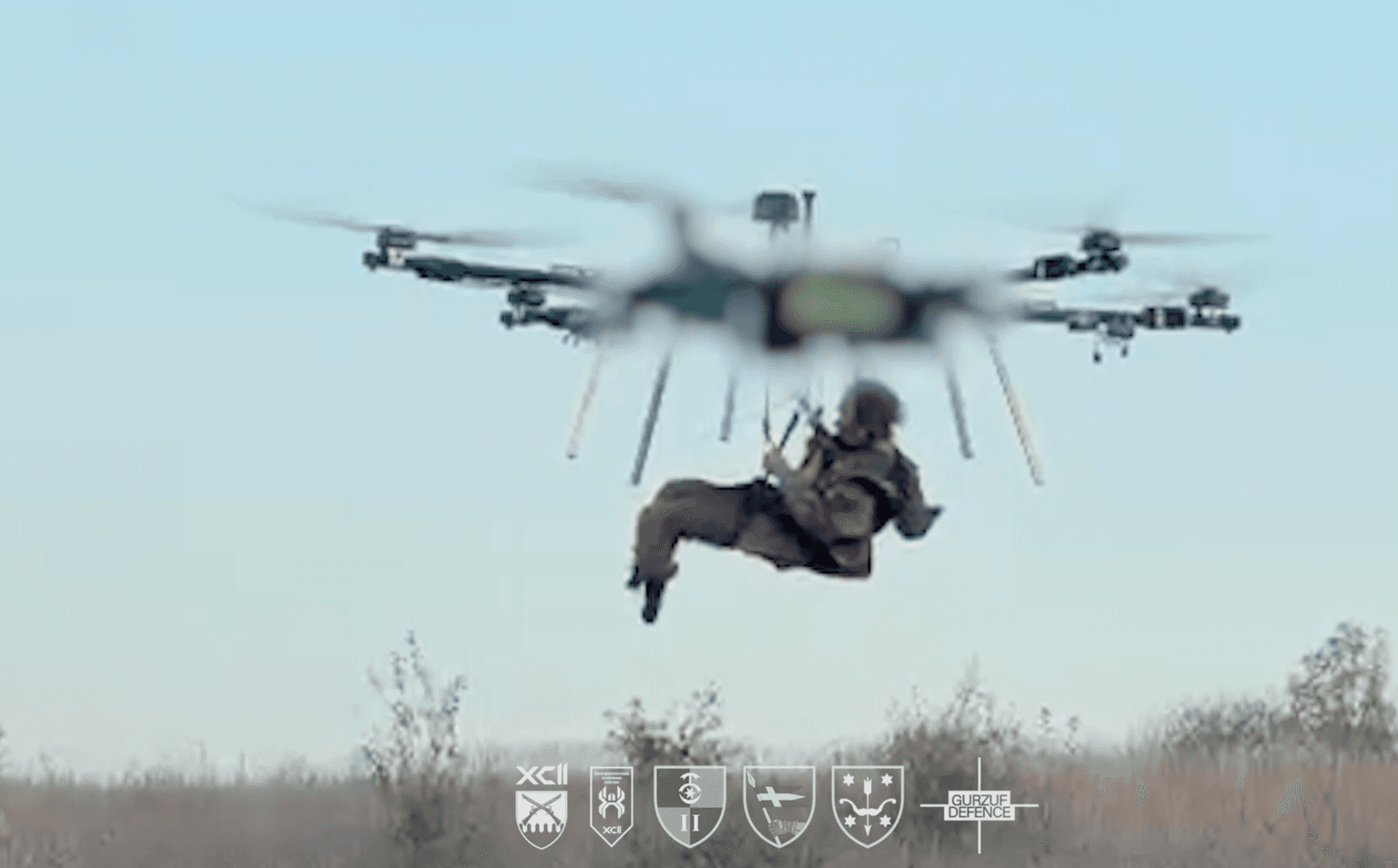
Ukrainian forces have carried out what they describe as a "first-of-its-kind" aerial evacuation of a wounded soldier directly from a front-line position by drone, the Ukrainian military and defense company Gurzuf Defense announced on Oct. 19.
The operation involved Ukraine's 92nd Separate Assault Brigade, 30th Separate Mechanized Brigade, and 10th Army Corps, along with Ukrainian drone manufacturer Gurzuf Defense.
The Ukrainian military did not disclose the date of the operation or the section of the front line where it took place.
The wounded soldier, serving with the 30th Brigade, had spent nearly 500 days at a front-line position "under constant threat of death." His fellow soldiers maintained contact with him and delivered food, water, ammunition, and medicine by drone, Gurzuf Defense said.
After the soldier suffered a severe injury, evacuating him by ground became impossible because of Russian drone activity in the area and mined terrain. Attempting to reach him on foot or with a ground robotic vehicle, the usual way of evacuating the wounded, would have put the rescue team at risk.
Ukrainian troops used a heavy-lift hexacopter drone, the Heavy Shot Ayudag-6.
The team first delivered special equipment with carabiners to the wounded soldier, then sent the drone equipped with a winch. Guided remotely by fellow soldiers who remained in contact with him, the soldier secured himself to the evacuation system, Gurzuf Defense said, calling the operation an "unprecedented mission."
The drone then transported him to a safer position, where other soldiers met him and arranged further evacuation to a hospital. The mission lasted 1 hour, 14 minutes, and 36 seconds, covering a distance of 62 kilometers (39 miles).
Drone operator of the 30th Mechanized Brigade, callsign "Chornyi" ("Black" in Ukrainian), said he is "very pleased" that everything went well.
The company said the operation required close monitoring of the airspace and electronic warfare protection throughout the flight. The soldier is now receiving treatment and rehabilitation, and his life is no longer in danger, according to the 30th Separate Mechanized Brigade.
"An extremely complex operation, but a successful one. This is a historic event," "Napalm," a 92nd Brigade programmer who was involved in preparing the operation, said.
"It marks the next stage in the evacuation of the wounded, which we will all eventually reach. Now the serious, systematic work begins to ensure that such missions take place on a regular basis," Napalm added.
Gurzuf Defense co-founder Pavlo Feldblium warned that aerial evacuation should not be treated as a routine practice, citing the risks to wounded soldiers during flight. Each mission would need to be planned individually for the specific circumstances and location, he said.
"Air rescue is a last resort when there is no other way to save a person," Feldblium said.
According to the Ukrainian outlet Ukrainka Pravda, the hexacopter Heavy Shot Ayudag-6's platform has a flight range of up to 25 kilometers (15.5 miles) and an operational altitude of 150–300 meters (500 to 1,000 feet), while the aircraft itself weighs about 98 kilograms (215 pounds) and can carry 70–90 kilograms (150 to 200 pounds).
It is named after its six motors and Mount Ayudag near Gurzuf, a resort town in Russian-occupied Crimea.
Heavy drones have primarily been used to deliver ammunition and other supplies to front-line positions.