Ukraine must preserve system that took one of its most powerful men to corruption trial
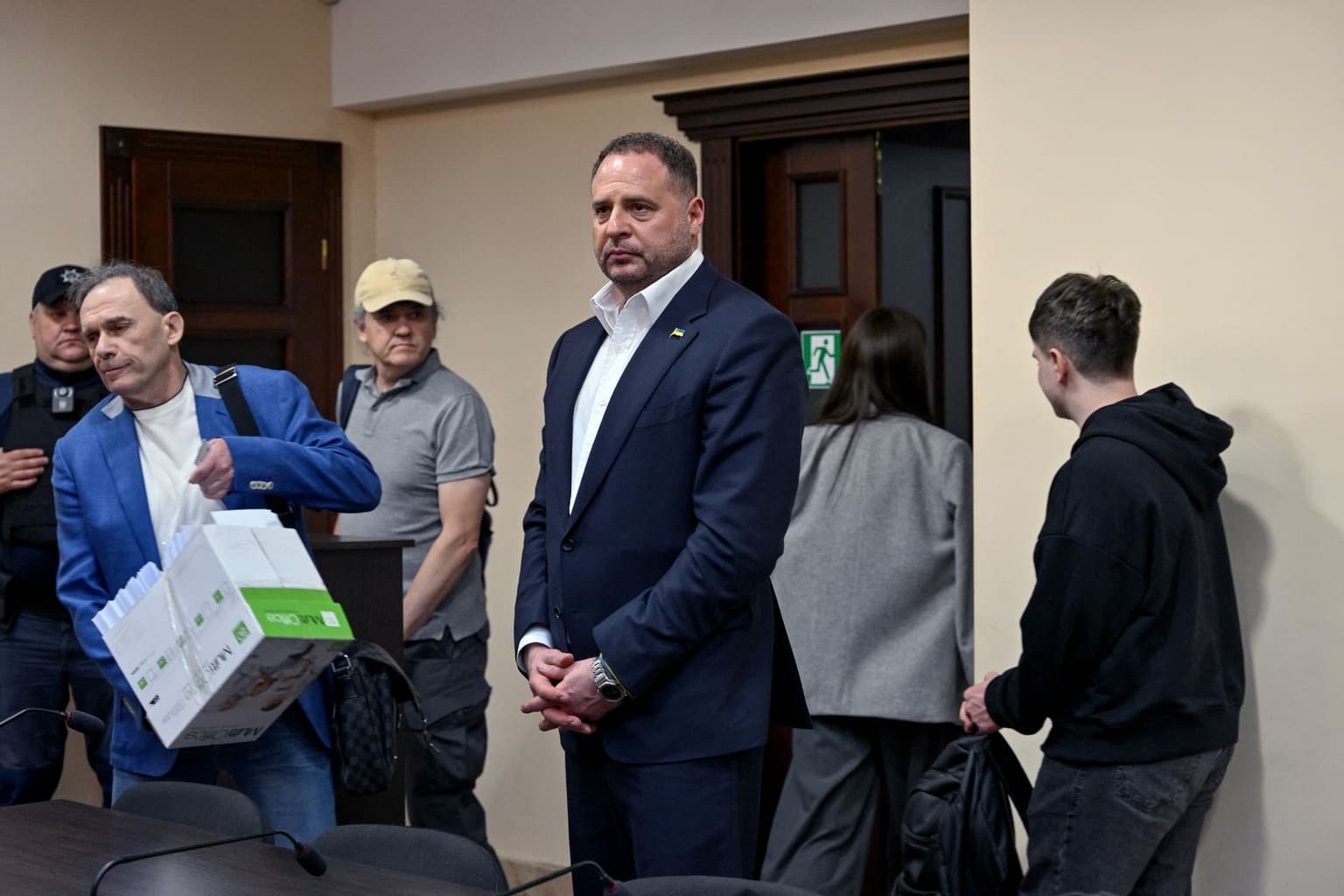
President's former Chief of Staff Andriy Yermak (C), stands in court before a hearing in a money laundering case, to determine a preventive measure, in Kyiv, Ukraine on May 12, 2026. (Genya Savilov / AFP via Getty Images)
 on Google
Mykhailo Zhernakov
Co-founder and Chair of the Board of DEJURE Foundation
Over the past week, news of a major corruption scandal has swept through the Ukrainian media landscape like a storm. And none other than former Presidential Chief of Staff Andriy Yermak is at the center of it all. Yet perhaps the most revealing part of this story is not the scandal itself, but the system now investigating it.
Andriy Yermak has been linked to a corruption scandal involving embezzlement in the energy sector. Searches at his residence pushed him to resign as head of President Zelensky's office.
This "semi-voluntary" career change led Yermak, a lawyer by training, to the Ukrainian National Bar Association (UNBA) — an unreformed Bar's self-governance body.
Its leader has remained unchanged for the past 12 years, while there have been numerous reports of the UNBA chair's ties to pro-Russian forces.
The UNBA's leadership created a whole separate committee for Yermak. His role and involvement there appear to be an attempt to whitewash his own reputation, given the fact that he brought his UNBA reference to a hearing at the High Anti-Corruption Court (HACC) last week.
But now his reputation will be determined by Ukraine's key anti-corruption institutions. The decisions by the High Anti-Corruption Court, the Anti-Corruption Bureau (NABU), and the Specialized Anti-Corruption Prosecutor's Office (SAPO) in this case are unprecedented in their scope and political impact.

So what exactly is this "genie lamp" that granted us a wish for unbiased anti-corruption institutions?
The answer lies in one of the key reforms in Ukraine's justice system — the selection commission involving international experts. These experts are delegates from EU partners, tasked with conducting professional evaluations of candidates for open positions.
The presence of international experts is the main safeguard against political bias in judicial appointments under different circumstances.
Currently, the selection process for key judicial institutions follows a model involving an Advisory Group of Experts (AGE). It involves three international experts and three Ukrainian experts. The AGE evaluates all candidates for the position and decides whether to recommend them for the next stage of the selection process.
To avoid situations in which the votes split 3 to 3, the international experts have the final word.
Some reform opponents like to exploit the argument about foreign intervention to cancel the presence of international experts altogether. However, this claim is nothing more than simple manipulation. International experts operate within the framework of Ukrainian law, and the final decision always rests with Ukrainian institutions.
However, they must now choose among the best candidates, rather than from "convenient" ones.
International experts help select judges for the Constitutional Court of Ukraine (CC) and the High Qualification Commission of Judges (HQCJ) — an institution that evaluates judges of all levels and determines whether they are fit for the profession.
But this model is now at risk. In June 2025, the mandate of international experts on the HQCJ Selection Commission came to an end; in September 2026, the same fate awaits the selection process for the Constitutional Court. Parliament is yet to decide whether to extend its mandate.
In our previous reports, we also documented attempts to diminish the role of international experts in the Bar reform process, which could weaken external oversight and the protection of anti-corruption agencies. This is a key issue that those in power are trying to eliminate.
Walking away from this model raises risks of derailing Ukraine's EU accession. Our partners are waiting for results, and funding depends on the progress.
Yet this independence has not been reciprocated with enthusiasm in political circles. NABU and SAPO faced institutional obstacles back in July of 2025. President Zelensky was practically forced to reinstate their independence after mass protests.

Back then, the Ukrainian government faced harsh criticism from EU Commission President Ursula von der Leyen and other European leaders. They publicly highlighted the negative consequences of the said bill. Recently, other lawmakers submitted another harmful bill to Parliament. This one could limit the Commission responsible for appointing judges to the Constitutional Court.
All of this is a prime example — the Ukrainian system is still too young to entrust selection processes in key bodies to professional representatives. Unlike EU countries with well-established democratic institutions, in Ukraine, professional solidarity in the fields of anti-corruption and justice often takes precedence over principles of integrity and accountability.
This issue directly concerns Ukraine's commitments to European partners. Independent competitive selection processes are included in the list of the top 10 priority reforms that Ukraine must implement by 2026 on its path to EU accession. This refers to the selection of the General Prosecutor and Economic Security Bureau formation — those exact bodies responsible for trying to limit NABU and SAPO in July 2025.
These selections must involve international experts with a real influence on the outcome.
Otherwise, the system will simply reproduce itself. The same kind of Selection commissions should reevaluate the Bar self-governing bodies, too.
The Bar reform is long overdue and is on Ukraine's list of priorities for EU accession. If we don't start making changes any time soon, we risk losing all the progress and facing a possible kiss goodbye from the European family.
Editor's note: The opinions expressed in the op-ed section are those of the authors and do not purport to reflect the views of the Kyiv Independent.