Armenia’s westward tilt tests Russia's grip in the South Caucasus
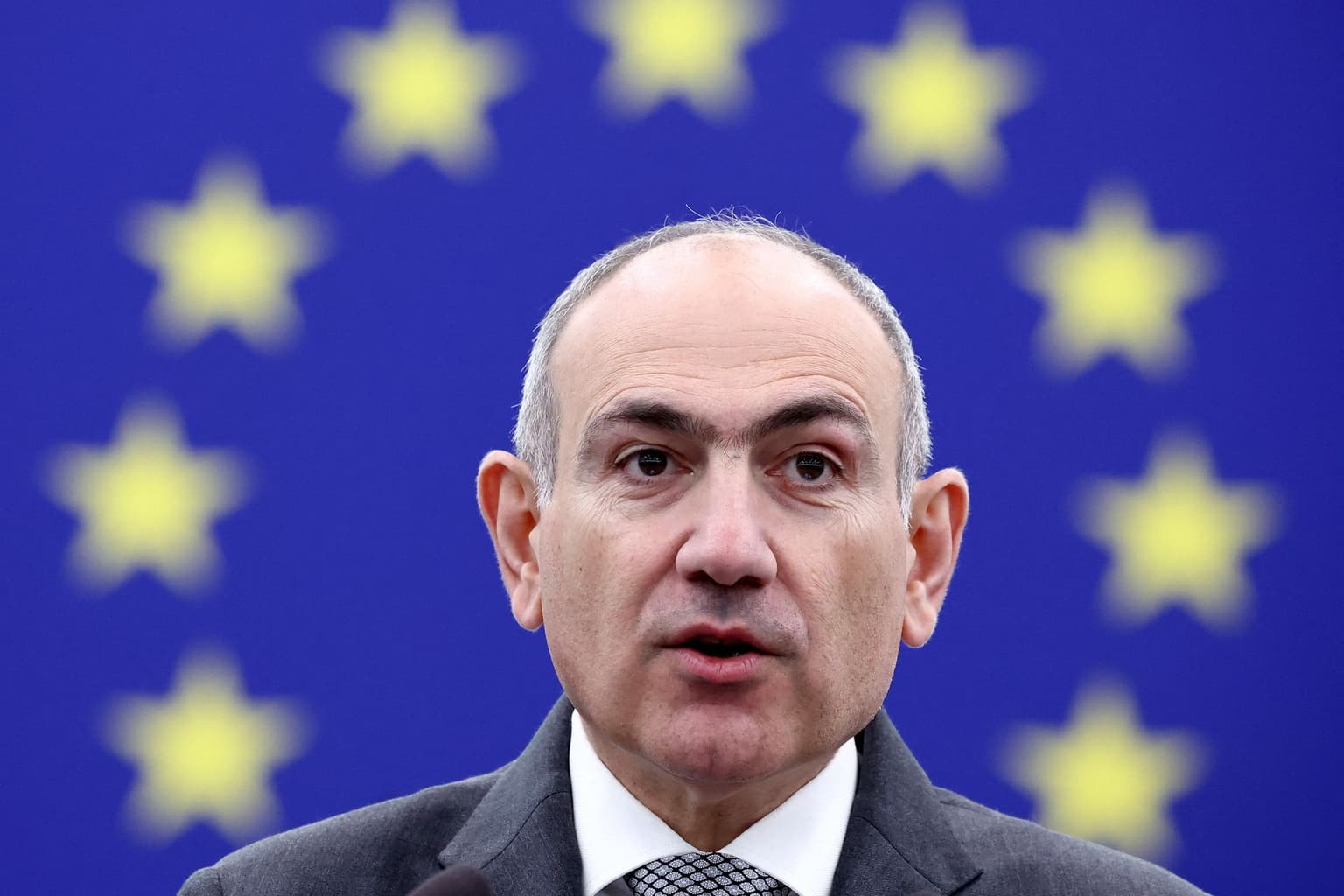
Prime Minister Nikol Pashinyan addresses members of the European Parliament during a formal sitting in Strasbourg, France, on March 11, 2026. (Frederick Florin / AFP / Getty Images)
 on Google
Once one of Moscow's closest allies in the South Caucasus, Armenia has recently handed the Kremlin a series of diplomatic humiliations.
Not only did Yerevan host the first Armenia-EU summit on May 4-5, but one of the guests was President Volodymyr Zelensky, marking his first official trip to the country.
The state visit by the Ukrainian leader, whose country has been resisting Russia's full-scale invasion for over four years, sparked fury in the Kremlin.
Moscow demands an explanation for platforming Zelensky's "anti-Russian statements," Kremlin spokesperson Dmitry Peskov fumed.
The Russian Foreign Ministry, meanwhile, openly asked Armenia: "Whose side of history are you on?"
Armenian Prime Minister Nikol Pashinyan, who skipped Moscow's scaled-down May 9 Victory Day celebrations in another diplomatic snub, gave an unequivocal answer: "On the issue of Ukraine, we are not an ally of Russia."

Pashinyan's response was a "turning point" for Armenian diplomacy, according to Anna Ohanyan, political science professor at Stonehill College specializing in South Caucasus politics.
The expert sees Pashinyan's meeting with Zelensky — as well as Yerevan's pursuit of closer European integration — as part of the country's push to reaffirm its sovereignty vis-à-vis Russian imperialism.
But Ohanyan argues that Armenia is pursuing a more "diversified" foreign policy rather than a clear-cut pivot away from Russia — despite the Kremlin's effort to frame it in these exact binary terms.
Diversification, but not an anti-Russia pivot
When it comes to international relations, the 3-million South Caucasus country has little room for maneuver.
Armenia's neighbors include Azerbaijan, its bitter rival in a series of bloody wars, and Turkey, Baku's powerful patron. In the face of such odds, Yerevan has looked to Moscow as a counterbalance.
Yerevan remains — in theory — a military ally of Russia, being a formal member of the Moscow-led Collective Security Treaty Organization (CSTO) and host to about 4,000 Russian troops.
But the country "froze" its participation in the CSTO after the alliance failed to protect Armenia from military advances by Azerbaijan.
The CSTO did not step in during the violent 2021-2022 border clashes, nor did Russian peacekeepers intervene as Azerbaijan took the Nagorno-Karabakh region in 2023, leading to the expulsion of about 100,000 ethnic Armenians.
Disillusioned with Russia, Armenia has looked westward for new partners.
Last week, Yerevan signed strategic partnership declarations with the U.K. and France, with Paris emerging as Armenia's key defense supplier.

The EU has also stepped up support for Armenia, allocating 30 million euros ($35 million) to the Armenian Armed Forces and 270 million euros ($320 million) to the country's economy and European integration.
Europe's ties with Armenia are now "closer than ever," European Commission President Ursula von der Leyen declared during the summit, which saw the two sides sign a new Connectivity Partnership.

New engagement with Kyiv is also bound to win Armenia's favor in the EU due to the bloc's support for Ukraine amid Russian aggression.
Yet, there are limits to this westward drift.
Armenia's foreign policy direction is "definitely not a pivot… It's diversification with a tilt," Ohanyan says.
While Armenia passed a law last year to start accession talks with the EU, officials both in Brussels and Yerevan have been clear that this would be a long journey.
Constraints go beyond the Russian military base in Armenia's city of Gyumri.
While reducing military dependence, Armenia remains closely tied with Russia in economic sectors, including agriculture, energy, and consumer goods.
The chief issue, however, "is Armenia's Russia-linked oligarchic influence, economic interests that were unchecked" in the early years of the country's independence, Ohanyan argues.
This has led to a "vast oligarchic use of corruption as a strategic tool in influencing Armenia's sovereignty, curtailing Armenia's room to maneuver," she adds.
Armenia has pushed back against this influence. The 2018 Velvet Revolution that ushered Pashinyan's Civil Contract into power led to laborious reforms and institution-building.

Amid democratic backsliding in neighboring Georgia, Armenia is now ranked the freest country in the South Caucasus by Freedom House.
The Civil Contract's direction is about to be put to the test, however, in the June 7 parliamentary elections, closely watched by the Kremlin and Europe alike.
Moscow eyes Armenia's elections
European governments have raised alarm over what they said was Russia's disinformation machinery being deployed to undermine Pashinyan ahead of the vote.
The EU even dispatched a civilian mission to help the country tackle fake news and hybrid threats.
Hand-in-hand with covert hybrid operations, Russia has sent public signals to Armenia.
Hosting Pashinyan at the Kremlin on April 1, Russian President Vladimir Putin rebuked Armenia over some opposition politicians — including those with "Russian passports" — being unable to "take part in domestic political life during elections."

He seemingly alluded to Samvel Karapetyan, a Russian-Armenian oligarch who has cycled in and out of detention and whose Strong Armenia party polls second-strongest at 10%.
While the latest polls give the Civil Contract party a strong lead (around 30%) over the fragmented pro-Russian opposition, Pashinyan carries the painful baggage of Azerbaijan's Karabakh offensive.
To further fuel polarization, Moscow has also sought to "geopoliticize" the elections, framing the domestic vote as a geopolitical choice, Ohanyan says.
The Kremlin has become increasingly vocal about Armenia's foreign policy steps.
Putin warned Yerevan that it cannot be both a member of the EU and the Moscow-led Eurasian Economic Union (EAEU), telling Armenia it must choose: Russia or Europe.
Pashinyan dismissed the Russian leader's framing and pushed back against Putin's suggestion that Armenia hold a referendum on the issue.
"I have spoken out on this issue repeatedly... I have publicly stated that until there is no need to choose — de jure and de facto — we will not put such an issue on the agenda," he said.
Moscow now appears to be drawing Ukraine into the Armenian elections as well.
"Zelensky's visit just gives the Kremlin yet another opportunity to push, to geopoliticize, to securitize, to heighten the context on Armenia ahead of the elections," Ohanyan notes.
Only a few days after the Ukrainian president met Pashinyan, the Russian leader drew parallels between Armenia's European aspirations and post-EuroMaidan events in Ukraine — comments seen by some as a veiled threat.
"We are witnessing the consequences of developments surrounding Ukraine," he said. "And where did it start? With Ukraine seeking to join the European Union."
Russia's response to the 2013–2014 EuroMaidan Revolution was the occupation of Crimea, orchestration of the war in Donbas — and an all-out invasion launched eight years later.
Note from the author:
Hi, this is Martin Fornusek.
I hope you enjoyed this article. In our team, we believe fact-based and truthful reporting should be available to all — that's why we don't use any paywall.
If you want to see more in-depth coverage of regional politics and how it shapes Ukraine's struggle against Russian aggression, please consider joining the Kyiv Independent community.