Beyond Hungary: New obstacles emerge in Ukraine's EU membership push
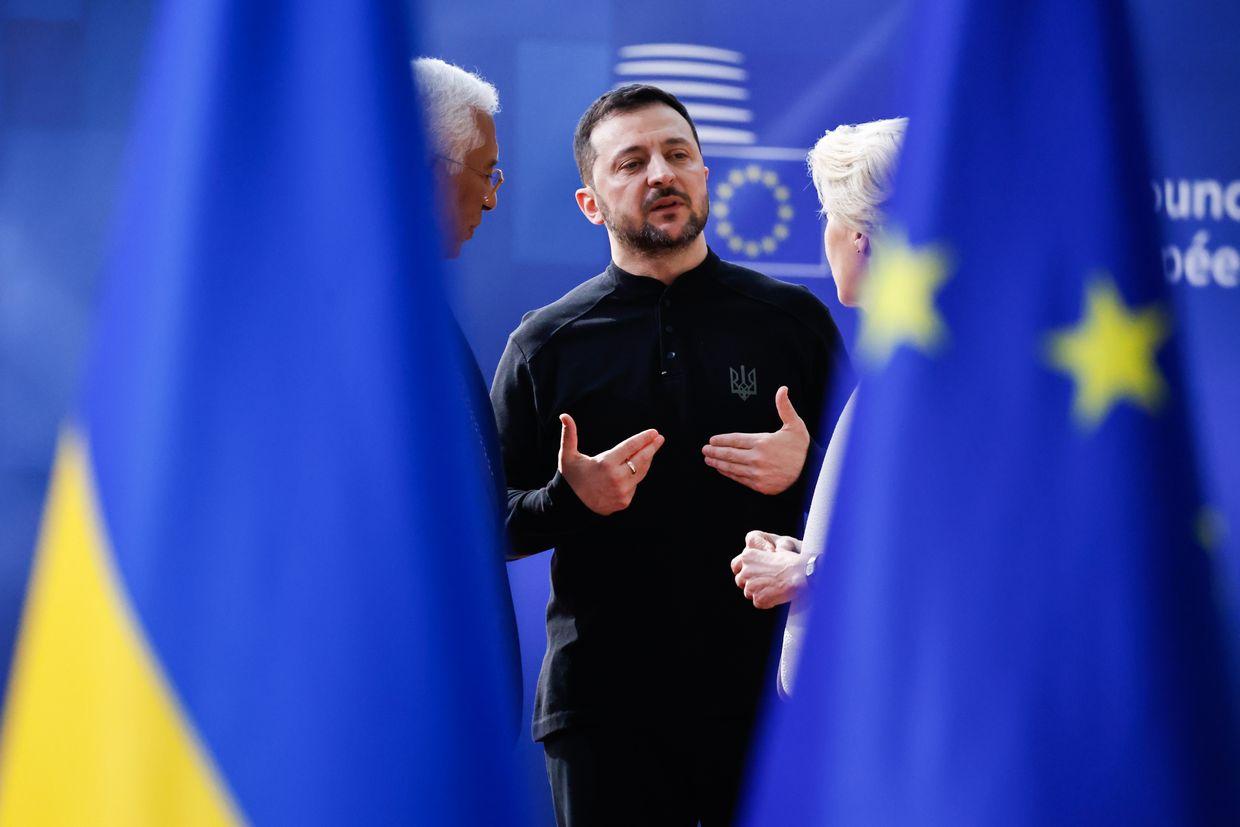
Antonio Costa (L), president of the European Council, President Volodymyr Zelensky (C), and Ursula von der Leyen, president of the European Commission (R), in Brussels, Belgium, on March 6, 2025. (Simon Wohlfahrt/Bloomberg via Getty Images)
 on Google
Some hoped that with Hungarian Prime Minister Viktor Orban leaving office on May 9, Ukraine's path to EU membership would become much smoother. Instead, problems of substance have risen to the surface, which could prove difficult for Kyiv to fully address.
Pressure is rising in Brussels to find a way to reach an agreement on opening so-called "enlargement clusters" by the next meeting of EU leaders on June 18. National ambassadors have raised the concern that there might not be sufficient progress in time, but who or what is blocking the way now?
Not the European Commission. The EU's Enlargement Commissioner, Marta Kos, has repeatedly said that Ukraine is ready to open all six of the enlargement clusters. Any blockages, therefore, are politically driven by specific EU countries.
Hungary
Cluster 1, called "Fundamentals," and which addresses broad themes such as democracy and rule of law, is always the first to formally "open" and the last to "close." The other five clusters are more policy-specific, and their completion means the would-be EU member state is aligned with EU laws and norms.
While Orban's defeat has changed the tone of the Hungary-Ukraine relationship, it has not necessarily removed the issues preventing Budapest from allowing cluster one to open.
New Prime Minister Peter Magyar implied in a tweet on May 18 that European Council President Antonio Costa told President Volodymyr Zelensky that accession talks can't proceed until the issue around minorities is resolved.

The Orban government had made 11 demands to Ukraine around the use of the Hungarian language in the country's far west, mostly in the education system and in political life.
A spokesperson for Costa confirmed that he and Magyar had spoken but declined to comment on the details of the call. Zelensky's press release on his call with Costa did not mention the minority issue.
Hungarian politician Marton Hajdu, who Magyar counts on for EU guidance, said there must be "a bilateral agreement concluded which will ensure that their rights are met," and that the issue cannot wait, in an interview in April.
On May 18, the foreign ministers of Ukraine and Hungary each wrote that the issue is being sent immediately for expert-level talks, showing a new willingness to break the impasse.
Poland (& not only)
Two national diplomats told the Kyiv Independent that while Poland won't block the opening of cluster 1, Warsaw is holding back on sectoral issues where it is most afraid of Ukraine — agriculture and transport.
At an event organized by the European Policy Center think tank in Brussels in April, Ukraine's Deputy Prime Minister Taras Kachka, in charge of European integration, mentioned the two areas as the potential hold-up to enlargement talks.
"Polish farmers will be afraid whether the European integration of Ukraine will impact the subsidies they receive," Kachka said.

He sought to reassure that Ukraine is "not going to pose any threat to Polish farmers. This is our intention, this is our task," but the problem stems from how subsidies are awarded in the EU's Common Agricultural Policy (CAP).
To solve the issue, the EU will have to change that system of awarding agricultural subsidies; it's not for Ukraine to make the change, Stefan Meister from the Kyiv-based think tank EPIK said on the KI Insights podcast on May 14.
Kachka likewise conceded that "road transport is also very sensitive," and that "our task is to find a solution that is not posing any threat to (Polish) truck drivers."
He added that "in the negotiations, there is a task to ensure that our intention is reflected in the accession terms," but whether that will happen by June 18 remains uncertain.
But Poland might not be the only country holding back with sectoral concerns. France apparently has similar reservations, with an agricultural sector whose concerns are politically important for Paris.
What is achievable in June?
Enlargement Commissioner Kos said that she expects cluster one to open by the end of June, but that she would have to "count on the Irish presidency in the second half of the year," to drive through the opening of the remaining clusters.
To get there, EU countries have to agree on a "Common Position" for Ukraine, after which they can organize an "Intergovernmental Conference," which would rubber-stamp the opening of one or more clusters for Ukraine.
Looking at the EU's calendar, there is a General Affairs Council scheduled for June 16, two days before EU leaders hold their summit. A likely time for the Intergovernmental Conference to take place would be between those two meetings, which would give EU leaders something to celebrate with Zelensky on June 18.
Assuming agreement can be reached with Hungary, the first cluster should be able to open.
As for the other five clusters, the expectation is that clusters 4 and 5 (which cover transport and agriculture, respectively) will not open in June.
Cluster 6, on external relations, is likely to open as soon as talks progress, with clusters 2 and 3, which cover a broad sweep of economic criteria, remaining an open question.