Starving residents of Oleshky must not become props in Russian propaganda
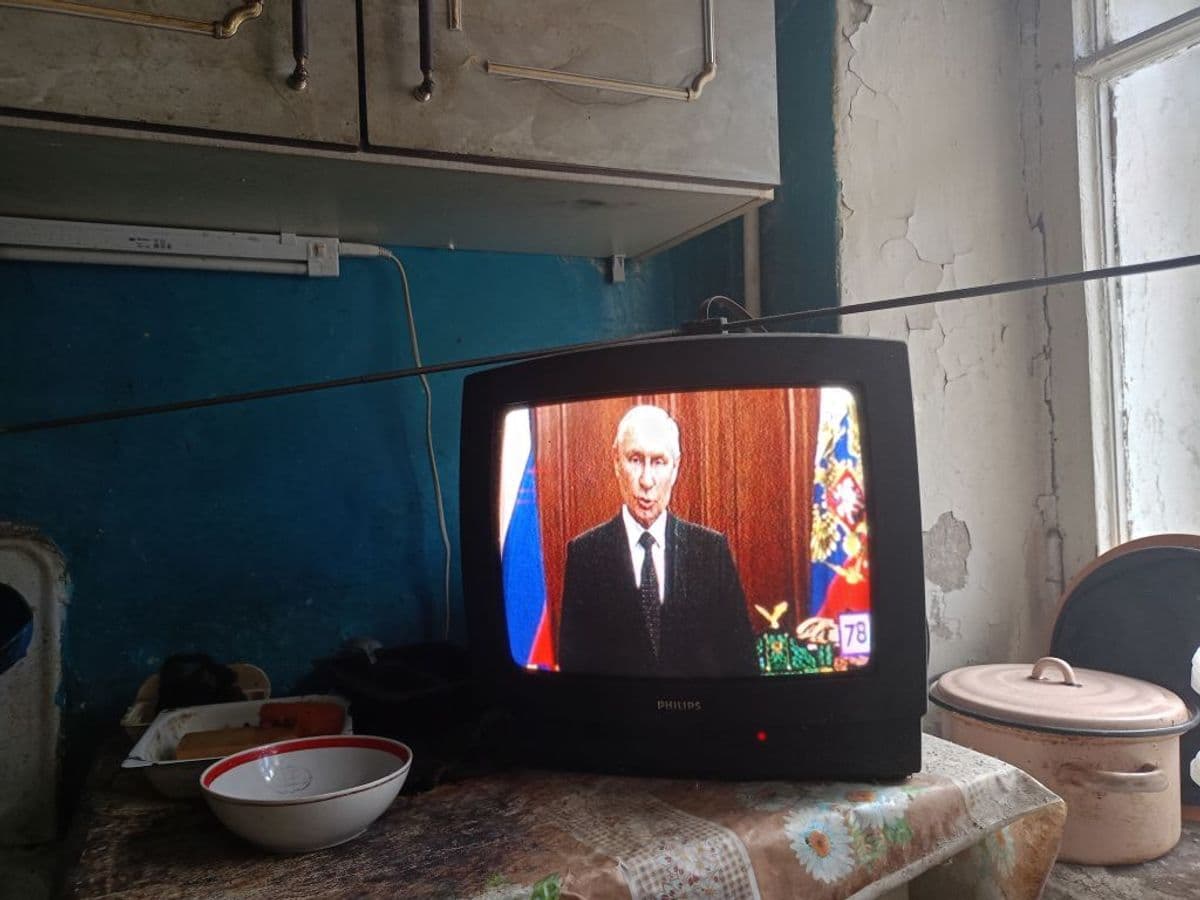
Russian President Vladimir Putin addresses the Russian public, the country’s armed forces and law enforcement agencies amid the Wagner Group’s armed rebellion on June 24, 2023. (Artem Priakhin/SOPA Images/LightRocket via Getty Images)
 on Google
Peter Pomerantsev
Executive Editor of The Reckoning Project
For months, desperate civilians remaining in the southern Ukrainian city of Oleshky have been blockaded inside, as Russia severed food and medicine supplies to the city amid constant shelling, food shop closures, and reports of looting; many of the city's elderly and less mobile residents have been forced to forage for weeds and eat grass in order to simply survive.
Oleshky is starving. The stories of the residents have been well documented.
Now, there seems to be light at the end of the tunnel: U.S. First Lady Melania Trump has helped to broker a temporary, localized ceasefire agreement, which, in theory, should take place from Tuesday, Oct. 27. Much-needed aid could finally be delivered, and residents evacuated.
But this city of weak, hungry, and vulnerable people will face a new danger as Oleshky slowly opens: under the pressure of living on the brink of death, they could become props for Russian propagandists attempting to rewrite the history of what happened in the city.
Russia has a long track record of attempting to blame Ukraine for its own atrocities, and who better to use than Ukrainian civilians themselves?
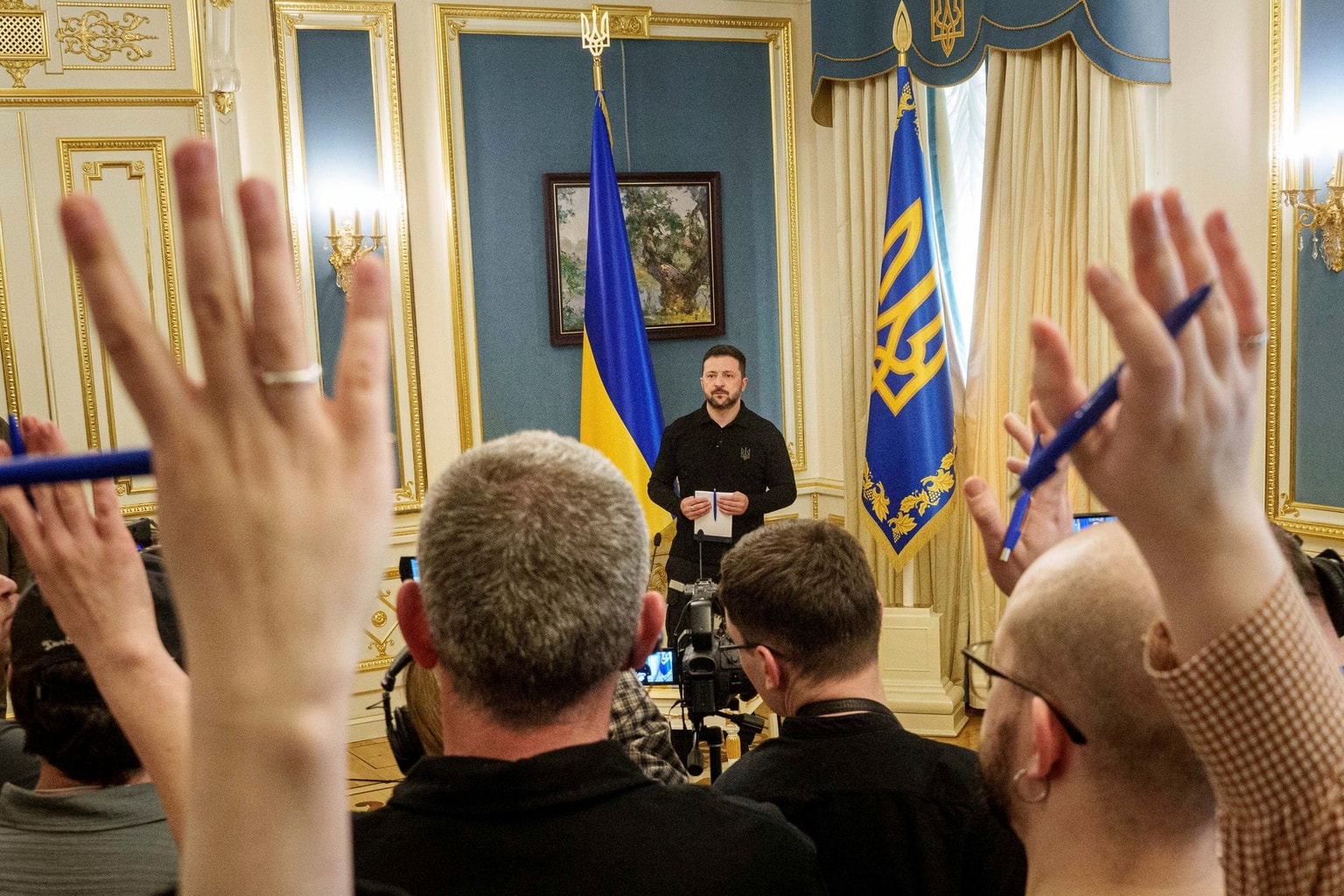
Ukraine is well aware of the danger. Ukrainian President Volodymyr Zelensky and Ukrainian Foreign Minister Andrii Sybiha have already raised concerns about how Russia will likely manipulate the ceasefire.
Russia will likely "do everything it can to clear the roads in such a way that these people head toward Russia and remain there," said Zelensky. Sybiha has noted that Russia is preparing to stage "dozens" of videos in occupied Oleshky.
"Then they would ask a question, turn off the camera, tell her what to answer, and then turn the camera back on to record the 'required' response. Armed soldiers were present the entire time together with the journalists, standing behind their backs."
"Local residents will be forced to say on camera that they are happy, well-fed and grateful to the Russian occupiers," he stated. Ukraine's Security Service noted that one Russian unit has been specifically tasked with preparing "a series of 'compromising' interviews with the residents” in which they should accuse Ukraine's defense forces of "constant shelling."

At The Reckoning Project (TRP) — a global team of journalists and lawyers documenting and publicizing atrocity crimes and helping build cases to hold perpetrators accountable — we also know that this is a tried-and-tested Russian method based, among many other reasons, on the testimonies of several of our interviewees: Ukrainian civilians in the temporarily occupied territories who have previously been forced to participate in Russian propaganda campaigns against their own nation.
"Russian disinformation campaigns frequently pave the way for future aggressive Russian actions, with propaganda operations coordinated with military operations."
As these testimonies reveal, Russians exploited every opportunity to coerce civilians into becoming actors at gunpoint, serving in the Russian military, or, as one interviewee recounted, even producing and editing propaganda footage themselves if Russian forces discovered they had the necessary skills.
"They interviewed my mother-in-law. At first, they asked her name, age, and where she had lived," one witness, Viktoria, told TRP (name changed for security reasons). "Then they would ask a question, turn off the camera, tell her what to answer, and then turn the camera back on to record the 'required' response. Armed soldiers were present the entire time together with the journalists, standing behind their backs."
Russia has a long track record of creating propaganda videos to prop up its military objectives.
In July 2014, for example, after Russia's catastrophic destruction of a civilian plane carrying 298 people, Russian media and officials began promoting claims that Ukrainian forces shot down Malaysia Airlines Flight 17 traveling from Amsterdam to Kuala Lumpur.
The subsequent investigation established that the Buk, the missile launcher used in the attack, was transported from Russia before the attack and smuggled back immediately after the attack.
Russian disinformation campaigns frequently pave the way for future aggressive Russian actions, with propaganda operations coordinated with military operations.

For example, prior to Russia's full-scale invasion, the U.S. stated that it had intelligence that Russia planned to release faked footage of a supposed Ukrainian attack on Russian speakers to use as a pretext for its invasion, including plans to excavate fake "mass graves."
The same playbook could well be used today — and we are seeing the first signs — during the temporary ceasefire in Oleshky.
Key Russian media figures are already starting to spread the narrative that Russia is "rescuing" the residents that it has been terrorizing.
Kremlin propagandist Margarita Simonyan recently posted a video on her Telegram channel claiming that Ukrainians had been responsible for creating a "living hell" there.
Simonyan is notoriously unreliable: in February 2022 she stated that Russia "is not going to start a war with Ukraine, and this will not happen in any way." She also received a state award for her role in the annexation of Crimea in 2014.
As TRP has previously documented together with law firm Global Rights Compliance, Russia has also relied on preparing "information alibis" to publish cover stories for attacks even before they take place.
"The Kremlin's propaganda style has a decades-long track record, and we’ve seen these tactics even well before the war in Ukraine."
We established how Russia had started laying the groundwork to blame Ukraine for its own deadly assault on Kramatorsk railway station, stating a week beforehand that Ukraine was planning to use civilians as "human shields" in the area. Dozens were killed on April 8, 2022, but Russia gave itself away when state outlet RIA Novosti tweeted about the attack three minutes before it took place.
Russian officials, online media, and pro-war Telegram channels also spread stories that hospitals and a theater in Mariupol were full of Ukrainian military as a pretext for hitting civilians — accusations that have been debunked by journalists who were in the city, as well as eyewitnesses, UN groups, and OSINT specialists.

Similarly, Russian propagandists accused Ukrainian forces of planning the Kakhovka dam explosion and the bombing of POW camps (under the orders of U.K. intelligence) — all before Russia committed these acts itself.
The Kremlin's propaganda style has a decades-long track record, and we've seen these tactics even well before the war in Ukraine.
In Syria, Kremlin media would accuse the Syrian opposition of "gassing" civilians to cover for Putin's ally Assad's use of chemical weapons against his own people. Or going back to Soviet times, the Kremlin cynically organized a mass media campaign aimed at Western correspondents in order to make it look like their mass murder of some 14,700 Polish officers and prisoners of war at Katyn was actually the work of the Germans.
The German philosopher Nietzsche once argued that there are "no facts (...) only interpretations."
Kremlin propaganda has long followed that idea to a triumphantly cynical extreme.
At moments like this, it's important that news media do not slide into bothsideism which credits well-known sources of disinformation with the same valency as more reliable sources.
We are entering a fierce cognitive battle, where propagandists know how to play the media to whitewash their regimes' crimes.
The siege, we hope, is ending — but the assault on truth and perception is just beginning.
Editor's note: The opinions expressed in the op-ed section are those of the authors and do not purport to reflect the views of the Kyiv Independent.