We must return Ukrainian journalists still imprisoned in Russia
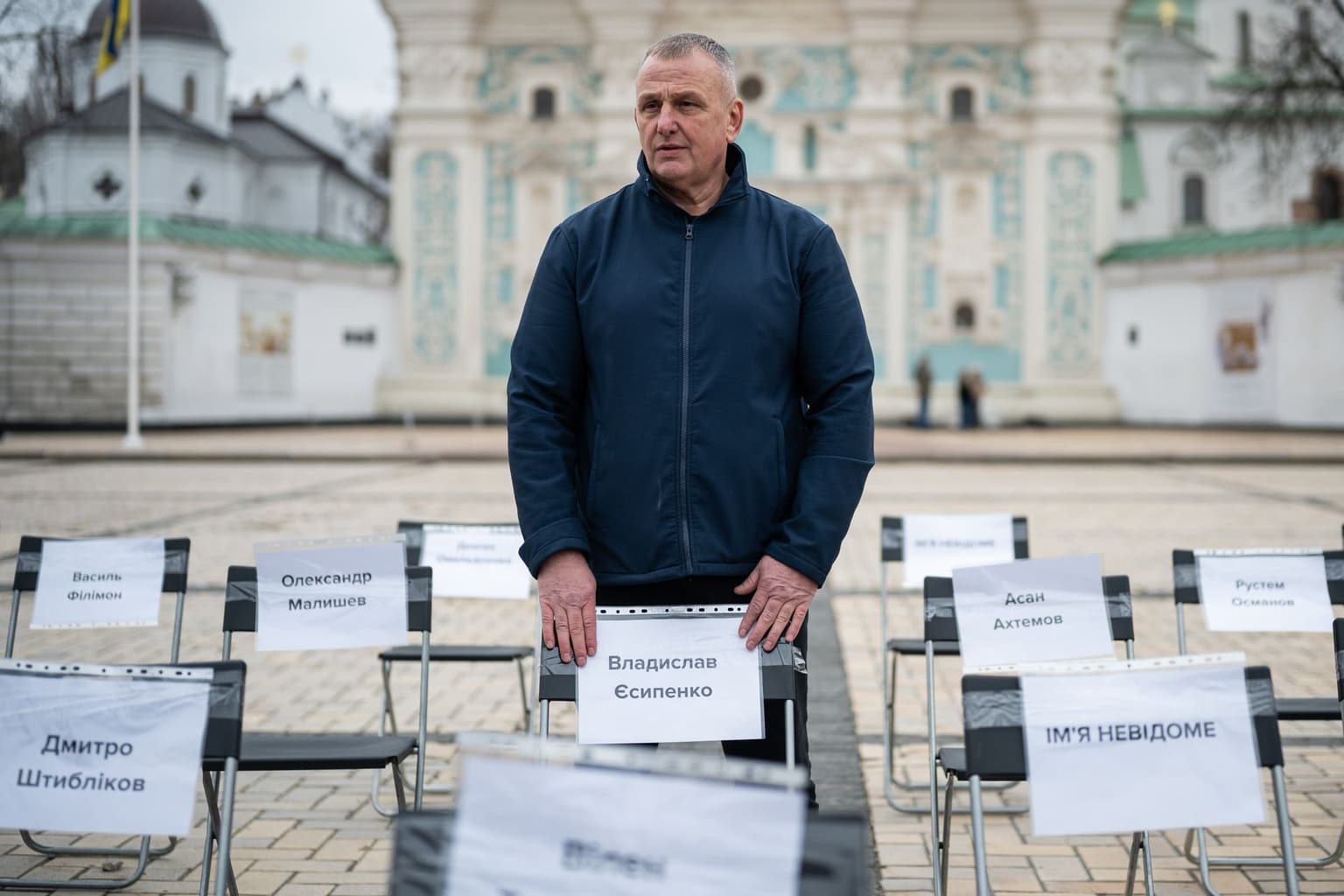
Ukrainian journalist Vladyslav Yesypenko, who was released from Russian captivity, stands next to a chair bearing his name during the Empty Chairs rally at St. Sophia Square in Kyiv, Ukraine, on Nov. 15, 2025. (Danylo Antoniuk / Anadolu via Getty Images)
 on Google

Dasha Sherstiuk
Communications Lead at PEN Ukraine
On Nov. 15, the global community marks the Day of the Imprisoned Writer, also known as Empty Chair Day.
You will not find this date in traditional calendars of public holidays, but that does not diminish the gravity of a day that reminds the world of hundreds — if not thousands — of unlawfully imprisoned writers, journalists, media workers, and cultural figures.
Empty Chair Day was established by PEN International as a human rights initiative to draw attention to writers, artists, journalists, and rights advocates who are unlawfully detained, held captive, or missing due to their work and beliefs.
Since 2018, the Empty Chair campaign has also taken place in Ukraine.
Today, for us, the Empty Chair Day has transformed into a vital way to return a voice to those whom Russia is trying to erase and silence in captivity.
"In a civilized 21st-century world, journalists should never be taken hostage, freedom of speech is an absolute standard, and torture is an unquestionable crime."
Russia is striving with particular vigor to silence independent journalists — people whose professional duty is to document facts and provide unbiased coverage of reality.
Even though Russia's war against Ukraine has been ongoing for over 12 years, the Ukrainian side still lacks an exact figure for how many Ukrainian media workers are currently held in Russian captivity and unlawful detention.
For instance, the Institute of Mass Information (IMI) reports that at least 27 Ukrainian journalists are unlawfully detained in the occupied territories and in Russia, 17 of whom are media workers from temporarily occupied Crimea. Meanwhile, the Crimean Tatar Resource Center cites 20 Crimean journalists behind bars, adding that occupation courts have sentenced a total of 29 civilian media workers from the peninsula.

Petro Yatsenko, a representative of the Coordination Headquarters for the Treatment of Prisoners of War, quotes an even larger number: 45 Ukrainian journalists and media activists, with 33 cases confirmed and seven listed as missing.
At first glance, an outside observer might assume that Ukrainian institutions lack coordination or focus regarding captive media workers if they cannot consolidate their data into a single figure. After all, the difference between 17, 27, and 45 is substantial, and behind every ordinal number lies the fate of a real person.
However, the core of the problem lies not in the work of Ukrainian monitors, but in the fact that Russia deliberately sabotages international rules on the detention and exchange of civilians while systematically cutting off journalists from any connection to the outside world.
"Russia’s withdrawal from the European Convention for the Prevention of Torture (ECPT) marked another step toward the complete isolation of its penal system."
As early as 2025, Ukraine's Main Directorate of Intelligence (HUR) exposed how Russia creates fake public and "humanitarian" organizations to conceal the detention sites of Ukrainian captives and block access for independent monitors.
In parallel, the Kremlin has weaponized its proxy, the Russian Red Cross, while the International Committee of the Red Cross (ICRC) remains deprived of real, unhindered access to most places of detention across the Russian Federation.
Another factor rendering precise verification impossible is Russia's consistent sabotage of international legal norms.

In a civilized 21st-century world, journalists should never be taken hostage, freedom of speech is an absolute standard, and torture is an unquestionable crime.
Moscow, however, systematically dismantles every legal safeguard, and Russia's withdrawal from the European Convention for the Prevention of Torture (ECPT) marked another step toward the complete isolation of its penal system.
This political decision carries direct and catastrophic consequences.
As Alan Mitchell, President of the European Committee for the Prevention of Torture, stated, Russia's denunciation of the treaty brings an end to the committee's monitoring mandate in the country and halts any independent international oversight of Russian detention facilities.
Put simply: ascertaining the fate, health status, and detention conditions of captives is now significantly harder, if not impossible.
Yet despite Moscow's attempts to conceal the truth, information about many unlawfully imprisoned media workers continues to surface. Captives themselves and their families play a key role in this, passing news and letters out of captivity piece by piece.

Civilian journalist Iryna Danylovych from Crimea remains behind Russian bars.
Agents of the Russian secret service, the FSB, abducted her directly from a bus stop in 2022, charging her with alleged "unlawful acquisition of explosives" and sentencing her to seven years in prison in December of that year.
In prison, Danylovych faces constant abuse and torture. Despite suffering severe hearing loss, the colony administration deliberately subjects her to additional psychological torture by playing loud music and denying her basic medical care.
Server Mustafayev, coordinator of the Crimean Solidarity human rights movement, has been held in Russian prisons since 2020, serving a 14-year sentence under fabricated charges of "participation in a terrorist organization" and "preparing for a violent seizure of power."
Indicatively, Russian authorities also labeled Crimean Solidarity — an organization dedicated to documenting human rights abuses on the peninsula — as an "extremist" entity and banned it.
In the temporarily occupied parts of Zaporizhzhia Oblast, occupation forces imprisoned Iryna Levchenko, a retired journalist abducted alongside her husband in occupied Melitopol in May 2023. For months, nobody knew anything about her fate, and only in fall did Russians reveal her 15-year prison sentence.

The plight of these journalists is complicated not only by unlawful arrests, but also by the fact that they were detained in Ukraine's temporarily occupied territories.
Russian authorities illegally force Russian citizenship upon them and try them in occupation courts, seeking to sever them from any international legal protection.
Yet, as long as public advocacy and global pressure continue, we see that freedom is attainable.
Rights advocate, journalist, and serviceman Maksym Butkevych, Crimean Tatar politician and media figure Nariman Dzhelyal, Radio Free Europe/Radio Liberty freelancer Vladyslav Yesypenko, UNIAN correspondent Dmytro Khylyuk, and many other cultural figures have already returned home.
Their release is the direct result of persistent work and active engagement by the Ukrainian public, PEN International, human rights advocates, media workers, and everyone who continues to bear witness to the unlawfully imprisoned.
This year, we want to make sure that each empty chair becomes more than just a reminder for us all about the fate of many journalists illegally held hostage by Russian prisons, and that each and every one of them returns home.
Editor's note: The opinions expressed in the op-ed section are those of the authors and do not purport to reflect the views of the Kyiv Independent.