Inside Operation Vivaldi — how Ukraine uses drones, robots to liberate territory in Donetsk Oblast
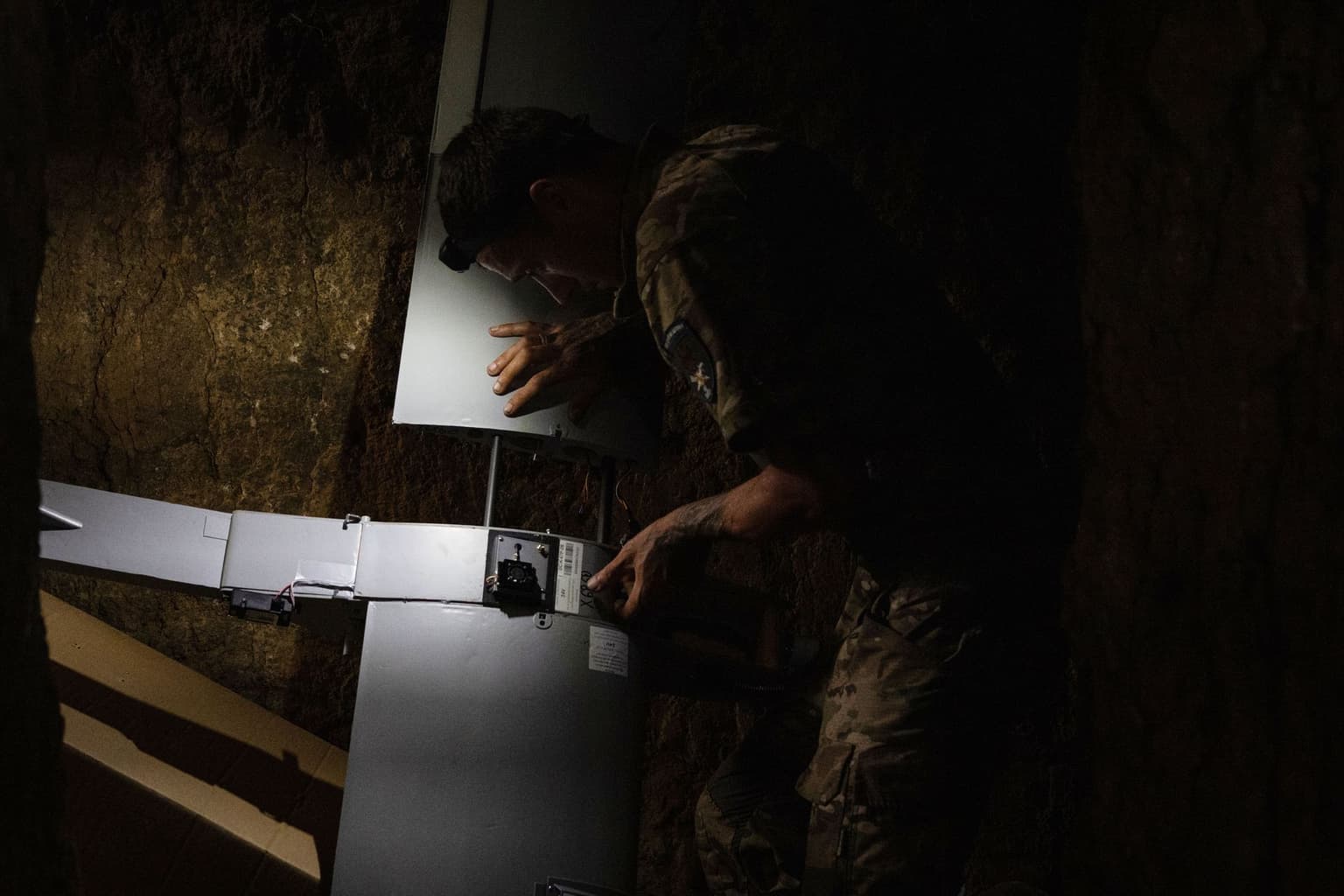
Tsyhan, a combat wing operator of the Darts crew of the NAFO, the 66th Mechanized Brigade, assembles a Dart in the Lyman sector, Donetsk Oblast, Ukraine, on Aug. 11, 2026. (Diana Delyurman / The Kyiv Independent)
 on Google
DONETSK OBLAST — On a screen, live footage from a reconnaissance drone shows two men in Ukrainian pixel camouflage dashing in short bursts through the ruins of apartment buildings. Then they vanish into a basement.
It is late summer, and the 3rd Army Corps and attached units are fully engaged in a counteroffensive in the Lyman sector called Operation Vivaldi. Russian forces are trying to recapture Lyman, a city in Donetsk Oblast that Russian officials have claimed their forces control. Ukrainian infantry on the ground tell a different story.
For weeks, the operation ran under a news blackout until 3rd Army Corps commander Brig. Gen. Andrii Biletskyi made it public on Sept. 15. By late September, the corps said it had retaken 176 square kilometers using closely coordinated infantry, air defense, electronic warfare, aerial drone units, and unmanned ground vehicles.
A four-person job
Watching the video feed are drone operators from the 66th Mechanized Brigade, subordinate to the 3rd Army Corps. They are waiting for a batch of Darts, fixed-wing strike drones, to join the fight for Lyman.
Their commander, call sign Deputat, is rushing to bring the drones. His car races down a road beneath tunnels of anti-drone netting, pine forests on either side, a landscape typical of northern Donetsk Oblast. Out of the darkness, a roadside coffee stand appears, glowing faintly. The car speeds past, then turns off onto rough ground.

"Turn on the electronic warfare device," Deputat orders a soldier in the car.
After some time, Deputat stops, quickly unloads the cargo, shakes hands with the soldiers, and drives off. The crew carries the drones into the dugout. They moved into this position only recently, after pushing closer to the front line. The gray zone is less than 10 kilometers away.
Four men live, sleep, and work in the cramped shelter. Crews usually rotate every couple of weeks, but heavy Russian shelling near the positions can delay a rotation.

In one corner is a workstation: a desk with several screens, one showing a video call with other units, another a live map of Donetsk Oblast. The areas marked gray or occupied are different from the picture Russian commanders paint. The soldiers listen to the call as they prepare to join a combined strike.
For hours, units attached to the 3rd Army Corps have been striking a Russian artillery position with HIMARS rockets and drones. According to the 3rd Army Corps, such missions play a crucial role in the operation by pushing Russian mortar and artillery crews out of the area and clearing the way for the infantry.
On the call, someone says, "If I were in their shoes, I'd hop on a motorcycle and get the hell out of there." The soldiers in the dugout laugh. The Ukrainians say the Russian crew won't abandon its howitzer because its soldiers are more afraid of their own commanders.

The strike is delayed. As the wait drags on, the young men grow restless and step out into the dugout's corridor to smoke. Kalash, a soldier with light stubble, is the oldest in the crew. The others jokingly call him Mom. As he cooks breakfast on a camping stove, the smell of scrambled eggs and sausage fills the damp air.
Finally, the duty officer on the call says, "Let's start the mission."
"This is the NAFO crew. We want to join the strike on the howitzer," replies a soldier with the call sign Intelihent, who is piloting today. Every member of the crew can do every job: assemble the drone, prepare it for launch, navigate for the pilot, and fly the strike.
Tsyhan, tall and tanned, assembles a Dart. It reminds him of building Lego as a kid, he says. He and Kalash carry the drone out into the field, set it up for launch, and talk over the radio with the men in the dugout.

"Get out of there," comes the voice over the radio.
"Launch," Tsyhan replies.
The drone must fly several dozen kilometers. Intelihent works the controls while Bratok, a dark-haired soldier, helps him navigate. Back in the dugout, all four stare at the screen, fidgeting nervously on the wooden bench.
"NAFO, locking on target," Intelihent says.
The drone strikes. Direct hit. The men cheer and clink cans of energy drink.
On the reconnaissance drone's feed, a stand of trees bursts into flames. Russian soldiers run out of a dugout and try to put out the fire. Then the feed cuts out. Pleased, the men post screenshots to the platoon's group chat. But someone on the call reports that the smoke is clearing and the target has survived. They must strike again.

"Don't worry, we've got plenty of planes," Kalash tells the others.
But the threat of retaliatory strikes looms over the dugout. Drone operators are among Russia's top targets.
"I think it'll be a few days before they come after us," Tsyhan says.
Eventually, several Ukrainian units working together destroy the Russian artillery position. The 3rd Army Corps said coordination between neighboring units played a key role in the operation.
The men finish the breakfast Kalash made. Some stretch out on camping mats on the wooden benches and sleep fully dressed. Another strike request could come at any moment.

Bratok is on duty, keeping an eye on the screens. To pass the time, he flips through live feeds from reconnaissance drones and unmanned ground vehicles (UGVs). On the screens, the war plays out in real time across the Lyman sector. The video feed from a ground robot catches his eye: a dirt road, and in the corner a tiny call sign that reads Kuzya.
"Kuzya is a legend!" Bratok says.
Robots take over logistics
Elsewhere in the Lyman sector, Kuzya himself is watching the same feed. The young redhead was one of the first UGV operators in the 66th Brigade's tank battalion. He used to be a driver, risking his life to bring food, medicine, and ammunition to the infantry. He still delivers supplies, but at far less risk. His UGVs can carry half a metric ton of cargo and keep going even after hitting a mine.
The battalion began building up its UGV capabilities in early 2026. They learned how to use ground drones from the 3rd Army Corps. Now, the 66th Brigade ranks among the top five units for UGV use, according to the Delta system's June 2026 rating. According to the team, its 20 operators now cover most of the battalion's logistics, running 100 to 150 missions a month and rarely taking a day off.

At first, the battalion's commanders were skeptical of the robots, until a heavily mined road left them unable to resupply a group of Mavic operators. Today, UGVs play an important role in Operation Vivaldi. The 96th Separate Support Battalion’s robots move ahead of the infantry and clear mines. Some are carried behind Russian lines by drones and launch an assault. But less visible work, logistics, matters just as much.
"Soldiers win battles, but logistics wins wars," says Aibolit, a burly man whose long beard gives him a Viking look. At the UGV hub, he decides which cargo goes on which vehicle.
The increased use of UGVs for logistics in the 3rd Army Corps and its attached units means infantry can reach the front line in armored vehicles or on foot, carrying only light backpacks. Reliable logistics also lets support teams deliver small comforts to the front, lifting the morale of infantrymen who may hold the same position for a month.
Orders come in every day. A soldier can order something in the morning and be drinking a soda in the gray zone by midnight. "It's like ordering pizza," Aibolit says.
"Is the sky clear?"

As evening falls, the men prepare two vehicles, open platforms on massive wheels, for a mission. They load packs of bottled water, fuel canisters, a generator, and sealed boxes of food the soldiers ordered. It takes them only minutes.
"Is the sky clear?" Aibolit asks over the radio.
"Negative. Lancet threat," comes the reply.
"We're holding all movement," Aibolit says.
A drone icon flashes on their screens. It seems to be heading straight for the hub. "Maybe it'll come here, maybe somewhere else," one of them says, and shrugs. The soldiers play it down, saying their town is quiet, yet not a day goes by without a Russian strike. To disrupt Ukrainian logistics, Russian forces freely use guided bombs, including against targets with no apparent military value.
Once the threat has passed, the men drive the vehicles out into the yard. A few minutes later, the robots roll off into the darkness.
Kuzya usually takes the vehicles into the gray zone, where the ground is heavily mined. He knows every pothole and bush on the route. His screen is almost entirely black, except for a stretch of cratered road lit by the robot's headlight.
Along the way, he passes wrecked cars marked with a white "Z." Stray dogs run up and bark at the strange visitor. Before long, they get used to it and trot alongside until they lose interest. Kuzya smiles.

Eventually, the robot stops. Soldiers in camouflage appear on the black-and-white screen and quickly unload the cargo. One walks up to the camera and gives Kuzya a thumbs-up before they disappear into the woods.
Kuzya turns the robot around to reload for the next mission. On a narrow dirt road, it meets another robot, and the two little vehicles circle each other as if they were dancing.
That evening, Deputat drives back from another delivery to his soldiers, beneath the netting, stars peeking through the mesh. A burned-out SUV, recently hit by a Russian Lancet, lies by the roadside.
"When you're coming back from the positions and you see the coffee stand, you know you're safe," he says.