In Kyiv district battered by Russian strikes, a protest to save trees turns ugly
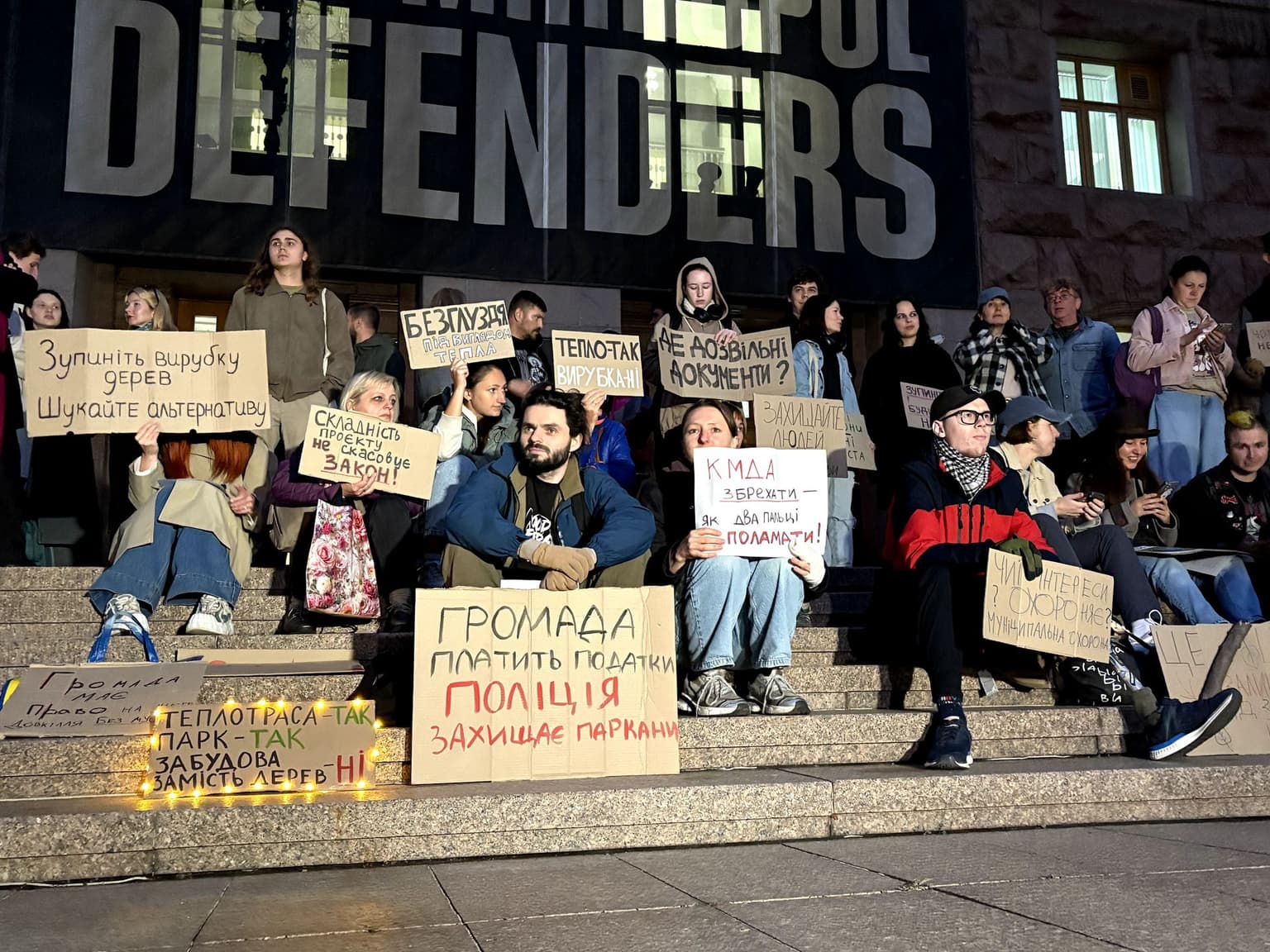
Demonstrators gather on the steps of the Kyiv City State Administration building during a protest in Kyiv, Ukraine, on Sept. 23, 2026. (Yevgeniya Doluda/The Kyiv Independent)
 on Google
In one of Kyiv's hardest-hit districts, a heating pipeline meant to help residents weather Russian attacks this winter has instead pitted them against their own city's administration.
Residents of Teremky, a neighborhood in southwestern Kyiv, say that while they are not against the pipeline itself, they oppose what they see as an unnecessary destruction of greenery to build it.
But after a violent pushback by municipal security guards injured several demonstrators, including women, the protests grew beyond an effort to save a century-old forest strip.
The community now wants to tackle not only ecological issues and winter preparations but also a broader problem with what they see as poor management by the city administration.
Following a series of protests, the demonstrators took to the stairs of the Kyiv City State Administration building on Sept. 23.
Aliona, a 34-year-old Kyiv resident, stood there with a clear message: "We are ready to fight. Not just with the enemy abroad. We are ready to fight injustice."
The root of the problem
The heating pipeline project in Teremky was presented as a way to help the capital through yet another harsh winter of relentless Russian attacks on the energy grid and other critical infrastructure.
The city administration says the project aims to provide backup heating to over 200 buildings, primarily residential, in a district heavily impacted by Russian strikes.
However, initial construction plans foresaw cutting down hundreds of trees, some of which have stood for over a hundred years, according to residents. The project, implemented by the municipal energy enterprise Kyivteploenergo, has faced criticism for allegedly exploiting local green areas for commercial gain.
"Kyivteploenergo is a very well-known company that, frankly, pursues a very socially irresponsible policy. Their legitimacy is under great question, and they make decisions that are beneficial to a minority of people," said Vitalii Dudin, a co-founder of Social Movement, a left-wing group campaigning for social justice.

"It's very easy to neglect the interests of the community," he told the Kyiv Independent.
Following close to a dozen protests, a two-week moratorium was announced on Aug. 12 to devise an alternative plan. Petro Panteleiev, the first deputy head of the Kyiv City State Administration, said the process "involved scientists and experts."
Panteleiev confirmed that the community's request to lower the number of trees to be felled had been granted and that construction should resume. The new plan supposedly reduced the number of trees to be cut down from 200 to about 10, but protesters remain skeptical of this promise.
Pipeline work resumed on Sept. 21, with heavy machinery appearing just a week prior. Although the city administration said that no trees were cut down that day, locals and protesters remained skeptical.
With temperatures already dropping in Kyiv, Panteleiev stressed the critical need to complete the pipeline project after a nearly two-month delay.
"Last winter, there were serious problems with heating in Teremky; after massive attacks, people remained without heating for a long time," the city official said in a Sept. 22 press release.

But protesters say they are not against the heating pipeline project itself, but rather the way it is being handled.
"I want to save my city, to see it green, and of course, I want warmth for all citizens. I don't want children and other people to be cold in the winter," said Kyiv resident Yuliia, 30, during the Sept. 23 protest.
"But we want this done properly and correctly," she added in comments for the Kyiv Independent.
"We have repeatedly proven (that alternatives exist) and found engineers who have proposed alternative routes, but the authorities ignore all this and do not communicate properly," said Tania, 36, a Teremky resident and protest participant.
A violent turn
The standoff entered a new phase when the rallies were met with force.
During a peaceful protest at the entrance to the construction site on Sept. 22, Tania said she was "roughly dragged through mud" by municipal guards, a local service tasked with maintaining public order and enforcing city regulations.
"I asked them to let me go, but they kept going and going, and they were really having fun doing it," Tania told the Kyiv Independent.
"They didn't let me go until the very end, when I was already starting to lose consciousness from the pain."
Despite multiple finger fractures on her left hand, she managed to attend the protest.
Videos of violent incidents involving Tania and others quickly circulated on social media, sparking outrage. Protesters called these events a "travesty" and demanded that the city administration issue a response.
In response to the Kyiv Independent's request for comment, the Kyiv City State Administration said that "the city is open to dialogue with residents," and "there have been repeated public meetings, during which residents' comments and suggestions were discussed."
The administration added that construction of the heating pipeline will continue according to updated plans despite repeated protests, but separately pledged to investigate the violent incidents.
"We will conduct a thorough and comprehensive investigation of the (municipal guard) employees' actions," Oleh Kuiavskyi, a deputy head of the city administration, said on Sept. 24 in a statement published on the administration's website.

However, since then, the violence has only escalated. On Oct. 6, Liubomyr Dmytryshyn, 24, a veteran who participated in the protests against the mass removal of trees, was arrested following a police search of his home.
According to a statement from Semiyarusna Hora, an urbanistic youth organization that Dmytryshyn leads, "law enforcement officers used physical force against Liubomyr without justification, resulting in bodily injury."
The organization also said the police seized his wife's phone and laptop, although she did not participate in any protest activities.
Dmytryshyn's sister, Yaroslava, said she is pained to see this happen to her brother, adding that "Liubomyr was detained without a proper explanation, and force was used against him during the search."
"People who defend their cities and their country should feel the support of the state, not face persecution from it," she added in a comment for the Kyiv Independent.
The Kyiv police confirmed they had launched a criminal investigation against a 24-year-old native of Lutsk, citing "a gross violation of public order… involving resistance to a representative of authorities maintaining public order."
The law enforcement body claimed that during an otherwise peaceful Sept. 27 rally, several participants provoked conflicts with police officers, using physical force and pyrotechnics, resulting in an injury to a policewoman.
The 24-year-old detainee "organized and coordinated the actions of the participants during the conflict with the police," according to the statement.
The police added that the investigation is ongoing, while Dmytryshyn's attorneys said he is currently being held in a temporary detention facility.
For many, these violent clashes marked a turning point at which the destruction of greenery was no longer the only problem.
Not just about the trees
The fact that the fight had grown beyond the trees was evident from dozens of cardboard signs during the evening protest on Sept. 23.
The messages varied from "Stop cutting down trees, find an alternative," and "Heating pipeline, yes; cutting down trees, no" to a poster with multiple pictures of civilians being assaulted by authorities with a statement: "This is not a dialogue."
Nadiia, 26, a photographer and copywriter, attributes the conflict to Kyiv Mayor Vitali Klitschko's shortcomings.
"Unfortunately, he (Klitschko) has been in power for what, 10 years; I haven't seen any steps towards ecology," she said.
Nadiia's pensioner mother, Slavna, agrees, adding: "We only see corruption."

The protests over the destruction of greenery grew into broader discontent with how Kyiv is being run.
"I just go around all week and tell people at work, and to my foreign friends, and to everyone about how Kyiv is an incredibly uncomfortable place to live," said Nadiia.
Residents are also frustrated with what they see as a lack of communication, transparency, and dialogue between their communities and the city administration. "This is not about a specific project, but about trust in the authorities," said Dudin.
Numerous protesters told the Kyiv Independent that they feel they are "being lied to" about the true intention behind the construction of the heating pipeline. Many believe there are undisclosed details about financing and the real beneficiaries.
"This is a blatant lie on the part of the Kyiv City State Administration," believes Tania.
There have been no reports or official investigations suggesting wrongdoing in connection with the project.
What's next?
As of now, there are no plans to halt the pipeline construction, nor is it clear whether the city administration will adhere to its promise to remove only 10 trees.
However, some protesters still hope the city administration will listen to them and understand their demands.
Despite her injury, Tania is motivated to keep protesting.

"We want to be heard, for people to understand that they are being lied to," she said.
For others, there is simply no alternative, as Teremky has been and will continue to be their home.
"I walked through that forest park area every day to kindergarten," Tamila, 50, told the Kyiv Independent.
She awaits her husband's return from the army and hopes that he will come home to a familiar green neighborhood rather than a construction site. Yet for her, this fight goes beyond the people who stood on the steps of the Kyiv City Administration building.
"We want to preserve the forest park zone not only for us, but for future generations," she said.
Yuliia Taradiuk contributed reporting.