Ukraine's charm offensive reaches Moscow's partners
Kyiv scores diplomatic points, but Moscow's partners aren't switching sides – yet.
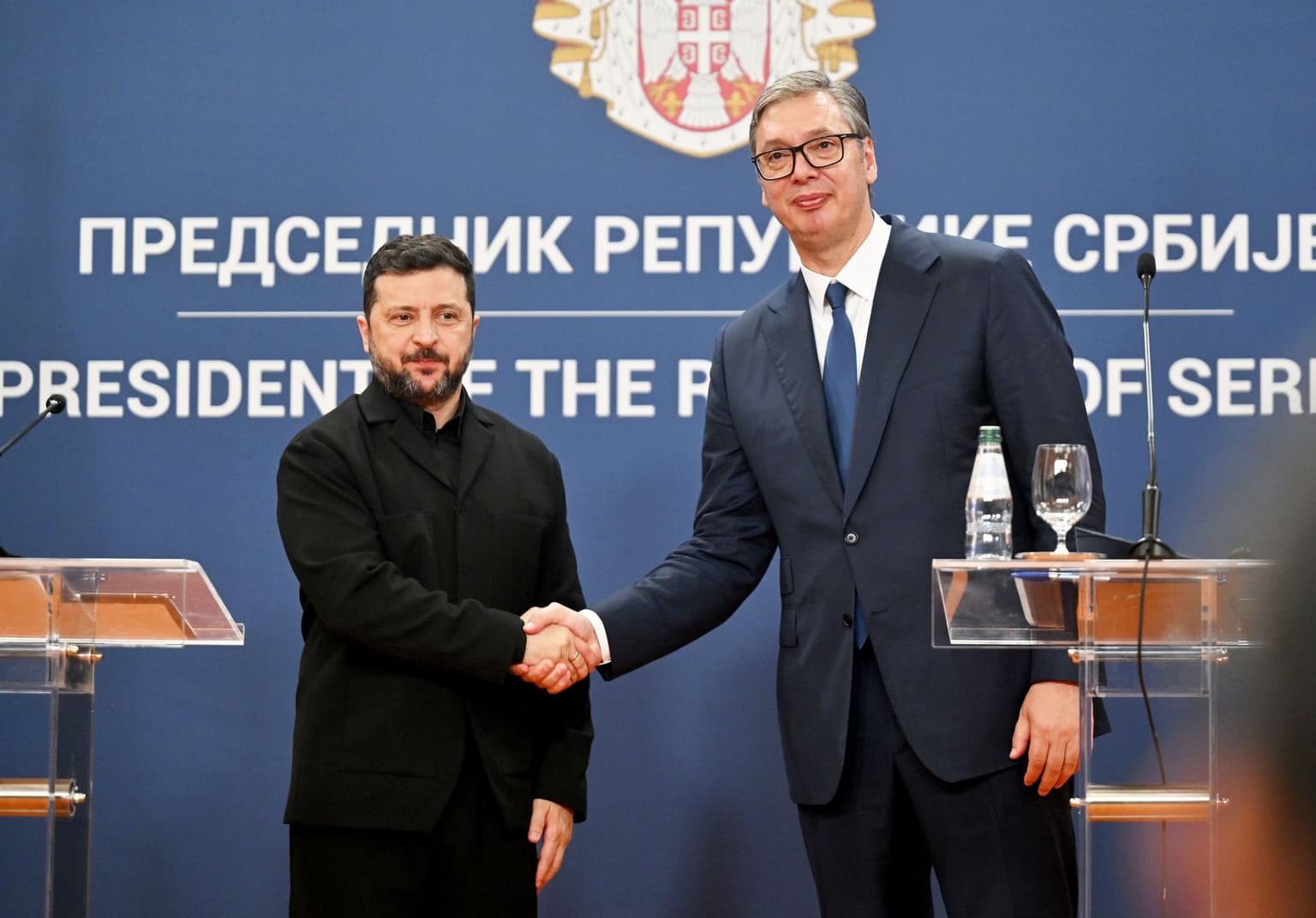
President Volodymyr Zelensky (L) shakes hands with Aleksandar Vucic (R), after a joint news conference at the Palace of Serbia in Belgrade, Serbia, on Aug. 8, 2026. (Oliver Bunic/Bloomberg via Getty Images)
 on Google
Ukraine's diplomacy is finding unexpected success beyond its traditional allies.
Within a span of a few months, President Volodymyr Zelensky has paid first wartime visits to Armenia, Azerbaijan, and Serbia — countries traditionally counted among Moscow's partners.
Economically and geopolitically weakened by its ongoing war against Ukraine, Russia is running short on political capital it can use to cement its sphere of influence.
This, mixed with recent hurdles in bilateral ties and pragmatic balancing in Belgrade, Yerevan, and Baku, provides an opening — one that Kyiv can use to seek arms, trade, or simply to deliver a diplomatic blow against Russia.
"Each of the countries… may have its own motivations, while Ukraine may pursue a different objective in each case," says Sergiy Solodkyy, director of the New Europe Center think tank in Kyiv.
"Nevertheless, one common trend can clearly be identified: the weakening of Russian influence and, in some cases, the emergence of serious tensions between Moscow and its traditional partners," he adds.
This outreach has its clear constraints, however.
None of these countries is ready to make a clear pivot from Russia, nor can they deliver the capabilities needed to tip the scales of the war, leaving Kyiv's tangible achievements modest or vague.
Russia's weakening sway
A common trait of Zelensky's recent destinations is that none are devoted allies of Russia. Rather, they hedge their bets between Moscow, the West, and other powers as needed.
Recent developments have made a cautious tilt from Russia westward increasingly appealing.
Yerevan, once a close strategic partner of Moscow, has been disappointed in Russia's refusal to step in when Azerbaijan invaded and seized Nagorno-Karabakh in 2023, leading Armenia to "freeze" its participation in the Moscow-led Collective Security Treaty Organization (CSTO) military bloc.
The U.S.-brokered peace deal with Azerbaijan in 2025 left Russia entirely out of the South Caucasus process and paved the way for the Trump Route for International Peace and Prosperity (TRIPP) trade corridor, which may help reduce Yerevan's economic reliance on Russia.
Engaging with Ukraine is also likely to win favors in Europe as both Belgrade and Yerevan aim to advance their European integration. A boost is much needed, as Serbia recently failed to open Cluster 3 in EU accession talks.

Engjellushe Morina, a Balkan politics expert at the European Council on Foreign Relations, says that even though Serbia continues to backslide on the rule of law and refuses to align fully with Europe's policies, hosting Zelensky is a pretense to cast Serbian strongman Aleksandar Vucic as more "pro-European."
Russia may itself be inadvertently driving this shift.
Moscow has publicly lambasted Serbia for indirect arms sales to Ukraine, issued threats and ultimatums to Armenia over its EU aspirations, and mishandled the fallout of its downing of an Azerbaijani airliner in 2024.
And countries once under Moscow's rule may have additional reasons for hedging between Ukraine and Russia, Solodkyy says.
"(These countries) understand that the outcome of the war will also shape their future: a Ukrainian victory would give them greater room to pursue independent foreign policies," the expert told the Kyiv Independent.
What is Ukraine's goal?
When it comes to tangible gains, Kyiv's motivations in courting Moscow's partners vary from case to case.
Serbia remains a vital source of Cold War-era ammunition, which Ukraine has been quietly obtaining through indirect sales.
Azerbaijan, in turn, is a major partner in energy — with the Socar oil company maintaining a strong presence across Ukraine — and the two countries are now exploring cooperation in drone technology.
But one goal may simply be to "needle Russia," Volodymyr Dubovyk, head of Odesa National University's Center for International Studies, told the Kyiv Independent.
It shows "that Ukraine is not only not folding under Russia's attacks but striving in its outreach to the others, including those who used to be close to Moscow," he adds.
"Each outreach may bring something and should not be underrated. Taken all together, it shows that Ukraine has some diplomatic prowess, and, indeed, has cards to play."
The recent successes stand in contrast to earlier years of the full-scale war, when Kyiv rarely managed to win support from countries beyond the Western bloc and its closest allies.
The key change now is Ukraine's shift toward a more transactional relationship with partners, made possible by its growing prowess in drone technology.
This was already evident in Kyiv's Drone Deals signed with Saudi Arabia, the United Arab Emirates, and other Middle Eastern nations that have also long walked a fine path between Russia and the West.
Limits
While Ukraine may have secured pledges of recovery support and taken steps toward a free trade deal with Serbia, it is unclear whether any military arrangements have been concluded.
Serbian ammunition has been reaching Ukraine through third-party countries for some time, and it is unknown whether the visit changed anything in this regard.
Zelensky's meeting with Armenian Prime Minister Nikol Pashinyan may have caused visible frustration in the Kremlin, but so far has had mainly a symbolic value.
There also remain significant constraints to how far these countries can go in their geopolitical balancing.
Russia continues to supply up to 90% of Serbia's gas, and many Serbs continue to view Russia as their Orthodox and Slavic "brother."
Surveys show that 58% of Serbs trust Russia, and Zelensky's visit sparked public protests from pro-Russian and right-wing groups.

"We've heard this so many times that Vucic is tilting towards the West or distancing himself from Russia. I will believe it when I see it," Morina says. When Vucic "needs to use the Russian ties and the religious ties, he does it very well."
Similarly, until the TRIPP project is materialized, Armenian trade remains heavily reliant on Russia, and Baku appears comfortable as a swing player between Turkey, Moscow, and the West.
And no matter the diplomatic snub Russia may suffer as a result of Zelensky's diplomatic tours, Armenia, Azerbaijan, or Serbia cannot replace the critically needed military support provided by the EU and — to an increasingly smaller degree — the U.S.
Kyiv's charm offensive has already had at least one negative impact.
Zelensky's statement in Belgrade that Ukraine does not recognize Kosovo's statehood — Ukraine's long-standing policy — was met with anger in Pristina, which has been a vocal advocate of Kyiv amid the full-scale war.
As Dubovyk warns, the "balancing" countries may yet again turn away from Ukraine if the situation calls for it.
None of the countries Ukraine courted has shifted its position on sanctions against Russia nor direct military aid to Kyiv, and there is no indication they will.
"But Ukraine has to diversify its relations in any case," Dubovyk adds.
"Each outreach may bring something and should not be underrated. Taken all together, it shows that Ukraine has some diplomatic prowess, and, indeed, has cards to play."
Note from the author:
Hi, this is Martin Fornusek.
I hope you enjoyed this article. In our team, we believe fact-based and truthful reporting should be available to all — that's why we don't use any paywall.
If you want to see more in-depth coverage of regional politics and how it shapes Ukraine's struggle against Russian aggression, please consider joining the Kyiv Independent community.