Ukraine faces race against time as Russia chokes Black Sea ports
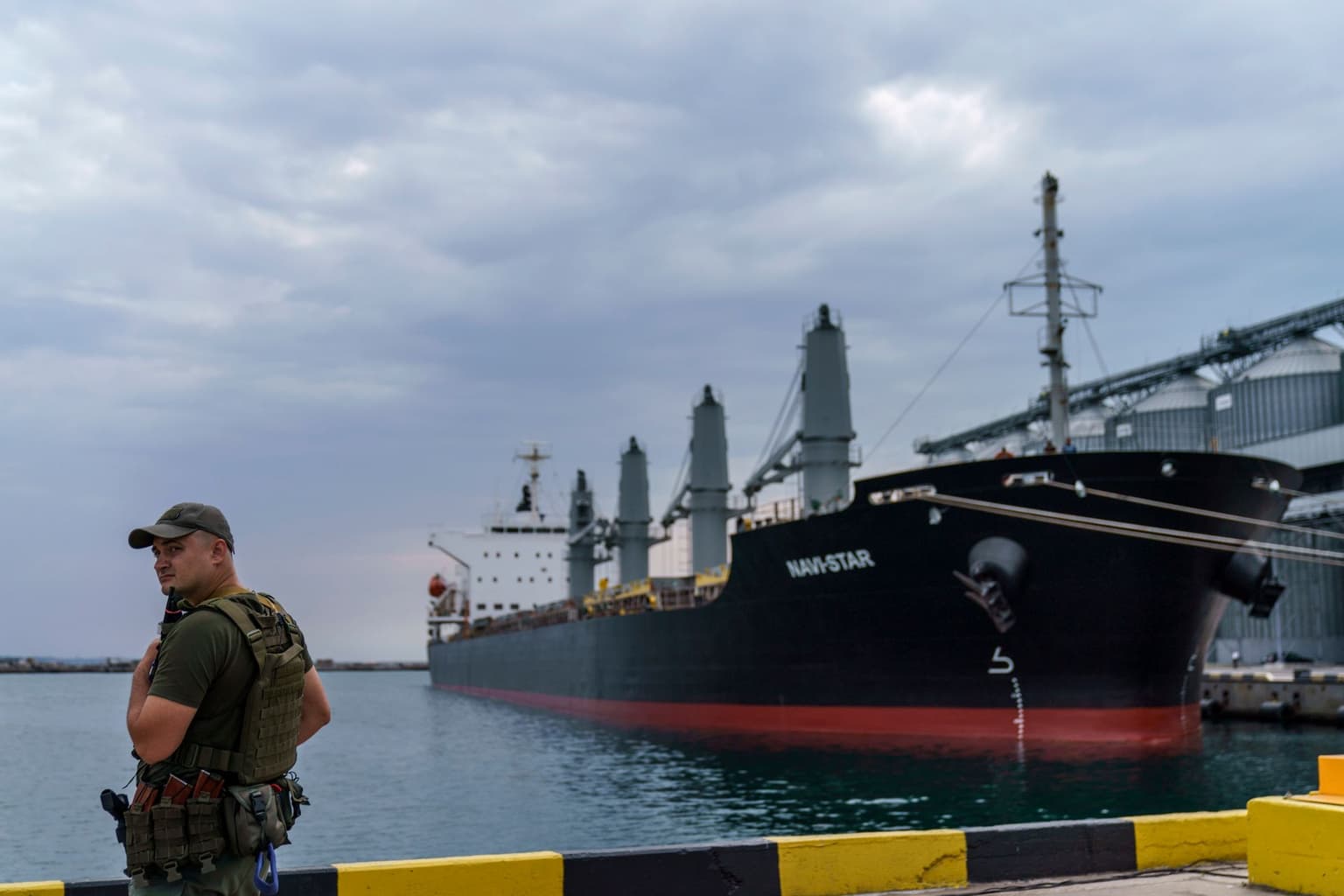
A security officer stands next to the grain ship Navi-Star at the Odesa Sea Port in Odesa, Ukraine, on July 29, 2022. (David Goldman / AP)
 on Google
Smoke billowing over the Black Sea is now an everyday sight in Odesa Oblast as Russia continues to strike ports and vessels in Ukrainian waters. But it’s on land that the impact of Russia’s campaign is most keenly felt, with Ukraine facing an economic crisis unless the country finds a solution soon.
The biggest victims are Ukraine’s agricultural and steel firms — both key economic drivers — which are cut off from crucial trading routes via the Black Sea. Ukraine could lose 1%-1.5% of its gross domestic product (GDP) by year-end, according to Olena Bilan, chief economist at investment firm Dragon Capital.
While the Black Sea isn’t officially blocked, vessels are avoiding Ukraine for fear of being hit by missiles. Since June, Moscow has deliberately stepped up attacks on civilian ships as well as port facilities, as Ukraine puts pressure on Russia’s economy by increasingly striking oil refineries, the shadow fleet, and dual-use logistics hubs.
For now, there is no clear solution to the crisis. Overland trade routes are simply incapable of transporting the same volumes as the Black Sea and are more expensive, while the shallower Danube River ports face Russian attacks and record-low water levels.
"You can barely find a vessel owner brave enough to actually go for one of the Ukrainian ports right now," Bogdan Kostetskyi, an operating partner at consulting service Barva Invest, told the Kyiv Independent.
"It looks like we will end up with the only option of overland border crossings, which in the best case can result in 1.5 million metric tons of traffic (for agricultural goods) when we need about 5 million metric tons of traffic per month."
The consequences are already dire. Logistics costs for grain have increased by $50 per metric ton while domestic grain prices plummeted, agricultural exports dropped by 23% last month compared to June, and steel giants Ferrexpo and Metinvest have shut down production at several mines because they are unable to import and export products.
"You can barely find a vessel owner brave enough to actually go for one of the Ukrainian ports right now."

In the long run, cash-strapped farmers may plant fewer crops, steel companies may lay off staff, and consumer costs could rise in tandem with increasing railway freight tariffs, which rose by 30% this month as a result of the port attacks, Serhii Vovk, director of the Center for Transportation Strategies, a consulting firm in Kyiv, told the Kyiv Independent.
For now, Ukrainian farmers are opting to store their grain instead of paying sky-high export prices, while officials seek solutions. But the critical moment will come in mid-September, when the corn harvest begins, with Ukraine expecting a bumper year, and storage space runs out, Vovk said.
"Corn is one of the key grain goods and is oriented toward the China market. It needs deep water and big vessels to export it," he said.
Kyiv is desperately looking to partners for support. One option currently being discussed is exporting through four Polish ports, despite Warsaw’s current ban on Ukrainian grain imports, according to Ukraine’s Agriculture Ministry.
Meanwhile, Ukrainian Railways, the state-run train company, is negotiating a 50% transit tariff discount with Moldovan Railways to reduce cargo costs, with the end goal of transporting goods to the Romanian port of Constanța.
Kyiv also asked the EU for 220 million euros ($254 million) in grants to support small and medium-sized farmers by helping them pay the interest on their bank loans through the state’s 5-7-9% loan program.
Brussels told the Kyiv Independent that it has received the request and is assessing the situation, as well as holding discussions with Kyiv, Bucharest, and Chisinau. It did not confirm whether it will provide the funding.
The big breakthrough could come later this month as Turkey mediates talks between Russia and Ukraine after calling for a moratorium on Black Sea strikes on Aug. 9. Ankara previously helped negotiate the Black Sea grain deal in 2022, which restored the transport of Ukrainian grain that had previously been blocked by Russian vessels.
The first results of the talks to restore maritime operations may be seen on Aug. 20, Valerii Tkachov, deputy director of the Commercial Operations Department at Ukrainian Railways, told ASAP Agri, an analytical firm, later confirming the timeframe with the Kyiv Independent. Ukraine’s military is also working to physically unblock the ports, he told the Kyiv Independent.
Turkey is a key stakeholder that operates in Ukrainian and Russian ports and buys both Russian and Ukrainian grain and metal, Vovk said. But whether Ankara can successfully negotiate another Black Sea deal in time is uncertain, he added.
"The window for a solution is very short. We have from now until October or the start of November. After that, our storage will be full, it will be really a big problem," he said.
Additional reporting by Chris Powers.