Zelensky's Serbia gamble puts Ukraine's principles to the test
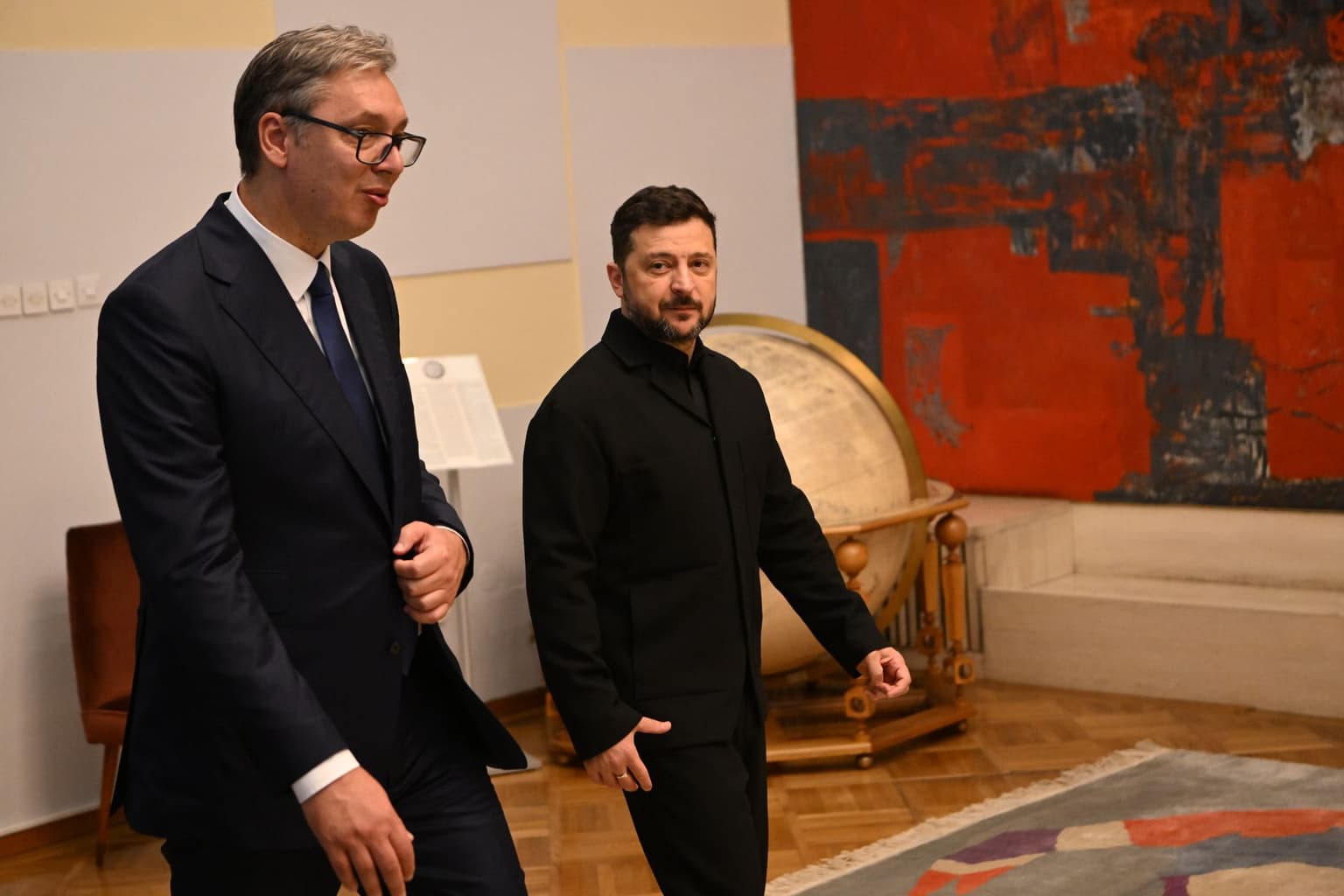
Serbian President Aleksandar Vucic (L) meets with President Volodymyr Zelensky (R) during Zelensky's first visit to Serbia at the Palace of Serbia in Belgrade, Serbia, on Aug. 8, 2026. (Stringer / Anadolu / Getty Images)
 on Google
Blerim Vela
Non-Residential Fellow at UTSYN
President Volodymyr Zelensky's first official visit to Serbia was a diplomatic gamble.
Ukraine needs partners wherever it can find them, including states that maintain close ties with Moscow. But Serbia is not becoming a conventional Ukrainian ally. Belgrade nominally supports Ukraine's territorial integrity and has provided humanitarian assistance, while Serbian-made ammunition has reached Ukraine through third countries.
At the same time, Serbia has not joined the European Union's sanctions regime against Russia and continues to maintain close political and economic ties with Moscow.
That contradiction is not necessarily a reason for Kyiv to disengage. A country fighting a major war cannot afford to disregard useful diplomatic relationships, economic opportunities, or practical assistance. The challenge is to distinguish between cooperation and alignment, pragmatism and endorsement.
In Belgrade, Zelensky and President Aleksandar Vucic announced deeper cooperation in energy, infrastructure, food security, and trade, with Serbia offering additional humanitarian assistance, support for reconstruction, and a pledge to work toward a free-trade agreement by the end of 2026.
These are useful outcomes. But the optics matter too: in the Western Balkans, as in Brussels and Washington, diplomatic gestures are closely watched.
For a government that has made sovereignty and territorial integrity central to its international appeal, the partners Ukraine chooses, and the language it uses to describe those partnerships, carry strategic weight.
Serbia can be useful, but it is not aligned
There are practical reasons for Kyiv to maintain pragmatic relations with Belgrade: Serbian-made ammunition has reached Ukraine through third countries, and Serbia has provided humanitarian assistance and economic cooperation.
These have real value for a country at war, but should not be mistaken for Serbia's broader geopolitical realignment away from the Russian orbit.
Serbia remains closely connected to Russia politically and economically. Its energy relationship with Moscow remains significant, and Belgrade continues to maintain political channels with the Kremlin. Serbia's domestic political and public environment also remains completely receptive to Russia-sympathetic narratives.

Two days before the full-scale invasion, the pro-government tabloid Informer ran a headline echoing Kremlin claims that Ukraine had attacked Russia. When Serbia's student protests gathered momentum in 2025, Vucic and regime-aligned voices repeatedly cast the demonstrations as a foreign-backed "color revolution," invoking Ukraine and the Maidan as examples of popular uprisings allegedly orchestrated from abroad.
None of this makes Serbia an adversary, and Serbian society should not be equated with the policies of its government. But these episodes show why Kyiv should treat Serbia as a practical partner rather than a strategic or political model for the region.
Territorial integrity cannot be selective
This distinction matters most over Kosovo.
After the Zelensky-Vucic meeting, Vucic reaffirmed Serbia's nominal support for Ukraine's territorial integrity under the UN Charter, and Zelenskyy thanked Serbia for respecting Ukraine's sovereignty, including the status of Crimea. Ukraine's appreciation is understandable. But principles of territorial integrity are strongest when applied consistently.
Zelensky also confirmed that Kyiv's position on Kosovo has not changed: Ukraine still does not recognize its independence. Yet Ukraine has already shown that non-recognition need not mean opposition to Kosovo's membership in European institutions.
In 2023, the Committee of Ministers of the Council of Europe advanced Kosovo's membership application. Ukraine did not vote against the application — instead, it abstained. The decision demonstrated that Kyiv's policy of non-recognition does not include an opposition to Kosovo's membership in European organizations.
Kosovo, for its part, has unequivocally supported Ukraine by aligning with all EU sanctions against Russia, providing humanitarian and military assistance, and hosting a dozen Ukrainian journalists.
Kyiv can keep its formal position while making clear that Serbia's claim on Kosovo gives it no permanent right to political leverage over it. Non-recognition should not justify coercion, destabilization, or indefinite obstruction of Kosovo's international participation; relations between the two should instead rest on mutual recognition and functional coexistence.

This matters beyond Kosovo. In Bosnia and Herzegovina, fragile institutions are still tested by secessionist rhetoric from Republika Srpska, whose leadership is close to both Belgrade and Moscow.
Montenegro, too, has felt significant Serbian political and informational, political and religious influence.
The broader question, whether neighboring states can determine their own political futures free of pressure from a larger state claiming special responsibility for its ethnic kin, is close to the heart of Ukraine's own case against Russia.
Why this matters to Ukraine
Ukraine's diplomatic strength rests on more than military resistance. It also rests on persuading other countries that Russia's conduct violates principles meant to apply universally: sovereignty, territorial integrity, and the right of nations to choose their own futures.
That coalition needs consistency. If these principles hold when Russia invokes history or ethnicity to justify aggression but become negotiable when another state makes a similar argument on a smaller scale, their legitimacy erodes, which is exactly why Kyiv needs to separate cooperation from endorsement.
The EU's own approach offers a template: its 2023 Agreement on the Path to Normalization envisaged Serbia not objecting to Kosovo's membership in international organizations, even without recognition. Ukraine can draw on the same distinction: it can support Kosovo's security and international agency until it changes its position on recognition once the war is over.
What Ukraine could do differently
Kyiv should continue engaging Serbia, but with clearer political boundaries.
It should compartmentalize the relationship by welcoming practical cooperation without assuming that it signals a Serbian realignment away from Russia. It should also clarify its position on Kosovo while explicitly supporting regional normalization and Kosovo's international agency.
Kyiv should also deepen direct engagement with Kosovo, as other EU member states, such as Greece, that do not recognize it, have done.
Finally, Ukraine should apply the principle of sovereignty consistently by challenging any doctrine — Russian, Serbian, or otherwise — that grants a state special rights over its neighbors on ethnic or historical grounds.
A Europe that is whole, free, and at peace cannot be built on selective principles. Ukraine has shown its commitment to resisting hegemonic aggression on the battlefield. Its diplomacy in the Balkans should now demonstrate that the same commitment to sovereignty, self-determination, and the security of smaller states extends beyond Ukraine's borders.
Editor's note: The opinions expressed in the op-ed section are those of the authors and do not purport to reflect the views of the Kyiv Independent.