Explainer: What's behind the standoff between Ukraine's two intelligence agencies?
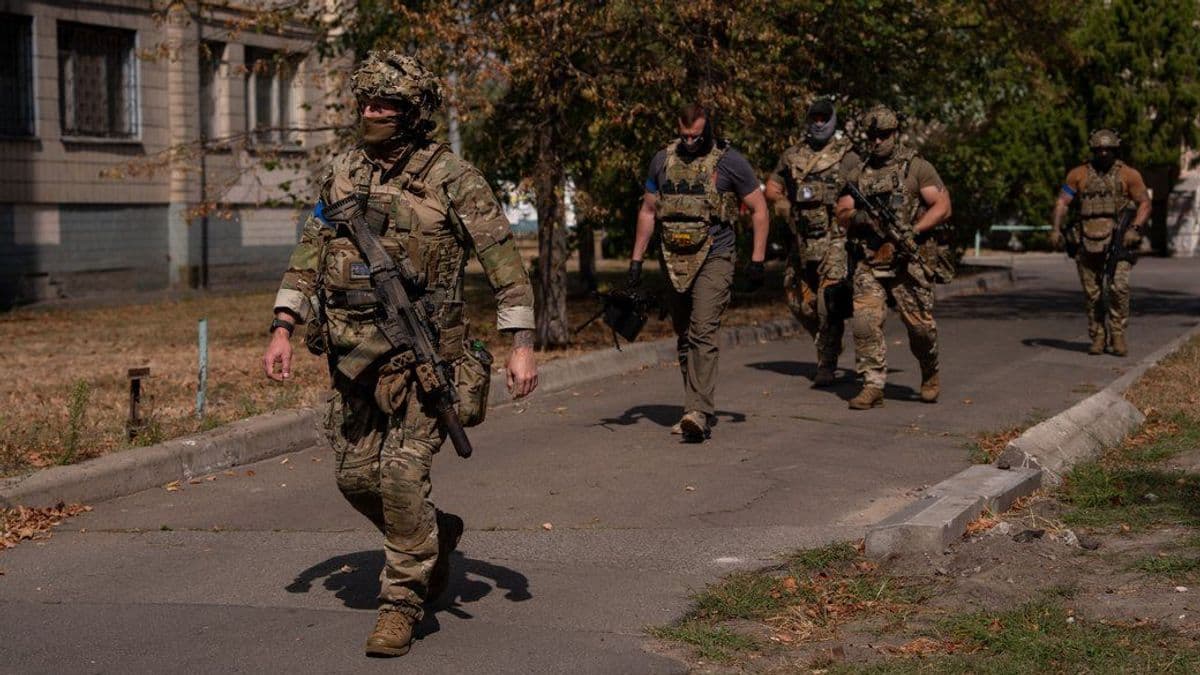
Military personnel of the military intelligence (HUR) walk through a yard in the Dniprovskyi district of Kyiv, Ukraine, on Sept. 2, 2026. (Olexandr Magula / Suspilne News)
 on Google
The violent standoff between Ukraine's Security Service (SBU) and the military intelligence agency (HUR) on Sept. 2 exposed two dysfunctions of Ukraine's law enforcement and security system.
One is the long-running conflict between the two intelligence agencies: although competition among secret services is common worldwide, shootouts that result in injuries are far more troubling than a routine institutional rivalry.
The conflicts between Ukraine's two security agencies "have gotten out of control," political analyst Volodymyr Fesenko told the Kyiv Independent.
Another underlying problem is the lawless methods allegedly employed by Ukraine's intelligence and law enforcement bodies.
Some observers link the recent wave of lawlessness with the controversial figure of Oleksandr Poklad, who became the SBU's acting chief in July.

Others view the conflict differently: not merely as an inter-agency standoff but as an attempt to damage the political standing of President Volodymyr Zelensky's Chief of Staff Kyrylo Budanov, who had served as Ukraine's popular military intelligence chief until January.
What happened?
The dysfunction within the agencies was laid bare in the Sept. 2 shootout, though the parties involved offered differing accounts of the incident.
The SBU claimed on Sept. 3 that Stepan Kaplunov, a deputy commander of the Russian Volunteer Corps, had been tasked by Russia's Federal Security Service (FSB) with "preparing an assassination attempt against one of the leaders of the Russian opposition movement, who was due to arrive in Ukraine at the time."

The Russian Volunteer Corps is a HUR unit comprising Russian fighters who support Ukraine.
The media outlet Babel reported on Sept. 3, citing its sources, that the SBU was referring to the visit of Akhmed Zakayev, the prime minister of the Chechen Republic of Ichkeria in exile.
The SBU also published alleged correspondence between Kaplunov and an FSB officer.
Kaplunov's version
Kaplunov presented a different version of the events.
He said that SBU officers falsely presenting themselves as police had illegally abducted him on Aug. 23 "like bandits." He said they had taken him to a "secret prison," applied psychological pressure, and threatened him with death.
He also said that, while under duress, he confirmed the investigators' version of the events "although in reality nothing like that happened."
Kaplunov was then taken by SBU officers to his apartment building in Kyiv on Sept. 1, where a shootout between SBU and HUR officers ensued.
Two HUR officers were heavily injured, Kaplunov's lawyer Taras Borovskyi said.
Borovskyi also alleged that SBU officers had carried out an emergency nighttime search of Kaplunov's apartment without allowing his lawyer inside and without a court warrant.
Eventually, the SBU and HUR reached an agreement, and Kaplunov was released.
Denis Kapustin, head of the Russian Volunteer Corps, told the Kyiv Independent that the SBU operation was "an attempt to exert pressure outside the bounds of the law in order to make Stepan (Kaplunov) falsely implicate his commanders, which could then have served as grounds for further action."

Kaplunov was neither charged nor brought to court. Under Ukrainian law, a person must be charged within 24 hours and brought before a court within three days or be released.
Olena Shcherban, a lawyer for the Anti-Corruption Action Center, an independent watchdog, believes that, based on video footage of the incident, Kaplunov's detention "appears to be clearly unlawful."
Fedir Venislavskyi, a member of the parliament's national security and defense committee, said that both HUR chief Oleh Ivashchenko and SBU acting head Poklad had presented their versions of the events at a committee meeting on Sept. 3.
"In the committee members' view, there were violations on both sides — both by HUR and the SBU. Any use of firearms — particularly automatic weapons — in a densely populated residential area is inherently unacceptable," he told the Kyiv Independent.
Veinslavskyi declined to share further details about the agencies' accounts, as they were provided "behind closed doors."
The Kyiv Independent has requested comments from the SBU and HUR but has not received a response at the time of publication.
A long-running conflict
The conflict between HUR and the SBU has reportedly been going on for years, with major controversies appearing as early as the start of Russia's all-out war.
Denys Kireev, a member of Ukraine's negotiating delegation, was shot dead by SBU officers at the beginning of Russia's invasion in 2022. Kireev had reportedly been working for HUR.
The SBU claimed it had "strong evidence" that Kireev was leaking information to Russia.
In 2023, both Budanov, then head of HUR, and Mykhailo Podolyak, a presidential staffer, said that Kireev was not a Russian agent.
The SBU told the Kyiv Independent that Kireev's death is being investigated by the State Investigation Bureau — Ukraine's chief agency investigating potential crimes by high-ranking government, law enforcement, and military officials — and information on the case cannot be disclosed without the consent of investigators and prosecutors.
"(The confrontation between the SBU and HUR) goes back a long way," Fesenko told the Kyiv Independent. "Conflicts between intelligence and security agencies are actually quite common."
Kapustin, commander of the Russian Volunteer Corps, portrayed the Sept. 2 incident as a confrontation with the fifth unit of the SBU's counter-intelligence department — the one involved in the shootout — not with the SBU as a whole.
The commander argued that his subordinates "have a very good relationship with SBU personnel" from other units and carried out joint operations with them.
Venislavskyi voiced a similar opinion.
"There has always been competition between law enforcement agencies in Ukraine, and there always will be," he told the Kyiv Independent. "But HUR combat units and SBU units very often work side by side, carrying out joint combat missions and special operations. So I don't think it is accurate to talk about some broader confrontation or conflict between the two agencies."
Dmytro Lytvyn, a Zelensky aide, also denied any conflict between the two agencies on Sept. 3.
"They are not fighting each other," he said. "Each agency simply gave its own account of what happened in response to numerous inquiries from (journalists)."
read also
Budanov's role
There is also the theory that the SBU attack was intended to deal a blow to Budanov.
Budanov emerged as a popular figure in Ukraine while he served as head of HUR from 2020 to January 2026, when he became Zelensky's chief of staff.
Ivashchenko, the current head of HUR, is believed to be in conflict with Budanov and is firing Budanov loyalists, the media outlet Ukrainska Pravda reported in August, citing its sources.
Meanwhile, the Russian Volunteer Corps was set up in 2022 under Budanov's leadership and is still reportedly connected to Budanov.

Kaplunov said on Sept. 3 that the SBU was trying to discredit Budanov by implicating the unit in alleged cooperation with the FSB.
"The whole thing looks like an attempt either to find compromising material on Budanov or to manufacture it," Fesenko said.
Kapustin told the Kyiv Independent that he had "heard different versions" of the events.
"Some say this was an attack on Kyrylo Budanov; others say it was an attack on the current head of the HUR, Oleh Ivashchenko," he said. "I see this as an attempt to discredit (HUR) as a whole."

He argued, however, that Budanov and Ivashchenko "are in communication with each other," and that "it would not be accurate to say that there is any kind of rivalry between them."
read also
A culture of lawlessness
Some observers link the recent conflict to the controversial reputation of Poklad, who has served as acting head of the SBU since July.
Civic activists and legal experts accuse Poklad of having operated with little regard for the law throughout his career.
"There are indeed a lot of rumors about his particular management style and his use of methods that are not entirely lawful," Shcherban told the Kyiv Independent. "He is known for this, and that is the reputation he has both within the SBU and outside it."
Poklad was reportedly involved in the controversy over the murder of the negotiator Kireev in 2022.
On the night before negotiations in Belarus, Kireev received a phone call from Poklad's office, the Wall Street Journal reported in 2023, citing Budanov. Budanov said that Poklad wanted to meet Kireev.
The Anti-Corruption Action Center and other activists have also accused Poklad of leading the authorities' 2025 attack on the National Anti-Corruption Bureau (NABU).
According to the Kyiv Independent's sources in Ukraine's law enforcement agencies, Poklad had visited Dubai ahead of the return of Fedir Khrystenko, a key figure in the NABU controversy, to Ukraine in 2025.
Khrystenko, who has been charged with treason, was brought back to Ukraine by Poklad without any legal extradition or deportation procedure, Shcherban said.

The SBU's aim was to make Khrystenko testify against NABU officials and anti-corruption prosecutors and implicate them in alleged cooperation with Russia and corruption, according to Shcherban.
The acting SBU chief also allegedly directly participated in the Kaplunov controversy, as Kaplunov said that Poklad had personally interrogated him.
The Sept. 2 shootout has not been the only controversy surrounding the two agencies in recent months.
A HUR officer and a former SBU agent were charged in July with killing the alleged perpetrator of the June murder attempt on Ukrainian businessman Vadym Iermolaiev in Monaco, according to the Ukrainian authorities. They have also been investigated as potential participants in the Monaco assassination attempt.
These incidents increasingly raise questions about the limits of Ukraine's powerful security and intelligence agencies — a sensitive topic as both continue to play a vital role in the country's war effort.