As Russian missiles slip through Kyiv's air defenses without warning, officials say US intelligence sharing remains intact. For now
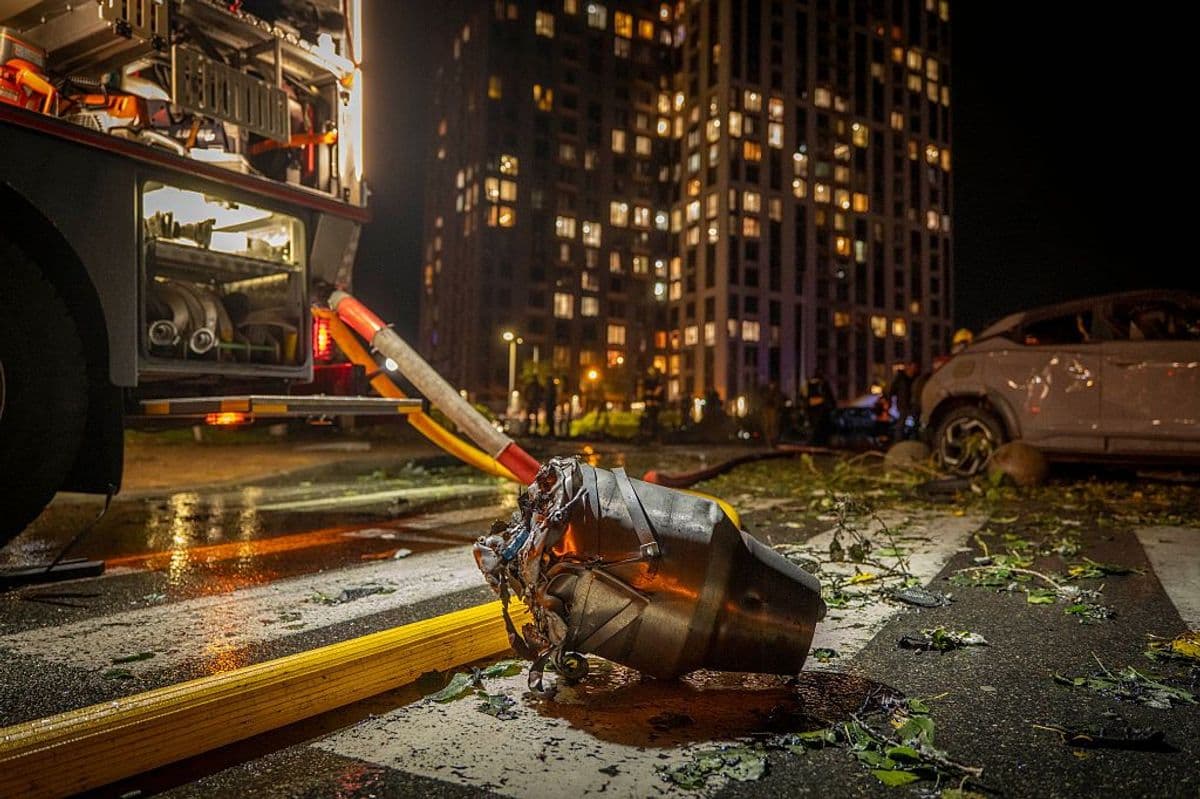
A piece of a drone lies in front of a fire truck that arrived to extinguish the aftermath of a Russian strike on Oct. 12, 2026 in Kyiv, Ukraine. On the evening of October 12, a Russian strike drone hit the courtyard of a residential high-rise building. Two people were killed and 11 others were injured in the explosion. (Dan Bashakov/Global Images Ukraine via Getty Images)
 on Google
Despite the recent failure of Kyiv's early warning system and threats to halt U.S. intelligence sharing with Ukraine, Washington made no such decision, Ukrainian and American sources told the Kyiv Independent.
Five Russian S-400 missiles struck the Ukrainian capital shortly after 10 p.m. local time on Oct. 12, causing "massive explosions," Kyiv Independent journalists reported. Air raid sirens and mobile alerts sounded only after the attack.
The attack came as Washington had threatened to suspend intelligence sharing unless Kyiv stopped striking Russian energy infrastructure, the Kyiv Independent has learned.
Ukraine receives intelligence from the U.S. to help detect and track Russian missile launches and other aerial threats.
Zelensky described the strike as "particularly vile," saying Kyiv "received no early warning from our partners about this strike." His remarks raised questions about whether Washington had suspended intelligence assistance to Ukraine.
Ukrainian Foreign Minister Andrii Sybiha, in turn, publicly said that intelligence sharing with the Americans continued, saying on Oct. 13, "Yes, we continue this cooperation."

Multiple sources told the Kyiv Independent that there was no decision to cut intelligence sharing. The incident instead appears to have involved a failure to detect or communicate the missile launch in time to warn Kyiv.
The S-400 is a Russian air defense system with secondary ground-attack capabilities. Since 2022, Russia has repeatedly used the system, as well as its older version, the S-300, to strike Ukrainian cities.
One senior Ukrainian official familiar with the matter said Ukraine's military leadership contacted its U.S. counterparts after the strike to clarify what had happened.
"They say they didn't cut it off, but they didn't warn us (about the attack) either," the official said.
"The Americans said they just didn't see (the launch)... That's a weak excuse."
The official alleged that the incident might have been "a game" to test Ukraine's reaction. Ukraine's military leadership also warned senior officials that if similar incidents became a pattern, they could indicate that Washington was using intelligence assistance to pressure Kyiv.
There is, however, no evidence in the information provided that the incident resulted from a deliberate decision to withhold intelligence.
Detection of ballistic missile launches is largely carried out by a network of sophisticated infrared detecting spy satellites, which identify the thermal spikes caused by the launch of ballistic missiles, Fabian Hoffmann, a senior research fellow at the Norwegian Institute for Defense Studies, told the Kyiv Independent.
The system is generally extremely reliable but not infallible, Hoffmann said, explaining that certain environmental conditions, such as dense, unusually high cloud coverage, could impair its functioning.
Like any system, Hoffmann said, it was susceptible to "human or technical failure" or "extraordinary circumstances" that could impair its functioning.
Missile attacks on Kyiv, which precede air raid warnings, are uncommon but have occurred several times since 2022. In almost all cases, it was the ballistic missiles, which fly at extremely high speeds, that escaped detection by radar.
"Friends, this is not the first time that the intelligence services of our partners have not recorded the launch of the S-400," Zelensky's advisor, Sergey Beskrestnov, said on Oct. 12. "You should not draw conclusions prematurely."
read also