Ukraine’s increasingly violent mobilization problem
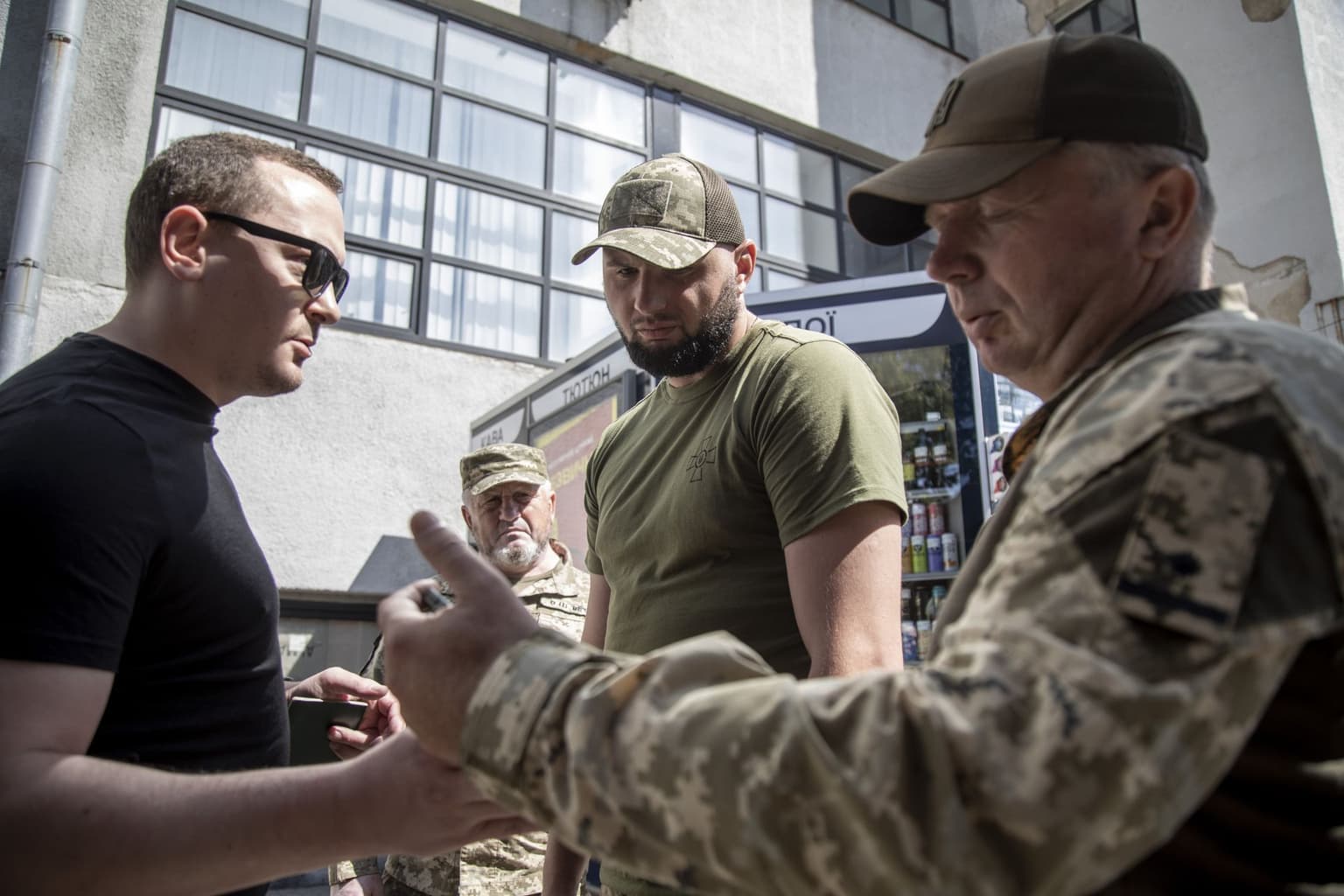
Members of the Kharkiv Regional Recruitment Office check a civilian's documentation in Kharkiv, Ukraine, on Aug. 8, 2024. (Narciso Contreras / Anadolu / Getty Images)
 on Google
Editor's note: The former soldier quoted in this article requested that his last name be withheld for security reasons.
After eight months recovering from war wounds, Mykola returned to duty — not to the eastern front, but to a posting far from the fighting, at an enlistment office in the country's west. Still relearning how to walk again, he soon discovered how differently society regarded his new role.
"Many people, including some of my acquaintances, now seem to view draft officers as the enemy," the former platoon commander told the Kyiv Independent.
Though far from the front lines, service at enlistment offices, reportedly responsible for around 90% of Ukraine's mobilization work, can be no less dangerous. Officers routinely face confrontations with civilians, and rising tensions have at times escalated into violence, resulting in injuries and, in some cases, even death.
Reported attacks on enlistment officers, many of whom are former front-line soldiers reassigned to recruitment duties after being wounded in combat, have surged: from five cases in 2022 to 341 in 2025. In the first four months of 2026 alone, 118 such incidents were recorded, the National Police told the Kyiv Independent.
Over the course of the full-scale invasion, three enlistment officers have also been killed, including one this year after a man fatally stabbed a 52-year-old service member in the neck in the western city of Lviv.
A strained public perception of enlistment offices, which has also fueled conflicts, has been driven by a deterioration in their image in recent years.
These concerns include a series of corruption scandals in regional branches, cases of document forgery, such as falsified medical reports, as well as allegations of violent unlawful detentions of conscripts, and reports of beatings at enlistment centers.
Social media has also been flooded with videos allegedly showing civilians being taken from the streets against their will, often involving violence. This has also played into the hands of Russian propaganda, which has amplified such content across Ukrainian and international online platforms in an effort to demonize military service and further discourage people from joining the armed forces.
At the same time, civilians often resist document checks in an effort to evade service, a dynamic that frequently escalates into physical altercations and, in some cases, the use of weapons against service members.
Although enlistment officers are authorized to use their service firearms when their lives are under threat, in practice, they are often unable to defend themselves.
As a result, Ukraine finds itself in a bind — it cannot afford to slow the pace of mobilization, yet those carrying it out have become among the most vilified in the public eye and now face deadly risks in the deep rear.
An 'enemy' within
While in 2022, enlistment offices were overflowing with people eager to join the military, in the fifth year of Russia's full-scale invasion, Ukraine is struggling to fill the ranks of its armed forces.
Under the current mobilization system, draft notices are sent by mail, and summonses may also be delivered at a person's place of residence or workplace, after which conscripts are required to report to enlistment offices.
Such notices, including those sent to a person's place of residence, are often ignored, making an alternative procedure more common in practice.
Military personnel, together with police officers, conduct street document checks on individuals eligible for military service. Those who have failed to update their records are listed as wanted, or have otherwise violated mobilization rules, may be taken by police directly to an enlistment office.

These incidents are often accompanied by allegations of human rights violations and are not always properly documented by law enforcement. In some instances, conscripts are sent to basic military training without being allowed to inform their families.
Law enforcement agencies have also recorded instances in which conscripts were allegedly beaten and held in inadequate conditions at enlistment offices. One such case was reported in Uzhhorod in April 2026, when photos circulating online showed unsanitary conditions at a local enlistment facility.
According to Ukraine's Ombudsman's Office, complaints about the work of enlistment offices have surged since the start of Russia’s full-scale invasion. While just 18 complaints were recorded in 2022, the number soared to 6,127 in 2025. In the first quarter of 2026 alone, authorities registered 1,657 complaints.
Despite this, tensions between military personnel and civilians often escalate even in cases where procedures have been followed in accordance with the law.
Mykola, the former service member at an enlistment office in Volyn Oblast, recalled an incident in which he was tasked with personally verifying the documents of a man who was wanted. The suspect was not at home, but his mother opened the door.
"She immediately started yelling at us and cursing," Mykola said. "She complained about us doing this instead of fighting (on the front line), even though I had only just started walking again after my injury."
Mykola said he did not personally experience physical abuse while serving at the enlistment office, but some of his colleagues did. In one incident, while escorting conscripts to a brigade, a soldier was stabbed just below the liver, an injury that later resulted in a disability.
"People react differently to such incidents. It could be stress or panic," Mykola said. "Their defense mechanism kicks in, and they do what they do, then think it through later."
Lawmaker Fedir Venislavskyi, a member of parliament’s Defense and Intelligence Committee and a representative of the ruling Servant of the People party, told the Kyiv Independent that conflict situations during civilian mobilization account for only 1% of total cases.
The Kyiv Independent was unable to independently verify the claim.
Even if the figure is accurate, it would still include cases that result in injuries to service members and, in some instances, death. Five years into Russia’s full-scale invasion, the government has yet to provide a clear solution for how to prevent or address such situations.
Reform still awaited
President Volodymyr Zelensky presented Mykhailo Fedorov as the new defense minister on Jan. 14, saying one of his priorities would be to address "systemic problems" that have accumulated in enlistment offices. Yet more than four months into his tenure, no reforms have been introduced.
At the same time, in early May, Zelensky said he had instructed officials to strengthen the contract-based service system in the Ukrainian Armed Forces, including the introduction of fixed service terms and the gradual discharge of some previously mobilized personnel starting in 2026.
But how and at what cost this will happen remains unclear. Demobilization would also likely require an unpopular step — extending and, in some cases, significantly expanding mobilization — an issue the government has not yet publicly addressed.
Speaking at the Kyiv Security Forum on April 23, head of the President's Office Kyrylo Budanov said mobilization is a prerequisite for conducting war and cannot be abolished.

"The only thing we can actually try to reform is such manifestations of inhumane treatment of people during conscription, not the fact of conscription itself. Because there is another terrible truth. We have millions of people who are evading service," Budanov said.
Military Ombudswoman Olha Reshetylova, who took office in October 2025, has repeatedly stressed the need to exempt military personnel from participating in direct mobilization.
According to Reshetylova, the executive branch, local governments, and law enforcement agencies — not military personnel — should be responsible for issuing mobilization notices, arranging transportation, detaining individuals, prosecuting offenders, and formulating relevant information policies regarding mobilization.

"When all these institutions stepped aside and shifted the responsibility onto those who lacked the necessary capacity, the consequences were obvious and predictable. The consequences have already materialized," Reshetylova said on Dec. 5, reacting to the killing of veteran Yurii Bondarenko while he was on duty at the enlistment office in Lviv.
In the absence of official information on a potential reform, Ukrainska Pravda, citing an undisclosed parliamentary source, reported on May 11 that the Defense Ministry is considering rebranding enlistment offices as "Reserve+ Offices," linked to an online app for conscripts launched in 2024.
Separately, discussions are ongoing within the Defense Ministry over who should be responsible for transporting conscripts to enlistment offices, amid a rise in incidents involving aggression and violence against military personnel. According to Ukrainska Pravda's source, the ministry has proposed assigning this task exclusively to police officers, but the National Police has opposed the idea, and no consensus has been reached.
Andrii Osadchuk, a lawmaker from the Holos party and first deputy head of parliament's Law Enforcement Committee, criticized the government for a lack of communication with the public on enlistment offices and mobilization. Osadchuk suggested the issue may also be serving as a lightning rod for public criticism directed at both the Defense Ministry and the President's Office.
"For some reason, no one is asking questions of Zelensky, who is directly responsible for mobilization," Osadchuk told the Kyiv Independent.
"It is a convenient position — not to talk about the most critical issues," the lawmaker said. "I also have doubts as to whether they have enough skills and courage to make substantial changes to this system."

While the government has yet to propose reforms to enlistment offices, public opinion polls point to a growing lack of trust. In 2025, only 24% of respondents said they trusted enlistment officers, according to a survey by the Rating Group — down 5% from 2024.
Oleksiy Antypovych, Rating Group CEO, said there is a "latent negative" attitude toward mobilization in Ukrainian society. Antypovych explained that while people are not prepared to openly criticize it under martial law, they may publicly express concern about the speed of mobilization or its forceful methods.
Antypovych added that most respondents view enlistment offices "purely negatively," with some comparing their work to "manhunters."
"No matter what is done, no matter what mechanisms are found to improve mobilization, this process in and of itself is already somewhat negative, because you could end up in a war and, consequently, die. There is no escaping that," the sociologist told the Kyiv Independent.
"But can we blame the state for this? No, because we have an enemy that caused this."
Mykola, who was discharged on medical grounds in 2025, said there is an urgent need for reform of the mobilization system, particularly in relation to enlistment offices.
He said people would be more willing to join the army if they had clear terms of service and a defined understanding of when they could return to civilian life. But this remains another unresolved issue after more than four years of full-scale war for Zelensky's government.
"I do not think that is possible in our current reality."
"Even now, there are not enough people, and I do not know how the authorities plan to take such a step."
Note from the author:
Hi, this is Kateryna. Thank you for taking the time to read this story. This is a deeply personal topic for me, as members of my family have been serving in the Armed Forces of Ukraine since 2022. But this cannot continue indefinitely, and there is no one to replace them as of now — that is the reality. I believe that greater awareness can help drive change. If you feel the same and would like to support our work, please consider joining our community.