Ukraine needs a prosecutor general chosen for merit, not loyalty
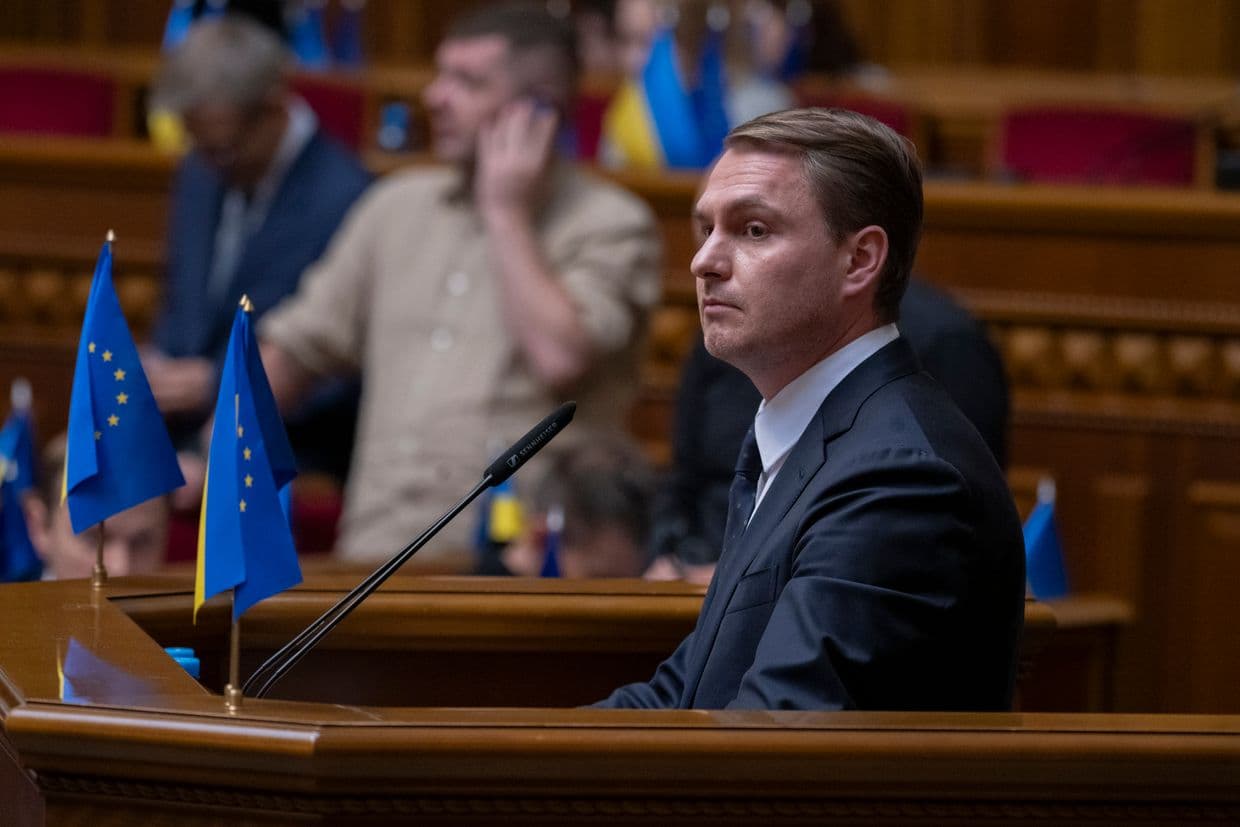
Ukrainian politician and then-prosecutor Ruslan Kravchenko speaks during a plenary session of the Verkhovna Rada in Kyiv, Ukraine, on June 17, 2025. (Andrii Nesterenko / Global Images Ukraine via Getty Images)
 on Google
Anastasia Radina
Chairwoman of the Verkhovna Rada Committee on Anti-Corruption Policy
The alleged escape of the former Prosecutor General Ruslan Kravchenko from Ukraine amid the fallout from the "Carthage" anti-corruption operation has made it impossible to postpone the question: how should Ukraine choose the person to lead its prosecution service?
My answer is straightforward: through an open, competitive selection based on professional competence, integrity, and leadership — not purely political considerations.
This June, I co-authored a draft law to introduce open competition for the prosecutor general as a step preceding political appointment. At the time, it was initiated in response to the European integration benchmark.
After "Carthage" and Kravchenko's cut-and-run, it has become a more fundamental issue: whether Ukraine wants its prosecution authorities to serve justice and law or to serve whoever happens to control the political appointment process.
The "Carthage" investigation by Ukraine's National Anti-Corruption Bureau (NABU) and Specialized Anti-Corruption Prosecutor’s Office (SAPO) exposed allegations of a criminal organization operating inside the Prosecutor General's Office.
According to the investigation, senior prosecutors may have abused their powers to protect a network of fraudulent scam call centers. Moreover, the roots of it may have reached the very top level of the Prosecutor General's Office. Kravchenko resigned on Sept. 7, six hours after publicly denying intention to resign and mere hours after his meeting with the President of Ukraine.
In less than a week, he fled Ukraine and was formally dismissed by the Parliament the following day.
In July 2025, Kravchenko personally signed the notification of suspicion to one of the NABU detectives involved in the "Midas" investigation, a major corruption scandal that uncovered a $100 million money-laundering scheme implicating multiple Ukrainian high-ranking officials.

Later, the case against a NABU detective proved to be unfounded since the court cleared all charges against a key witness in the case. By doing so, Kravchenko acted in synergy with political efforts to undermine the independence of Ukraine's anticorruption institutions — events that caused mass public protests in Kyiv and beyond in summer 2025.
Criminal allegations will eventually be presented in the courtroom, and it is for the court to make a final judgment. But one thing is clear and urgent right now — we must introduce Institutional solutions without delay to prevent further abuse of office and political power.
For decades, appointments in the prosecutorial system have prioritized political considerations over appointees' professional records.
While political appointments to such positions in the EU are not uncommon, the Prosecutor General of Ukraine does have uncommonly broad powers to interfere with almost any criminal case. Therefore, he plays an exceptionally important role in the judicial system to which he belongs under Ukraine's Constitution.
Got an opinion on anything you've read in the Kyiv Independent so far?
and it may appear in our Letters section.

An open competition cannot guarantee that a future Prosecutor General will never abuse power. No procedure can. Neither will it eliminate the political end of the appointment, set by the Constitution. But it can change the incentives and create a transparent mechanism for testing candidates against the qualities that actually matter: professional record, integrity, and leadership. It will also help ensure that only those who actually qualify may be considered for this position.
There is also a European dimension.
The European Commission has explicitly called on Ukraine to make the selection and dismissal of the prosecutor general more objective, transparent, and merit-based, making it an interim benchmark for EU accession. But this is not a box Ukraine needs to tick for Brussels and EU member states.
A nationwide survey conducted by the Ilko Kucheriv Democratic Initiatives Foundation and the Kyiv International Institute of Sociology in August-September found that 70% of Ukrainians do not trust the prosecution service, while only 26% do.
At the time of the survey, Kravchenko was still in office and had not yet left the country; the "Carthage" operation became public only in the final days of fieldwork.
The same survey points to a possible way out. About 56% of Ukrainians said they would trust a new prosecutor general more if the appointment followed an open competition involving independent international experts, like those Ukraine uses to select the chiefs for NABU and SAPO. Only 4% said such a process would make them trust the prosecutor general less.
We need to introduce a transparent and merit-based selection process because Ukraine needs a Prosecutor General whom the public can trust, and whom no political group, official, or institution, be it the majority in the Parliament or the President, can claim as their own.
The choice before us is therefore wider than choosing the successor to fugitive Kravchenko.
The task is not to find a person who will gain enough votes in the Parliament. We must build a system in which those who want to lead Ukraine's prosecution service have to earn trust through the transparent selection process first and then win back the trust of Ukrainians in their judicial system.
The draft law I co-authored is one way to do that.
After the "Carthage" operation, there should be no excuse for postponing this debate. Ukraine does not need another loyal prosecutor general. It needs the best prosecutor general we can find.
Editor's note: The opinions expressed in the op-ed section are those of the authors and do not purport to reflect the views of the Kyiv Independent.