How Ukraine’s Navy is defending its vital Black Sea ports from Russian attacks
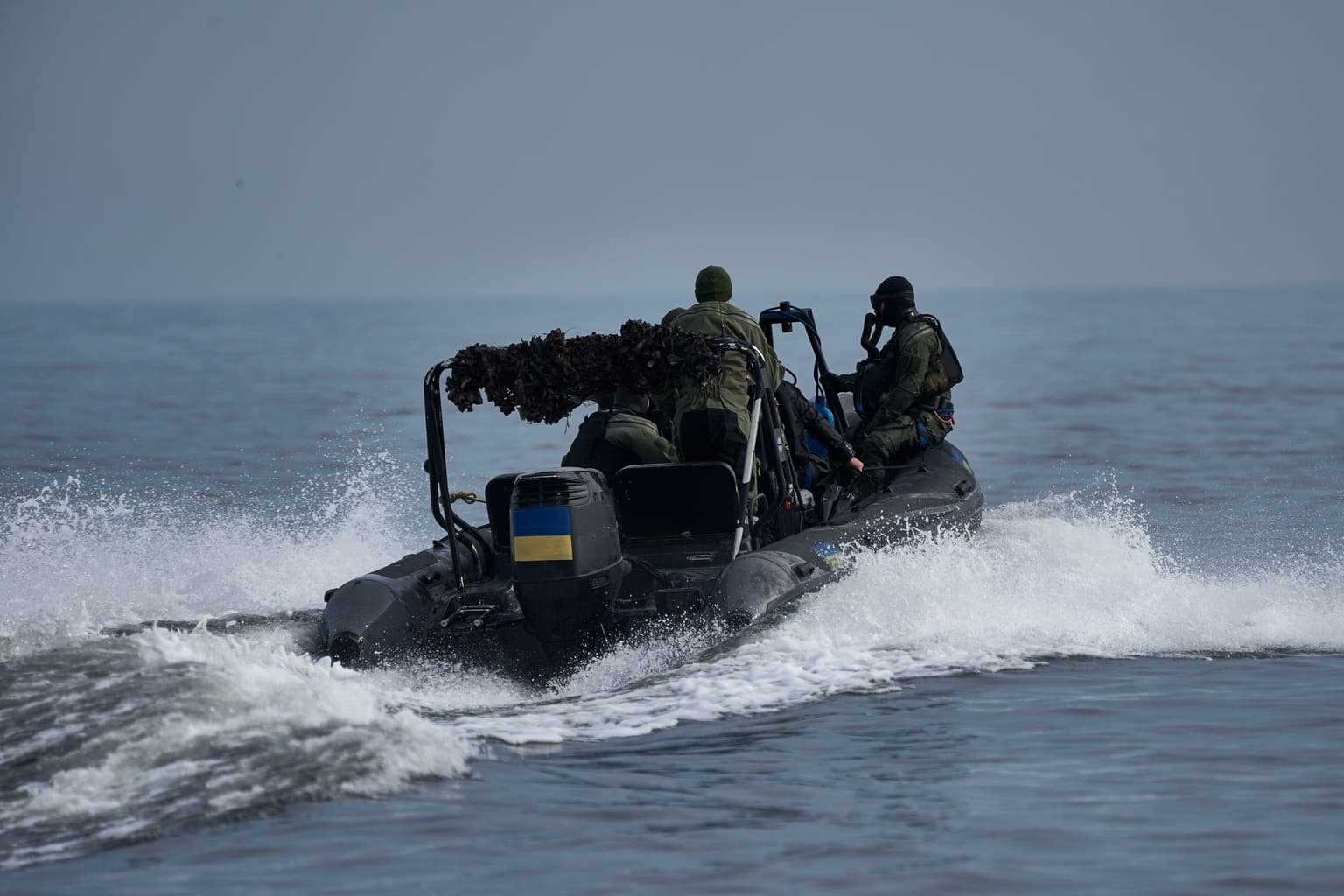
Divers from the Special Purpose Unit go through training exercises off the coast of Odesa, Ukraine, on March 6, 2024. (Kostiantyn Liberov / Libkos / Getty Images)
 on Google
ODESA — The danger comes from across the Black Sea, but the city itself ends at the shoreline. For Ukraine’s Navy, that has become a tactical problem.
"The main problem of fighting off drones in Odesa, which doesn’t exist in other cities, is that here’s Odesa, and here’s the sea,” Dmytro Pletenchuk, a spokesperson for the Ukrainian Navy, told the Kyiv Independent while speaking from the shore. "Factually, Odesa ends at the water’s edge, and as it turns out you can’t throw a lot of air defense into the water."
Across the Black Sea, from occupied Crimea and Russian territory farther east, Moscow is sending more drones and missiles toward the ports of greater Odesa, trying to enact by air an embargo that the Black Sea Fleet failed to impose in 2022.
The stakes are high for Ukraine: the ports of Odesa, Chornomorsk, and Pivdenne are now Ukraine’s main remaining gateway to the Black Sea, and the incessant attacks have forced Ukraine into an improvised naval air defense: armed cutters, converted boats, and unmanned platforms pushed out to sea to protect a vital shipping corridor.
It's not getting any easier — as Moscow has shifted away from its winter campaign against Ukraine’s power and heating plants, attacks on the port cluster have only intensified. The aim is to cripple Ukraine’s economy, Pletenchuk said.
Now, as the U.S.-Israel war with Iran disrupts energy shipping through the Strait of Hormuz, Ukraine is betting that its hard-won experience carving a shipping corridor through contested and mined waters, under regular threat from Russian drones and missiles, will prove valuable beyond the Black Sea.
Any port in a storm
The flags of Ukraine’s Military-Naval Forces — upper right-hand quarter yellow, the other three quarters white — fly all around the Big Port of Odesa, the country’s largest remaining trade hub.
Sailors like "Pirate," who asked to be identified by his callsign in accordance with Ukrainian military protocols, are tasked with defending the skies over the Black Sea as a way of keeping trade flowing, particularly Ukraine’s exports of grain and sunflower oil and imports of fossil fuels. It’s an assignment that’s become more dangerous in recent months as Russia’s attention turns away from Ukrainian power plants.
"They’ve started shooting more intensively, launching in massive numbers,” Pirate told the Kyiv Independent from the hull of a landing craft that has been converted into a floating air defense platform. As the vessel's engineer, keeping the engine running is his job. “Since they’re continuously in use, problems come up often. Our shifts can be 12-24 hours, maybe longer if there’s a long air raid alert."
Despite being from Poltava, farther north, Pirate said he’d always wanted to work on boat engines. "I’m planning on serving here as long as needed."
The military enforces strict rules against photographing Ukraine’s port so as to avoid giving the Russians any clues, however inadvertent, to what exactly they should be aiming at.
Within the port, many old rusted-out cargo boats stand along empty piers. Smaller boats belonging to the Naval Guard as well as the Military Naval Forces circulate, on constant watch for inevitable Russian aerial incursions.

"All of the cutters that we have go out on patrols," Oleh Zasyadvovk, a second-class captain with the navy who commands many such vessels, told the Kyiv Independent. "Why? The important thing for us is ensuring the safety of the sea. So every day, 24/7, all of these cutters are at sea, starting with shooting down Shaheds and finishing with patrols, which is the search for objects."
The navy faces threats from both directions: mines below, many of them drifting since at least the start of the full-scale invasion, and Russian drones and missiles from above, particularly Shaheds.
"If you pay attention, all of us, even former rescue patrols, now have machine guns. All of our folks take part in air defense," Zasyadvovk continued.
A gateway under fire
"For Ukraine, sea exports are vitally necessary — and that isn’t a metaphor," Pletenchuk told the Kyiv Independent. "
From the conquests of Catherine the Great and through to the Soviet Union, Moscow used Ukraine both as a breadbasket and a central point of trading with the outside world. The pretext for the 2014 annexation of Crimea, for example, was heavy on Russian naval tradition and Black Sea access. The professed logic was that a suddenly "unfriendly" Ukraine, purged of Viktor Yanukovich, might close the trade taps.
Constantine Sobol, a native of Izmail and longtime exporter from Odesa’s ports who now runs Marelis Navigation from Greece, said Ukraine’s geography made it a natural gateway to the Black Sea.
"Ukraine’s ports — like Ukraine itself — by their geographic location are an ideal point of entry to the Black Sea. That is, it’s a transit country. And many loads that passed through were not just Ukrainian, but also unfortunately, Russian," Sobol told the Kyiv Independent.
The three ports in the Odesa cluster face frequent air raid threats. Sobol said the danger has helped push some buyers who once relied on Ukrainian ports to look farther afield, even when the alternatives are slower and more expensive.


“The most striking example of all that I can draw on is Bulgaria and Romania buy up seeds to make oil, now using vessels from Argentina in massive volumes rather than from Ukraine,” Sobol said. “From any Ukrainian port to Constanța or Varna, for us it’s just four hours, while for Argentina it’s a week and a half to two weeks, so the trek is more expensive.”
Ukrainians react with special bitterness to Russia’s ongoing annual theft of Ukrainian grain harvests to sell through Ukrainian ports like Mariupol, Berdyansk, and Sevastopol to the outside world.
Odesa and the nearby Chornomorsk and Pivdenne ports are functionally all that Ukraine has left. Despite efforts to build up port infrastructure around Izmail, near the mouth of the Danube River, they remain in no condition to stand in for the cluster of ports near Odesa.
Naval innovation
Recent developments like expanded mesh networks mean that Russian pilots are actively controlling drones like Shaheds and Lancets. The Russian military has teased new sea drones that, for example, connect to shore via fiber-optic cables, theoretically allowing strong connectivity for FPV drones on-board.
Sailors in Odesa report that they haven't run into many Russian sea drones at this point. But the dangers are real, and the strain shows in how people here describe daily life, Sobol said.
"People can get used to anything," Sobol said. "The situation isn’t very good. There are strikes every day, unfortunately. People are dying on the shores, not even on the ships, and even the number of bomb shelters that are in the ports aren’t saving everyone. But the ports have more or less gone back to the pre-war transshipments. That is, like life in Odesa, it's divided into two parts. At night there are strikes, by day people are sitting in restaurants."
For Ukraine, the most promising recent development beyond sending more small boats with small arms into the sea is a raft of announcements in which sea drones like the Magura or Sea Baby have been pictured strapped with interceptor drones.
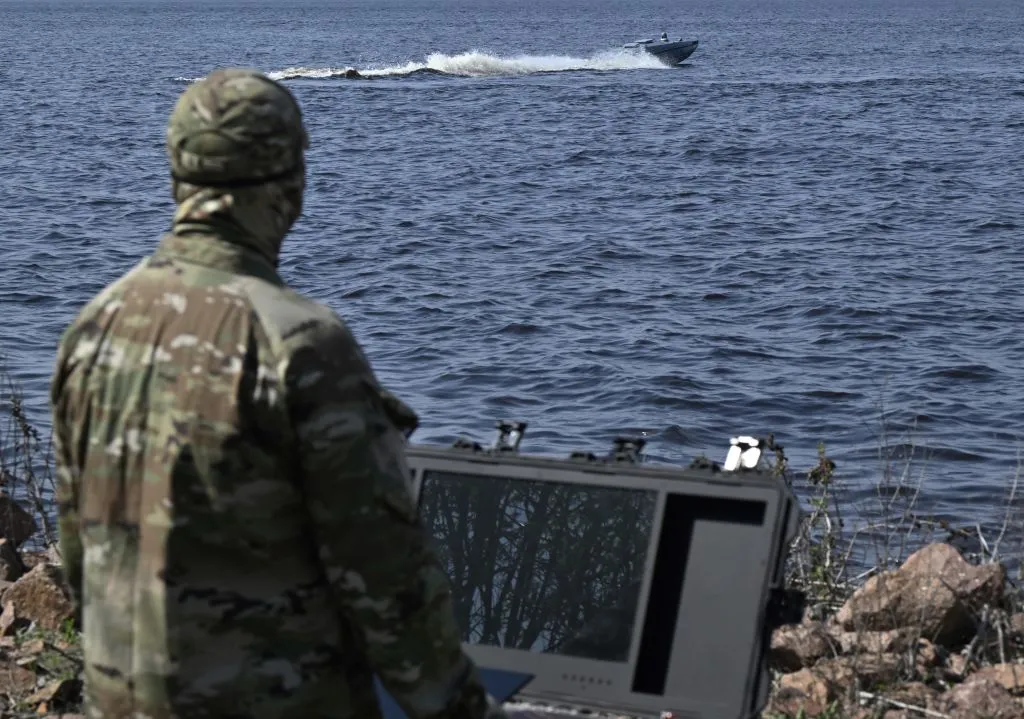
The Ukrainian Navy is also finding new uses for the Sargan-3000, a Ukrainian unmanned naval combat drone that, according to Pletenchuk, passed testing in mid-April.
"Now drones are already becoming platforms," Pletenchuk said.
Pletenchuk also recalled “the last really big case” in which the navy used two sea drones to blow up a Russian helicopter trying to unload onto a Ukrainian drilling platform.
"There was an automatic turret on one, and on the other were FPV drones. First they hit it with an FPV drone, then with the machine gun, and then once more with an FPV drone," Pletenchuk said. “That is two armed sea drones destroyed that helicopter, and it burned there.”
Editor's note: This article has been corrected to remove an inaccurate statement saying that “90% of Ukrainian exports and imports depend on seaports.” According to a June 2025 World Bank report, more than 56% of Ukrainian export tonnage moved by sea from January to July 2023, while only 19% of import tonnage did.
Author's note:
Hi, this is Kollen, the author of the article above. Thanks for reading. Ukraine's naval war in the Black Sea is one of the most innovative and underreported fronts of this conflict. As we continue covering it, please consider supporting our reporting.