Vucic swept aside in Serbian elections. Can Belgrade break free from Russia’s orbit?
The Student List's election victory ends more than a decade of Aleksandar Vucic's rule, hinting at a new chapter in Serbia's relations with the EU, Russia, and China.
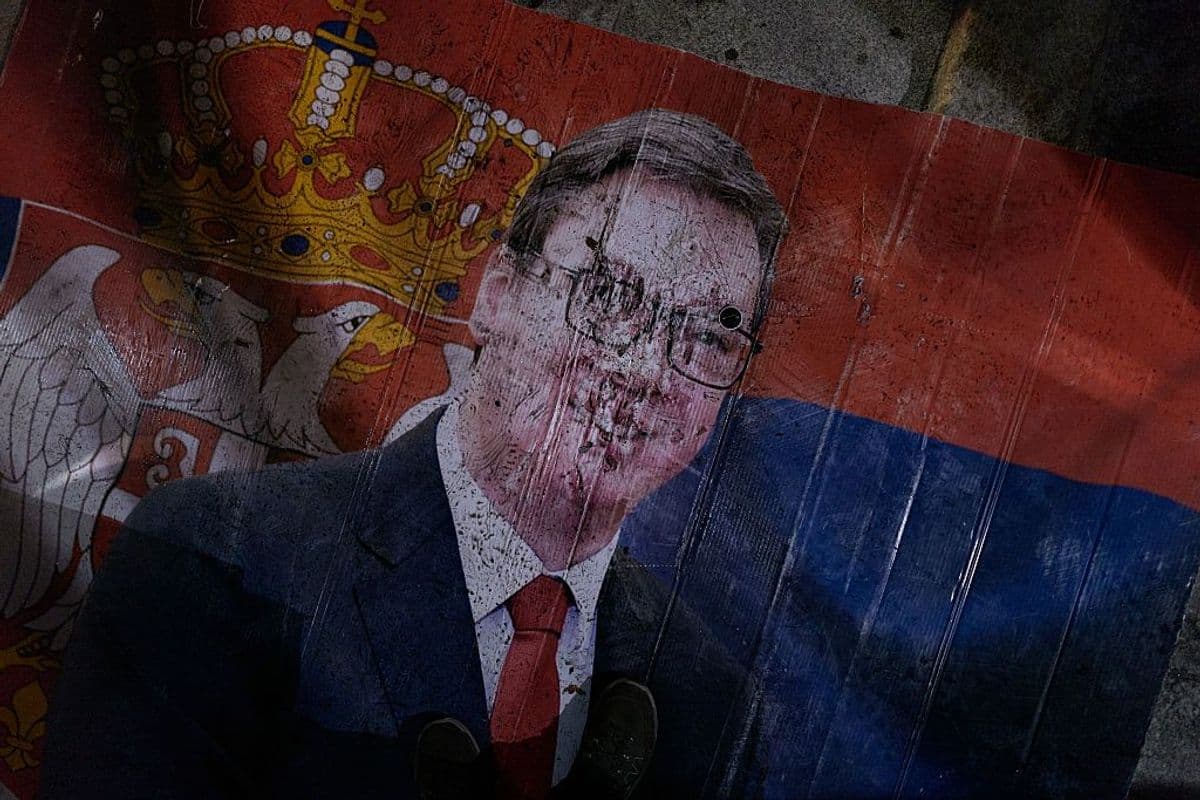
Supporters of the Student List opposition movement walk on a portrait of former Serbian President Aleksandar Vucic following his concession of defeat on Oct. 25, 2026 in Belgrade, Serbia. (Pierre Crom/Getty Images)
 on Google
Belgrade erupted in celebration on Sunday night as Serbia's Gen Z-led protest movement transformed nearly two years of anti-corruption demonstrations into an electoral victory over the political establishment of former President Aleksandar Vucic, who had held power for 14 years.
Among the crowds was Dijana Hrka, whose 27-year-old son Stefan was one of 16 people killed when a concrete canopy collapsed at the railway station in Novi Sad on Nov. 1, 2024.
Hrka, who had been demanding accountability for the tragedy and had previously gone on hunger strike, broke down in tears after Vucic conceded defeat.
"I have been waiting for this moment for almost two years," she told N1 television, struggling to speak through her emotions. "This is the victory of all of us, the victory of our children."
Change at the ballot
Protests in Serbia erupted following the Novi Sad disaster but soon evolved into a nationwide challenge to the government, mobilizing students, academics, workers, and citizens who had never before engaged in political activism.
By Sunday night, the movement had achieved what years of fragmented opposition efforts had failed to accomplish — a decisive electoral victory over Vucic's political camp. The Student List
The Student List — an electoral alliance formed by Serbia's anti-corruption protesters, bringing together 250 academics, professionals, and public figures — won almost 53% of the vote.
The coalition led by Aleksandar Vucic's Serbian Progressive Party secured less than 39%, according to preliminary results published on Oct. 26.

"The feeling is almost surreal," Dr. Mario Reljanovic, who ran on the Student List ballot, told the Kyiv Independent.
"The overwhelming support received by the Student List is a sign that we have managed to give the people of Serbia hope that a different society is possible, (a society) based on justice, the rule of law, solidarity, and the removal of party influence from the public sector," Dr. Reljanovic added.
The turnout, at almost 69%, was the highest since the fall of the Serbian strongman Slobodan Milosevic in 2000. The students are projected to secure around 140 of the 250 seats in parliament, giving them a majority to form a government without needing coalition partners.
"The election result marks the end of a government that displayed authoritarian tendencies," Serbian political scientist Aleksandar Ivkovic told the Kyiv Independent.
"It ended much the same way as the regimes of Viktor Orban in Hungary (2026), Milo Djukanovic in Montenegro (2023), and Nikola Gruevski in North Macedonia (2022), which were similarly authoritarian, and were deeply entrenched in corruption and organized crime."

The result marks a potential turning point not only for Serbia's domestic politics but also for its relations with the European Union, Ukraine, Russia, and China.
The Student List has pledged to pursue EU-oriented reforms and keep Serbia on a European path, a commitment that could reshape the country's relations with Brussels and redefine its place in Europe.
Political outsiders take center stage
The Student List's electoral success was built on an unusually broad mobilization. Long marches from towns across Serbia culminated in a mass rally in Belgrade shortly before the vote. Queues formed outside polling stations on election day, while Serbian citizens abroad also turned out in large numbers.
Formally known as the "Students Are Winning" activist group, the opposition electoral list was formed over the past few months to turn the student protest movement into an electoral alternative without becoming a conventional political party.
"The Student List is a phenomenon that will be studied for decades to come," said Ivkovic. "It is a movement, not a political party designed to last."
The students avoided presenting a single dominant leader and instead emphasized civic participation, professional expertise, and accountability. The campaign was deliberately collective. Rather than putting forward a familiar party leader, the student movement assembled a list of 250 candidates from different professional backgrounds, including academics, doctors, lawyers, farmers, athletes, and cultural figures.
The first on the list is Ilija Srdanovic, a cardiologist and professor at the University of Novi Sad's Faculty of Medicine.

Srdanovic, who could become the new prime minister, became widely recognized in 2025 after publicly supporting student protests and university blockades, including demonstrations over the past two years. The candidates earned voters' trust primarily through their professional achievements rather than previous political experience. Around 170 people on the list hold doctoral degrees.
"While many come from academia, the list also includes farmers, lawyers, journalists, teachers, and cultural workers, reflecting the movement's emphasis on expertise and diversity of backgrounds," says Dr. Reljanovic, who holds a PhD in Law.
He expects that the same principle is expected to guide ministerial appointments.
"Given that ministerial portfolios have until now been treated and distributed as political party spoils, this represents a different approach to forming a government, one in which professionals with relevant expertise will predominate."
The Student List's program centers on restoring the rule of law, freeing the judiciary and media from political influence, investigating corruption, reviewing public contracts, and improving education and healthcare. It has also promised to direct money recovered from illegal enrichment towards economic development and public services.
"The purpose of the Student List will be fulfilled once it achieves the student movement's key demands — freeing institutions from political influence, holding those responsible for the Novi Sad canopy collapse and similar scandals to account, and improving media freedom and electoral conditions," Ivkovic added.
Ivkovic believes that once the goals set by the Student List are met, Serbia's political landscape is likely to reorganize.
"Many established parties may not survive in their current form, but Serbia will quickly return to a system where old and new parties will compete in a conventional, multiparty system."
What's next for Serbia?
The immediate task for the Student List is to form a government and begin implementing its 11-point program of institutional transition, which will require decisions on the judiciary, public administration, media regulation, and the security sector.
The movement will also have to decide how to approach Serbia's relationship with the European Union. Its victory has been welcomed by European leaders, who have signaled that the EU is prepared to support democratic reforms and Serbia's European future.
"I do not expect radical foreign-policy shifts, but I expect a significant change in relations between Serbia and the European Union," Marko Todorovic, senior researcher at Belgrade-based think tank Center for European Policy (CEP), told Kyiv Independent.
"Above all, I expect an end to anti-European rhetoric and the creation of space for more objective information for citizens about the EU and the benefits of European integration," he added.
Serbia, an EU candidate country since 2012, has faced mounting criticism from Brussels over stalled reforms and remains one of the few European countries that has refused to join Western sanctions against Russia since its full-scale invasion of Ukraine in 2022.
"I do not expect sudden breaks in relations with either Russia or China, but I expect both countries to lose their current symbolic significance in Serbia's foreign policy," Todorovic added.
Over the last 14 years, Serbia remained an EU candidate country while preserving close relations with Russia, particularly in energy, and deepening economic ties with China. Belgrade condemned violations of Ukraine's territorial integrity at the United Nations but refused to join Western sanctions against Moscow.


Serbia also remains one of Europe's few remaining buyers of Russian natural gas, underscoring a dependence that leaves Moscow supplying about 80% of its total gas imports. Therefore, the question of sanctions against Russia is likely to remain one of the most sensitive tests for the new government.
As he conceded, Vucic suggested that a change of government could lead to sanctions being introduced against Moscow by March or April. However, Todorovic cautions against treating that possibility as an imminent policy shift.
"For now, there are no indications that sanctions against Russia will be introduced within such a short period. On the contrary, the student movement stated during the campaign that it opposed their introduction," he added.
A more democratic Serbia could offer Ukraine a more predictable partner.
"Serbia will certainly remain consistent in supporting Ukraine's sovereignty and territorial integrity, with the expectation that humanitarian aid and other forms of bilateral cooperation with Ukraine will continue," Todorovic added.
End of a decade of centralized power
Vucic's defeat marks the end of an era in which Serbia's president sought to maintain close ties with both Brussels and Moscow while consolidating political power at home.
His Serbian Progressive Party came to power in 2012, and Vucic served as prime minister from 2014 to 2017 before becoming president.
During that period, the government promoted infrastructure projects, attracted foreign investment, and presided over economic growth. At the same time, critics accused it of weakening democratic institutions, exerting pressure on independent media, and allowing political influence to permeate state institutions.
Several controversies came to define the period, while the collapse of the Novi Sad railway station canopy became the most consequential crisis of Vucic's rule. Protesters argued that the tragedy exposed systemic failures in public oversight and government responsibility. The authorities rejected many of their political accusations, while investigations and legal proceedings continued.

The Student List has promised to investigate corruption, strengthen independent institutions, and redirect public resources towards citizens. Delivering on those promises will require not only political will but also the ability to govern a diverse coalition and overcome resistance within the existing state apparatus.
"There is enormous excitement at the prospect of having the opportunity to implement a concrete and detailed program to rebuild institutions, the economy, culture, and science, all of which have been undermined," Dr. Reljanovic said.
"We must use the mandate we receive to lay the foundations for a different way of running the country, so that politics is no longer synonymous with crime and corruption, and so that a cult of personality and a subservient relationship between citizens and those in power can never exist again."