Our readers' questions about the war, answered. Vol. 11
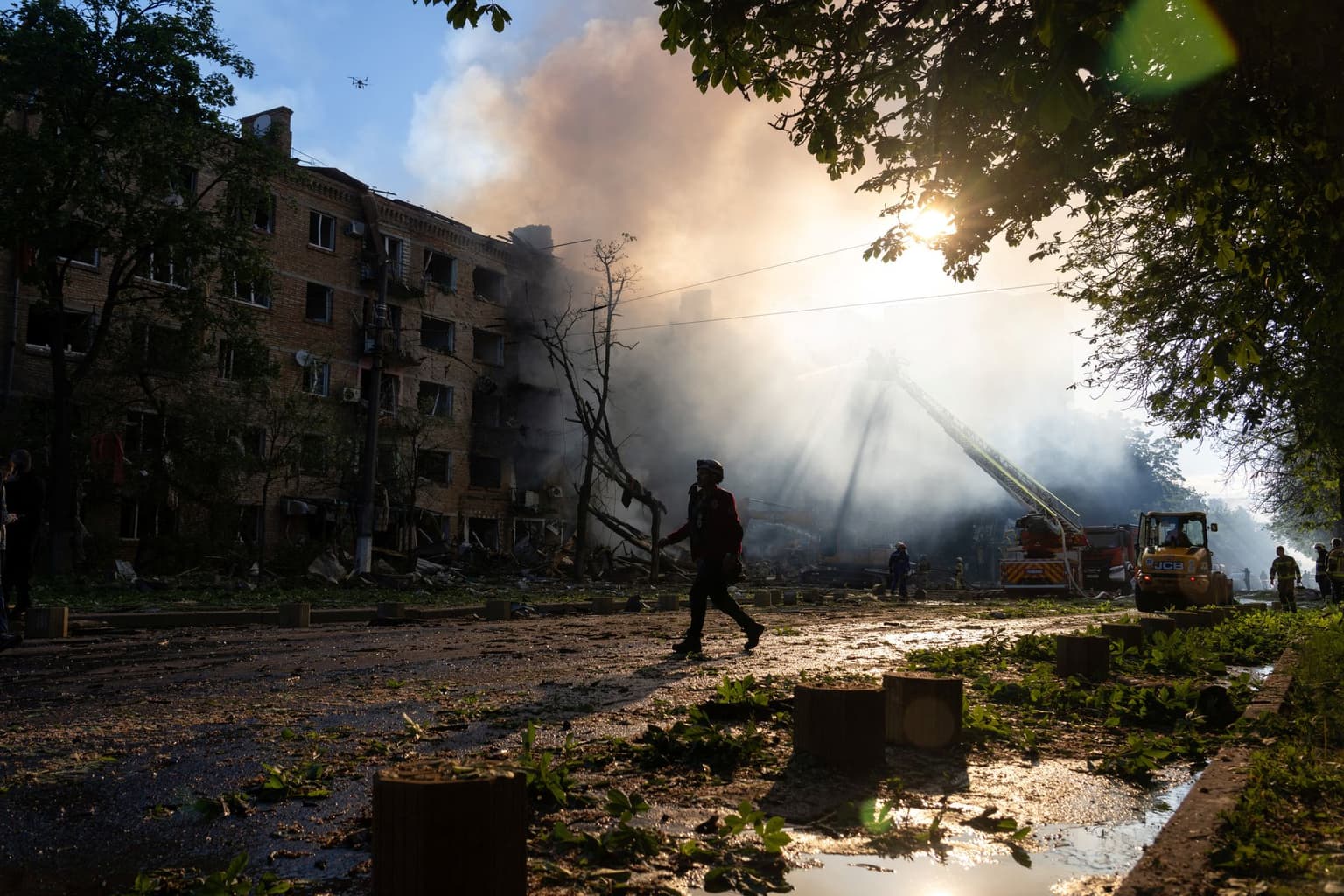
An emergency responder works at the site of a heavily damaged building as smoke rises following Russian strikes in Kyiv, Ukraine, on May 24, 2026. (Oleksii Filippov / AFP / Getty Images)
 on Google
Editor's note: We asked members of the Kyiv Independent community to share the questions they have about the war. Here's what they asked and how we answered.
Join our community to ask a question in the next round.
Question: With a new prime minister elected in Hungary, is the blocked loan to Ukraine expected to be approved, and when could it be disbursed? Are there other EU member states that might block funding or slow Ukraine’s integration into the EU, similar to Hungary’s earlier position? And with uncertainty in U.S. policy, how much can Ukraine rely on the EU alone for financial and political support?
Answer: Since the loan has already been approved, the disbursement is most likely to go as planned. The first payment is expected by early June, with half of the loan, that is 45 billion euros ($52.1 billion), to be paid out this year. All necessary legislation has been approved, and I don't expect any more opposition to the funding. Some members — Czechia, Slovakia, but also Hungary under Magyar — will be content with not contributing themselves while not blocking aid from the rest of the EU.
Regarding accession talks, it's more complicated. No member states currently oppose Ukraine's entry per se, but some maintain it should happen only after the war is over, and most reject fast-tracking the accession.
With Orban out, I think the process will at least start moving forward, and we can see the opening of the first negotiation clusters within a few months.
One major obstacle down the road is, sadly, still Hungary. Peter Magyar said that after Ukraine concludes the negotiations, Hungary will hold a referendum on Ukraine's entry, and there is strong opposition to Ukraine's accession among Hungarians. The mood may change as (former Prime Minister Viktor Orban's party) Fidesz propaganda tones down, but it still can be an obstacle. Magyar will likely have other demands, for example, about the status of the Hungarian minority in Ukraine.
At the moment, the EU is by far Ukraine's most important ally. Its members (next to the UK, Norway, Canada, etc.) accounted for almost all new military aid allocations in 2025, and the 90 billion loan is absolutely vital for Ukraine over the next two years.
But if the war doesn't end soon, rising populist, Ukraine-skeptic political forces (mainly RN in France and AfD in Germany) could bring unprecedented (and for Ukraine disastrous) changes in policy toward Russia and Ukraine, akin to U.S. President Donald Trump in the US. Ukraine would then have to rely on a handful of "loyal" but smaller nations, such as the Nordic and Baltic countries and the Netherlands. — Martin Fornusek, senior news editor
Question: What are the main attitudes among Ukrainians toward potential territorial concessions in peace negotiations, including views on restoring pre-2014 borders? Answer: When anyone brings up the phrase "territorial concessions" they could be meaning one of two very, very different things. The first is accepting a ceasefire deal — and then maybe a longer peace — according to the current line of contact, effectively giving up attempts to take back all of Ukraine's sovereign territory by force. Ukraine has already done that, because the Ukrainian leadership and people want peace. The other understanding of the term concerns handing over more territory to Russian occupation, which it hasn't even occupied yet: entire cities, fortified strongholds, and tens or hundreds of thousands of people. This remains completely unacceptable for Ukraine for so many reasons: moral, strategic, legal. But first and foremost is the fact that Russia cannot be trusted or expected to honor such an agreement, while no Western country is prepared to get in Moscow's way if they don't. So when this term comes up, make sure you know which "territorial concessions" are being discussed, and if someone tries to manipulate it, call them out. — Francis Farrell, reporter

Question: Why has the idea of deploying a multinational UN peacekeeping force, potentially including countries like China, to the Donbas region not been seriously considered or implemented?
Answer: First and foremost, because Russia has not shown any interest in stopping the war in the first place. Any peace in Ukraine, including one that is "kept" in theory by a UN or other multinational contingent, can only come when Russia is ready to stop. Instead, Moscow continues to tell us that no, they still want a lot more of Ukraine, and ideally, complete political capitulation. — Francis Farrell, reporter
Question: How is the military draft currently working in practice in Ukraine, and what are the service terms for those over 24 who have been mobilized since 2022? How does the recruitment system work to encourage enlistment? And could you provide context on the videos circulating online about mobilization in Ukraine — where do they come from, and how accurately do they reflect the overall situation?
Answer: It is difficult to present a single, uniform picture of how mobilization works in Ukraine. The terms vary depending on whether a person joins voluntarily or is mobilized, and in the latter case, whether they comply with the process or not.
Voluntary enlistment is generally understood in Ukrainian society as joining the army despite not being legally required to do so.
Who is subject to mobilization
Men aged 25–60
Under martial law, this is the core group legally subject to mobilization.
- Medical professionals (men and women)
Required to be registered with the military from age 18 (i.e., report to a military unit and submit documents). While they are not mobilized en masse, they remain on record and can be called up if they are aged between 25 and 60. - Individuals outside the standard age range with relevant background
People younger than 25 or older than 60 may still be mobilized if they have prior military experience or have graduated from a military department.
Who is generally exempt from mobilization
- Men outside the 25–60 age range
Not subject to mobilization unless they fall under the exceptions above (e.g., prior military experience). - Most women
Except for specific categories such as medical professionals or other registered specialties. - Individuals unfit due to health conditions
Determined through a medical commission. - Individuals exempt due to family circumstances
For example, those caring for a relative with a disability or raising three or more children. - Workers in critical sectors
Employees of strategically important enterprises or professions essential to state functioning may receive exemptions (“reservations”), depending on their role.
Voluntary mobilization typically involves individuals who are eligible for service but choose to proactively comply, submit all necessary documents and select a unit that matches their preferences and specialization. They report directly to a unit and can often choose the terms of their service, whether under a contract for a fixed period (number of years, most often 3) but often extending until the end of martial law, or under general mobilization conditions, which also last until the end of martial law.

A third case is forced mobilization. This refers to individuals who are legally subject to mobilization but have not updated their documents, failed to report when required, or did not receive a draft notice for various reasons. In such cases, individuals may be stopped in public spaces, including while driving in their private vehicles, and taken directly to a recruitment center to begin the formal process and be sent through subsequent stages of training before deployment.
In some of these cases, individuals comply, they recognize their legal obligation and accept it. In others, they do not. It is primarily in these non-compliant cases that the videos referenced in the question emerge. These often show officers from territorial recruitment centers forcibly placing individuals into vehicles, a phenomenon that has even led to the colloquial term "busification."
In other instances, individuals resist, attempt to flee, or use force against officers. There have been cases involving group resistance, firearms, and in rare instances, fatalities. Both violence by officers and violence against them are subject to criminal investigations.
In terms of how accurately these videos reflect the overall situation, most men in Ukraine are indeed legally obligated to serve, but they still retain a degree of choice, including being able to select units, roles, and service conditions. The incidents captured in these videos are relatively extreme and not representative of the majority of cases. However, they do reflect broader public dissatisfaction and criticism of what many see as a failure in state communication and recruitment strategy.
As for how the system encourages enlistment, there have been targeted campaigns, for example, a recent campaign aimed at people aged 18–24, encouraging voluntary enlistment under a one-year contract, which then grants a deferral afterward.
In practice, much of the recruitment effort is driven by individual brigades and units. They develop their own campaigns, messaging, and conditions to attract recruits. Some units have taken a principled stance against accepting forcibly mobilized soldiers, emphasizing that service within their ranks is based on motivation. However, such approaches have become less common over time as manpower shortages increase.
It is important to note that regardless of how someone enters the military, the process is largely standardized. This includes passing a medical commission to determine fitness for service, followed by training at a training center (currently set at around two months) and then assignment to a unit. In some cases, additional specialized training is provided before active service begins. The quality of these stages can vary significantly, with some units offering better conditions and leadership, and others less so.
Author’s note: In Ukraine’s resistance to Russian aggression, the stakes are existential and individual freedoms are, at times, compromised for what is seen as a more urgent cause. At the same time, in my view, the use of coercive mobilization methods discredits the military and can further discourage people from serving. Military service in Ukraine takes many different forms, and the Kyiv Independent’s war desk is currently working on a more detailed profile of this, but you can already read more here. — Anastasiia Verzun, junior reporter
Question: How could Ukraine’s growing engagement with Middle Eastern countries, including Gulf defense deals, affect its position in the war against Russia's full-scale invasion? And how might Russia’s reported cooperation with Iran shape both the war in Ukraine and the relations between Trump and Russian President Vladimir Putin?
Answer: To answer this question properly, it helps to break it into two parts.
First, regarding Ukraine's growing engagement with Middle Eastern countries, including defense and drone deals. What Ukraine is trying to do here is reposition itself — not as a security recipient, but increasingly as a security provider. This shift matters a lot diplomatically. Ukraine is signaling that it has valuable battlefield-tested technologies and expertise to offer, rather than simply asking for assistance.
At the same time, these partnerships are not one-sided. Ukraine is not just sharing technology for free. In return, it is securing broader agreements — particularly with Gulf countries — that often include energy cooperation and investment. These drone deals are, in many cases, part of a larger package of economic and strategic cooperation. So in both diplomatic and economic terms, Ukraine appears to be investing in long-term relationships with these states.
There is also a broader geopolitical dimension. The Middle East is a region where Russia has long sought to expand and maintain its influence. Moscow has been consistently active there, and it is telling that after President Volodymyr Zelensky visited countries in the region, Putin intensified his own outreach. That suggests Ukraine's engagement is being noticed — and contested.
Ukraine is also trying to present itself as a more reliable partner than Russia, particularly at a time when Moscow is cooperating with actors that directly threaten Middle Eastern states. This creates an opening for Kyiv to strengthen trust and credibility in the region.
Another important factor is the role these countries play in mediation. For example, Qatar has been involved in efforts to return Ukrainian children taken from occupied territories. Places like Abu Dhabi have hosted negotiation talks related to the war. So Ukraine's engagement is not only about defense or economics, but also about embedding itself diplomatically in processes that could shape future talks with Russia.
That said, in purely military terms (and I'm not a military expert), it is difficult to argue that these agreements will have an immediate, direct impact on the front line. Their significance is more indirect and long-term. What we are seeing is a complex diplomatic strategy — one that may not change battlefield dynamics overnight, but could prove crucial at key political moments in the future, especially when it comes to negotiations.
Turning to the second part of the question — how Russia's cooperation with Iran may affect both the war in Ukraine and relations between Trump and Putin — the picture is somewhat counterintuitive.
This alignment was not seen in Washington as a major surprise. There has long been an expectation that Russia — along with China — would, to some extent, support Iran in a broader confrontation. So in that sense, it did not fundamentally change the strategic calculus inside the U.S. administration.
At the same time, the practical impact of this cooperation appears limited so far. There are indications that Moscow has tried to use its relationship with Tehran as leverage — signaling to Washington that it could scale back support for Iran if the U.S. reduced its backing of Ukraine, for example by limiting intelligence sharing.

What matters here is that this framing seems to have partially taken hold within the administration, where Russia's behavior is viewed by some as a reaction to U.S. support for Ukraine rather than an independent escalation.
As a result, there is little evidence at this stage that Russia–Iran cooperation has significantly altered the personal dynamics between Trump and Putin.
However, it has had a noticeable effect elsewhere in the U.S. system — particularly among policymakers who act as checks and balances on the administration, such as members of Congress.
For critics of any potential easing of pressure on Moscow, this development provides a powerful argument: that Russia is simultaneously supporting actors hostile to U.S. interests while benefiting from Trump's concessions.
This line of criticism has been especially visible during congressional hearings, where administration officials have faced pointed questioning over the apparent inconsistency between their Russia policy and Moscow's actions.
Lawmakers have used this argument to push back more forcefully.
So while Russia's cooperation with Iran may not have directly reshaped Trump–Putin relations, it has strengthened the hand of those within the U.S. political system seeking to constrain or challenge any moves toward a softer approach to Russia. — Tim Zadorozhnyy, foreign policy reporter
Question: How does Ukraine justify facilitating or restoring the transit of Russian oil through its territory via the Druzhba pipeline? What are the main reasons for allowing these exports to continue, even though they generate revenue for Russia, potentially supporting its war effort against Ukraine?
Answer: It's fairly clear how Ukraine justified the resumption of oil transit. There was pressure on Kyiv from multiple fronts to restore the pipeline.
It's important to understand that this pressure didn't come solely from Hungary, even though Budapest's blocking of a new sanctions package and, more importantly, the planned loan to Ukraine created a serious problem.
The suspension of that funding put Ukraine in a very difficult position — at one point, it was close to a potential financial crunch.
At the same time, there was clear pressure from within the European Union itself. Representatives of the Commission and other European officials consistently signaled that it was important for Ukraine to resume transit. While their language was carefully worded, the message was... unmistakable.
As a result, Ukraine moved to restore the pipeline.
The Ukrainian operator, Ukrtransnafta, was responsible for carrying out the repairs. The Commission agreed to cover the costs of the restoration, meaning Ukraine did not bear the financial burden itself.
The key factor behind the decision was the blocked financial assistance — an issue far more serious than many might assume, as it carried significant long-term risks for Ukraine's economic stability.
By comparison, the revenue Russia generates from oil exports to the two countries, while substantial, was not seen as outweighing the immediate financial risks tied to the funding freeze.

There also appears to be some hope regarding Hungary's future political direction — namely, that the change in leadership could lead to a gradual reduction in the country's dependence on Russian energy.
The European Union does have a phase-out plan for this in place, although its timelines remain uncertain. Slovakia has already pushed back, including through legal challenges at the EU level.
From a diplomatic standpoint, any unilateral move by Ukraine to halt oil transit altogether would likely have been perceived as a hostile action — not only by Hungary and Slovakia, but also by EU institutions.
As we saw, European Commission spokespersons were talking about the need to restore the pipeline every day, basically showing that the pressure extended well beyond bilateral tensions with Budapest or Bratislava. — Tim Zadorozhnyy, foreign policy reporter
Question: How has Ukraine learned to protect or decentralize its critical infrastructure? Are new projects being designed from the outset to withstand strikes?
Answer: In some ways Ukraine has learned to protect and decentralize its energy grid but the real question is, is it too late for the next winter? There are more defense structures in place around key substations, but many are still missing. The problem last year was that some authorities started building them way too late. As for some facilities, particularly heating plants, there's not much one can do to protect them as they are just too big. So they will be hit again this winter. Without giving away too much, because I'm planning to write an article on this soon, there's still a lot that needs to be done and time is running out. But from where I'm standing, Ukraine will have another hard winter. — Dominic Culverwell, business reporter
Question: Ukrainian forces may be surrounding Russian troops in certain areas, like those reported in Kupiansk — how accurate is this? If so, why do Russian soldiers often continue to hold out rather than surrender in these situations?
Answer: Cases like this are not really an encirclement in the traditional situation, because on a tactical level, this is all happening in a gray zone environment completely controlled by both sides' drones, where anything that moves can and usually will be spotted and targeted within minutes. So as long as those Russian soldiers can hold out in a basement, which might still have plenty of food in it from years of humanitarian aid stocked up, they can survive for a very long time. — Francis Farrell, reporter
Question: What are the prospects for Ukraine to retake more occupied territory, and is a new offensive expected this summer?
Answer: As we saw with Ukraine's offensive operations in Dnipropetrovsk and Zaporizhzhia oblasts in February and March, Ukraine still does have the capacity to go on the attack. But, on the other hand, in the drone-dominated kill zone, where the idea of territorial control and a clear front line is blurred, calling that operation a big "counteroffensive" where this or that many square kilometers were "liberated" is also not quite accurate. Going forward, Kyiv might have more offensive plans in the back of their mind for a best-case scenario where Russian combat power starts to disintegrate dramatically, but in the meantime, they should just focus on an efficient defensive fight that protects their own soldiers while inflicting maximum casualties on the enemy. — Francis Farrell, reporter
Question: What is the current state of reconstruction in Mariupol and other occupied areas? Is it possible to estimate the scale of rebuilding in percentage terms? How is housing being allocated in these regions, and are there signs of corruption in the process?
Answer: As long as independent media and organizations lack physical access to the occupied territories, it is impossible to accurately assess the scale of destruction or the scope of reconstruction. The same applies to the number of civilian casualties from shelling and victims of war crimes.
Russia is actively using reconstruction efforts in Mariupol in its media, portraying a picture of rapid recovery. In reality, the situation is far less optimistic. The Mariupol City Council reported that 2,257 apartment buildings — about 90% of the housing stock — were damaged by Russian shelling. At the same time, Russian occupation authorities claimed that, by the end of 2024, they had built around 70 high-rise buildings. The quality of this construction also raises serious concerns. On social media, residents have posted videos showing problems with heating and water supply, as well as structural cracks in newly built buildings. Moreover, much of the housing Russia is building in Mariupol is being sold on mortgage terms rather than provided to residents.

Pro-Kremlin media highlight municipal work such as garbage collection and repainting buildings. However, large parts of the city remain in ruins and go unreported. Some buildings are demolished with excavators, without any attempt at restoration, effectively erasing evidence of war crimes. In some cases, victims of shelling may still remain under the rubble.
While Russian authorities have taken some action in certain occupied cities, many heavily damaged ones — including Avdiivka, Bakhmut, Sievierodonetsk, and Oleshky — remain in conditions that are nearly unfit for human habitation. — Myroslava Chaiun, War Crimes Investigations Unit Reporter
Question: What are the plans for post-war cleanup and reconstruction in Ukraine? How will this process be carried out? What are the estimated costs and timelines, and what resources and efforts will be required to rebuild the country after the war?
Answer: The first thing to say is that reconstruction is already happening in Ukraine, especially in areas away from the front line.
If you drive around Bucha, the suburb of Kyiv that was heavily damaged in the first weeks of the full-scale invasion, it looks super sleek — having benefited from donors such as the Howard G. Buffet Foundation, which contributed to its reconstruction.
Some reconstruction even takes place close to the front line. NGOs and humanitarian organizations operate inside the crescent-shaped frontline areas, meeting immediate humanitarian needs, such as replacing windows that have been blown out by artillery or drones.
But it is true that a much larger reconstruction will have to wait for the end of the war — and nobody knows when that will be.
The latest estimates for Ukraine’s reconstruction put the total cost at almost $600 billion. That’s an absolutely massive number — almost three times the size of Ukraine’s entire gross domestic product, and similar to the entire GDP of Thailand or Norway.
While there will certainly be cash flowing in from European governments and development banks, the harsh truth is that once the war is over, European taxpayers will likely have much less appetite to fund Ukraine. That’s especially true given the poor fiscal shape of many rich EU countries.
And the burden is likely to fall hardest on the European Union. Other countries will also likely contribute, including Japan, the UK, Norway and Canada — and potentially the U.S. should a more Ukraine-friendly administration enter down the line.
But the bottom line is that Ukraine will be looking to attract private capital to contribute to its reconstruction. The World Bank says that roughly 40% of its reconstruction needs could be met by the private sector, if Ukraine manages to complete the necessary reforms to reassure private investors about the business landscape in the country.
But this brings us back to the war. As much as private investors complain about poor access to bank financing or a lack of war insurance, the number one issue preventing a critical mass of investors coming is security. Until a point where investors believe that the war is completely over — with no risk of a repeated Russian invasion — I don’t expect to see the vision of a reconstruction evoked by grand speeches and vast international conferences. — Luca Léry Moffat, Economics reporter
Question: How can I support Ukraine?
Answer: There are many ways to support Ukraine, and there’s no single "right" approach — what matters most is contributing in a way that's sustainable for you.
Donating to trusted organizations is one of the most effective options, since they already have systems in place to deliver aid quickly and where it's needed most. For this, you can become a member and follow our How to Help Ukraine newsletter. There, we share information about trusted organizations seeking financial help, and last year we raised more than $100,000 for them.
At the same time, volunteering — whether in Ukraine or abroad — can also make a real impact, not just practically but by showing solidarity and keeping global attention on the war. You can learn more about volunteering opportunities here.
Even small actions add up — consistent support in any form truly makes a difference. — Anastasiia Chernova, community manager