Ukraine is already running out of time to prepare Kyiv for winter, officials warn
Energy officials and experts say delays, political infighting, and underinvestment have left Kyiv unprepared for another winter of Russian strikes.
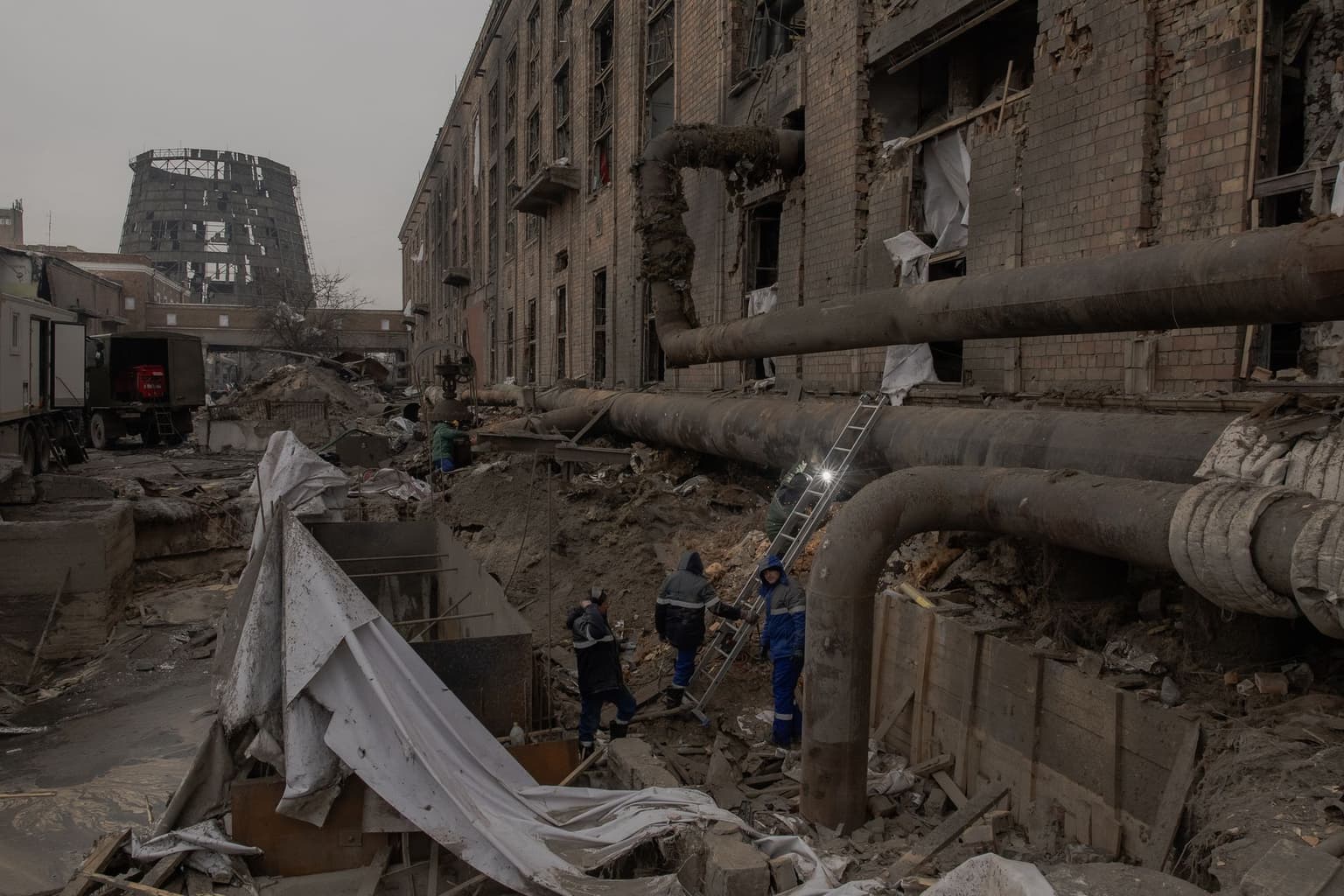
Workers repair damaged sections of the Darnytska combined heat and power plant in Kyiv, Ukraine, on Feb. 4, 2026. (Roman Pilipey/AFP/Getty Images)
 on Google
As the springtime sun coaxes Kyiv’s residents outdoors, memories of a winter without reliable heat or electricity caused by Russian strikes are beginning to fade — creating a dangerous distraction from the government's failure to prepare for the upcoming season.
Kyiv expects Moscow to launch another brutal campaign against its energy infrastructure this winter. But efforts to diversify Kyiv’s power generation and heating sources either started too late or not at all, several people in the energy sector, including a former senior official, told the Kyiv Independent.
Instead, decision-makers are wasting time infighting rather than taking responsibility, pushing the capital towards another winter of blackouts and heating outages, the people said.
Kyiv has also failed to secure the full $1.4 billion officials say is needed to strengthen the capital’s energy security, according to a former official with extensive knowledge of critical infrastructure preparedness.
"This winter could be even worse. Heating in Kyiv will be the biggest challenge," the official said, speaking on condition of anonymity.
"We won’t be able to fix the situation this winter."
Millions of Kyiv residents rely on three combined heat and power plants to heat their homes in winter. Huge in size, they are easy targets for Russian missiles and drone attacks. They are also impossible to cover with any kind of structure to protect from the attacks.
Last winter, Russian attacks took the plants offline, leaving residents without heat in sub-zero temperatures. With the country lacking enough air defense to protect the plants, they are likely to suffer the same fate this winter.
What's needed are alternative heating sources like decentralized cogeneration units — smaller versions of combined heat and power plants that produce heat and electricity and are distributed across the city to continue supplying energy even if the grid is damaged.

But officials say no meaningful steps have been taken by either the city or national authorities to deploy them.
For example, feasibility studies for projects such as installing new gas pipelines that connect decentralized cogeneration units only began in April, the former official said. And contractors still need to be found to carry out the work.
Beyond the capital's heating system, Ukraine’s entire power grid also suffered major damage last winter. Russian attacks knocked out 9 gigawatts of electricity generation across the country. All power plants, apart from nuclear plants, were damaged.
Kyiv will likely repair all its power plants by the winter, but without the decentralized generation units, it won’t be enough to power the capital through the winter, Volodymyr Kudrytskyi, former head of Ukraine’s state-grid operator Ukrenergo and co-founder of energy firm Nedzhen, told the Kyiv Independent.
"We’ve already wasted a lot of time and resources, and we won’t be able to fix the situation this winter," he said.

Last year, Kudrytskyi — a critic of the current presidential administration — was arrested on allegations of embezzlement, a move he and other observers have described as politically motivated and an attempt to scapegoat him for failures in the energy system.
Another issue is mixed messaging and inconsistent policies from the government, Kudrytskyi said. While the government says it supports alternative power generation, its policies this year have confused private energy companies.
As an example, Kudrytskyi points to Energy Minister Denys Shmyhal’s decision in March to end a special discounted gas pricing agreement for companies generating electricity from natural gas, like boiler plants. The policy had been introduced to encourage more electricity producers to join the market and boost the volume of electricity in the country.
"Gas generation is the only significant (energy) source that can be deployed quickly, and that can support the system during the wintertime when solar power plants are at zero efficiency,” Kudrytskyi said.
But with higher gas prices, many companies have now cut production, while others have halted new gas-powered projects altogether.
"I don’t think there will be a massive deployment of gas generation next year — not in Kyiv or across the country," Kudrytskyi said.
Blame game
Meanwhile, political finger-pointing — similar to the blame game during the winter energy crisis — has already spilled into the public sphere as Kyiv Mayor Vitalii Klitschko took aim at the central government in a Telegram message on May 6.
According to Klitschko, the national authorities are not helping the capital prepare for the winter. In one case, he claimed the Community and Territories Development Ministry backed out of a promise to help fund the restoration of a key thermal power plant, leaving the city searching for Hr 3 billion ($68 million).
"So it’s politics again. Kyiv is being cornered," wrote Klitschko, who has clashed repeatedly with his longstanding political rival, President Volodymyr Zelensky, about last winter’s preparations.
"The situation is threatening. After all, it’s about how Kyiv residents will survive the winter and how the city will function."
In response, Oleksii Kuleba, minister of community and territories development, said the state has allocated nearly Hr 4 billion to the city ($91.2 million). Instead, he said Kyiv’s authorities need to "immediately move from discussions to concrete actions," including finding contractors for its winter resilience plan and launching backup generation.

If Kyiv doesn’t provide agreed-upon solutions with defined deadlines and a structured financing plan by May 10, the state will "assess the management capabilities of the capital’s leadership and prepare for challenges," he wrote.
The political infighting is frustrating energy experts such as Olena Pavlenko, president of the Kyiv-based energy think tank Dixi Group. There is no unified vision between the city and the government, she told the Kyiv Independent.
"We need better backup power and heat generation for the winter, and that requires much closer cooperation between the city and the government. The city alone lacks the human resources and equipment to develop decentralized heating," she told the Kyiv Independent.
If another Arctic winter hits, people will be left to fend for themselves — or flee the city, she said.
Author's note:
Hi, it’s Dominic, thank you for reading this story. Ukraine's energy sector needs to prepare for the upcoming winter now in order to avoid the worst. If you want more on the ground reporting from Kyiv, please consider joining our community for as little as a cup of coffee a month.