Russia's methodical use of starvation in Oleshky
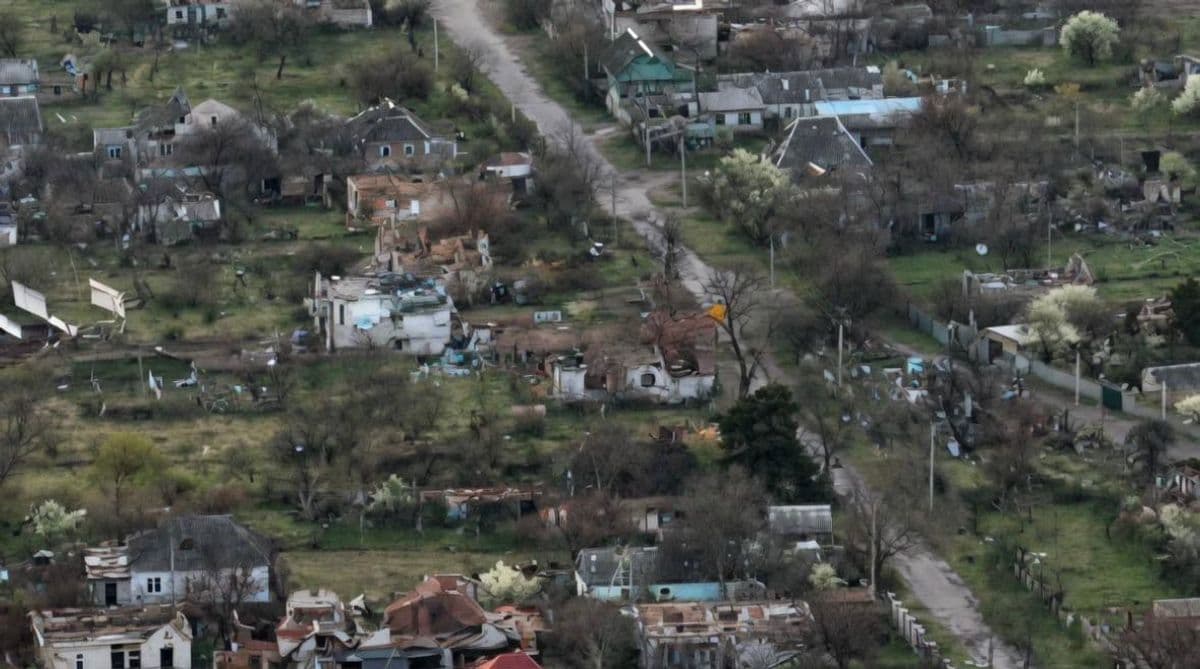
An aerial view of Oleshky, a Russian-occupied town in Kherson Oblast, Ukraine in a photo published on May 2, 2026. (UAOleshki2026 / Telegram)
 on Google
Elise Lauriot Prevost
Conflict, Business and International Crimes Lead at Global Rights Compliance
The town of Oleshky and the surrounding district in southern Kherson Oblast in Ukraine are under a total blockade imposed by Russian occupation forces.
Since May 26, 2026, no humanitarian aid has reached Oleshky.
Residents are hanging signs on their fences reading "no food, we're starving too," emaciated animals have disappeared from the streets, and a three-liter jar of preserved bread crusts has become, in the words of one resident, worth its "weight in gold."
Reports of civilians eating weeds draw harrowing parallels with the sieges of Yarmouk and Mariupol, both used by Russia to refine its use of starvation as a weapon of war. Following in their genocidal Holodomor in the 1930s, Russia is again using starvation to punish, terrorize, and humiliate Ukrainians.
Estimates of how many civilians remain trapped range from around 2,000, including some 50 children in Oleshky town, to more than 6,000, including 200 children across the wider district.
The dead are left in the streets for weeks and buried in plastic bags marked with serial numbers as Russia refuses to allow residents either access or the means for proper or dignified burials.
Russia has continuously occupied Oleshky since the full-scale invasion's first hours, and five of the community's thirteen settlements, Krynky, Pishchanivka, Pidstepne, Sagi, and Zaplava, were destroyed in the fighting, according to local officials, "ceasing to exist."
The Antonivka bridge, the town's last link to Ukrainian-held territory, was destroyed by Russian forces in November 2022. The June 2023 destruction of the Kakhovka dam by Russian forces unleashed a flood that submerged much of Oleshky, killed an unknown number of residents, and destroyed what remained of the town's water, electricity, and gas infrastructure.
Oleshky still has no centralized power, gas, or running water. Residents also lost most of their administrative documents in the flood; the hospital only has one department functioning, and residents are unable to obtain health or hygiene services or products.

By February 2026, any attempt to evacuate or deliver aid meant traveling down what locals call "the road of death" — a route littered with landmines and terrorized by Russian drones. On Feb. 12, at least four people were killed attempting to deliver food.
The last delivery that reached Oleshky arrived on May 26, 2026. Every attempt since has ended in death or injury at the behest of the so-called liberation forces: a convoy struck a landmine on June 2, and a food convoy was destroyed by first-person-view (FPV) drones in early September. On Sept. 20, two civilians were killed by a drone while attempting to bring food from a neighboring town.
Ukrainian authorities have tried to coordinate humanitarian access and evacuation with the ICRC. As usual, Russia has so far failed to cooperate, underlining its intent to starve the town's civilians.
Russia's cruelty and their intent are self-evident: their forces have delivered "humanitarian aid," condensed milk, to Oleshky twice - but only to those who held Russian passports.
Starvation as a method of warfare
Article 54 of Additional Protocol I to the Geneva Conventions, reflecting customary international law, prohibits starvation of civilians as a method of warfare, including by attacking, destroying, removing, or rendering useless the objects indispensable to survival (OIS). Starvation is also criminalized by the Rome Statute and Article 438 of Ukraine's Criminal Code.
In the case of Oleshky, the material element of the crime has been confirmed multiple times.
Civilians have been deprived of OIS since 2023, when Russia's deliberate destruction of the Kakhovka dam cut off water, power, and gas. That deprivation is now compounded by the Russian intentional collapse of the food supply, their refusal to allow humanitarian aid, and a consequential lack of medical personnel and services.
The mental element, which requires a specific intent to starve rather than mere indifference to a side-effect of war, is glaringly obvious in the case of Oleshky.
The attacks against humanitarian aid, the complete blockade of the town, and the discriminatory distribution of food to Russian passport holders all point towards an intent to starve Ukrainian civilians with the aim of terrorizing Ukraine into submission.

Oleshky's occupation, now in its fifth year, makes the conduct particularly egregious.
Since the first days of the occupation, Russia has had this positive obligation to feed the population of Oleshky, and has continuously breached it. Under the law of occupation, Russia is not only prohibited from starving the population; it also has a positive duty to feed civilians.
Article 55 of the Fourth Geneva Convention requires an occupying power, to the fullest extent of the means available to it, to ensure the population's food and medical supplies, bringing in what is needed if local resources fall short.
Article 59 goes further: where a population is inadequately supplied, the occupying power must agree to relief schemes proposed by states or impartial organizations such as the ICRC, and facilitate them by all means at its disposal. This is not discretionary. Once the supply is shown to be inadequate, the duty to accept such offers is unconditional.
An occupying power may impose reasonable technical conditions on how aid is delivered, but it may not arbitrarily refuse, delay, or obstruct it; doing so constitutes the war crime of wilfully impeding relief supplies, a sister war crime to starvation in the Rome Statute.
The duration and consistency of the violations in Oleshky are particularly heinous.
Oleshky has been occupied since the first day of the invasion; Russian forces destroyed the bridge linking it to unoccupied Ukraine; the attack on the Kakhovka dam destroyed the town’s infrastructure; and, year after year, Russia has systematically refused to let food and medicine in or let people evacuate.
This pattern of starvation is the method Russia uses repeatedly to force the capitulation of a people who refuse to disavow their Ukrainian identity and swear allegiance to the Kremlin.
Editor's note: The opinions expressed in the op-ed section are those of the authors and do not purport to reflect the views of the Kyiv Independent.