Growing up abroad, Ukrainian child refugees redefine the meaning of home
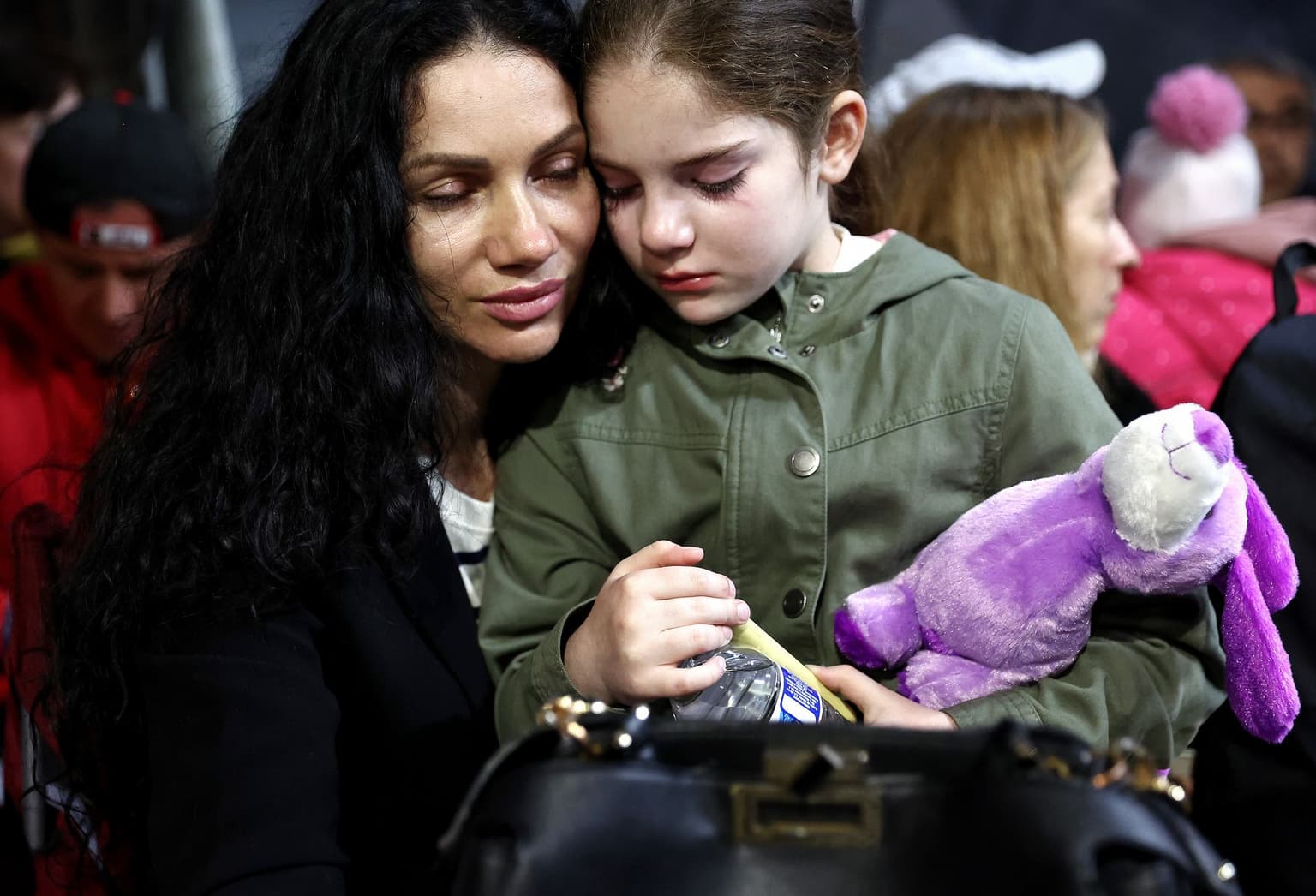
A Ukrainian mother and daughter seeking asylum in the U.S. wait to cross the border at the San Ysidro Port of Entry in Tijuana, Mexico, on April 5, 2022. (Mario Tama / Getty Images)
 on Google
When six-year-old Matvii Dovhan sees blue and yellow, he proudly tells his mother: Ukraine!"
Matvii moved to Canada from the Russian-occupied city of Enerhodar in Ukraine's Zaporizhzhia Oblast when he was three. He can’t remember much from that time.
His family never planned to leave. Their journey out was their first trip abroad — and a dangerous one.
Still under occupation, they applied for an emergency visa to Canada, relying on Google Translate for nearly every word they saw in the documents. Passing through multiple Russian-installed checkpoints on the way to Ukrainian-controlled territory left the children — Matvii, Mark, and Marharyta — frightened. And their parents, Yevheniia and Yevhen Dovhan, were exhausted and unsure what would come next.
They left most of their belongings behind and sold their car to afford tickets to Canada. But one thing made it with them — their license plate, now hanging in their home in Edmonton.
"Even though Matvii is the youngest, he clearly knows he’s Ukrainian," Yevheniia says. "It’s difficult for him to speak fluently, but Ukrainian words still find their way to him. He runs to me to check if he said them right."
Matvii is among nearly 1.8 million Ukrainian children UNICEF identifies as refugees living abroad — part of a generation growing up far from home, navigating new languages, education systems, and uncertain futures.
While younger children like Matvii often adapt quickly, older Ukrainian children face a more complex reality: balancing integration into life abroad with maintaining ties to Ukraine, all while making decisions that could shape where and how they will build their future.
read also
Matvii’s 13-year-old sister Marharyta took some time to adjust to life in Canada. While her brothers quickly found new friends, she mostly spent time with a few fellow Ukrainian students.
"The most difficult for me was to understand what was going on," she tells the Kyiv Independent. "How to behave, what to do and what not to do."

"In Ukraine, we often talked about the future — until (that future) was destroyed," Yevheniia says. "Now we just live day by day, trying to appreciate what we have. The most important thing is to be together. No matter how life challenges you, if your family is with you — that’s what matters most."
Like more than 300,000 Ukrainians who arrived in Canada under the emergency travel program, the Dovhans remain on temporary status despite having secured steady employment and even purchased a home. They must repeatedly apply for work and study permits — a costly and uncertain process, as they have yet to secure permanent residency.
After an initial wave of strong support for Ukrainian refugees following Russia’s full-scale invasion, several countries have tightened immigration policies. Across Europe, governments have begun debating the future of temporary protection programs, while reducing benefits and shifting people toward work-based integration systems. In the U.S., Ukrainian refugees have faced growing uncertainty as immigration protections have narrowed.
"We always worry about the documents," Yevheniia says.
Meanwhile, preserving their children’s connection to Ukraine is essential.
In the summer, the older children attend local Ukrainian youth camps supported by diaspora organizations.
“For me, Ukraine is home. Canada is a second home — I like both.”
Yevheniia also runs an Instagram bookstore selling Ukrainian books in Canada. Nearly every month, she receives large shipments from Ukraine that sell out within days — ensuring her children continue reading in their mother tongue. Marharyta often helps pack orders and sets aside a book for herself.
When asked where home is, Marharyta pauses.
"Probably Canada," she says. "Ukraine is where I used to live. My family is here now, so this is home."

"For me, Ukraine is home. Canada is a second home — I like both," her brother Mark adds in English.
For many Ukrainian parents abroad, adaptation has gradually become something more complicated than temporary survival.
When Anna Kolot moved to Poland with her 12-year-old son Yaroslav in the first days of Russia’s full-scale invasion, the first weeks felt unbearable. For about a month, she recalls, they attended church services in Wroclaw and cried.
"You were just pushed out of your home. It was so stressful. I never planned to leave (Ukraine)," she says.
But as they gradually secured housing, enrolled Yaroslav in school, and built new routines, life became more manageable.
Four years later, Yaroslav’s life in Poland looks very different. Now studying at a technical secondary school and hoping to pursue a career in software engineering, he says his connection to Ukraine has changed over time.
"With every day, I became more distant from Ukraine," the boy says. "Right now, it’s mostly my relatives and school that keep that connection alive."

One relationship remains especially important — his father, who stayed in Ukraine.
"They can talk for three hours straight," Anna says.
Yaroslav quietly corrects her: "More like an hour."
Mornings often begin with checking the news from home and making sure everyone they care about is safe.
Despite arriving without speaking Polish fluently, Yaroslav quickly stood out academically thanks to his Ukrainian education. Anna recalls that mathematics became one of his strongest subjects and helped him settle into school. After a year of additional Polish classes, he no longer struggled to communicate.
At the same time, he continues studying in a Ukrainian school remotely — something his parents encouraged so he would maintain ties with home.
Yet when asked what feels like home now, Yaroslav doesn’t hesitate. "Poland," he says. This is where he made friends and started imagining his future: "If everything is okay in my life and I have the means to help Ukraine, I would want to help."
“Recovery doesn’t happen overnight.”
For now, Anna and Yaroslav Kolot share one wish — for the war to end so they can fly to Kyiv to visit relatives.
In the meantime, they look for moments that keep them connected to Ukraine.
"When we go to football matches and Ukraine is playing, we jump and cheer so loudly," Anna says.
Anna says she still hopes Ukraine can eventually create conditions that would encourage people to return.
"I want our country to get back on its feet. I want it to be strong," she says. "I wish it could — economically speaking — bring back those who left."
Looking at Poland’s development over the past decades, she believes Ukraine’s recovery will take time but is possible: "I see the path Ukraine has to take. My colleagues tell me Poland also had to go through difficult changes. Recovery doesn’t happen overnight."

"We have to know all our poets," Oksana Nerush tells her two sons as they work through another Taras Shevchenko poem.
The lessons are not always popular with 11-year-old Denys and 9-year-old Ihor. Growing up in Austria after fleeing Kharkiv, the boys would often rather be doing something else. But for their mother, preserving their connection to Ukraine has become part of raising them.
"We’ll get through Taras Shevchenko, and then we’ll move on to Lesia Ukrainka," she says with a smile.
Nerush left Kharkiv with her sons during the first month of Russia’s full-scale invasion and eventually settled in Austria. The destination was not random. Denys had been diagnosed with leukemia when he was six months old and had long received support from an Austrian-based foundation helping children with cancer. After the invasion began, the same foundation helped the family relocate.
Although they have since built a life in Austria, Nerush tries to bring the boys back to Ukraine as often as possible. At home, that connection continues through language, books, traditions and poetry.
The boys also attend a Ukrainian school remotely, completing assignments and taking tests alongside their Austrian education.
Adjusting to Austria was not easy, particularly for Denys. At first, he was frightened when children at school or on the playground greeted him with a fist bump.
"I had to tell him, 'Dear, they just want to say hello. They won’t beat you,'" Nerush recalls.
He was also scared of starting school in a new country, surrounded by an unfamiliar language and different customs. But he adapted quickly. Denys completed two school grades in a single year and soon picked up German.
"I often hear the boys speaking German to each other,” Nerush says. “It’s just easier and faster for them."
German has been more difficult for Nerush herself. Denys sometimes jokes that he doesn’t understand how his mother manages to communicate at work.
"To be honest, my young translators are my pride and joy," she says. "They’re the ones who come with me everywhere."
Nerush works at a local bakery and says the family has received tremendous support from people around them, including their landlords and members of the local community. A friend of the landlords taught the boys to ski, while others regularly attend their school performances and holiday celebrations.
It took a year and a half before Nerush and her sons returned to Ukraine for the first time after leaving. She says she was grateful for the support of her husband and parents, but still worried about how the boys would react.
Instead, the trip brought them a sense of peace. They revisited familiar places and spent time with relatives. When it was time to leave, Denys hid in the garage, hoping he would not have to return to the train taking them back to Austria.
"Every time we leave, we die and come back alive after those trips," Nerush says.
After one of their visits home, the boys’ father told them he had decided to join the Ukrainian military after nearly four years of volunteering.
The news was devastating. "They cried. They cried a lot," Nerush recalls. "They always said, 'Oh God, if it weren’t for Russia, we could be living at home. We could be living with dad.'"
Nerush spoke to the Kyiv Independent from Kharkiv, where she and the boys were spending part of their summer vacation: “We’re so grateful that we have a chance to see our family and familiar faces,” she says.
"I love Ukraine so much. The moment I cross into Ukraine, even the air tastes better."