President Zelensky needs to change the way he talks to Ukrainians
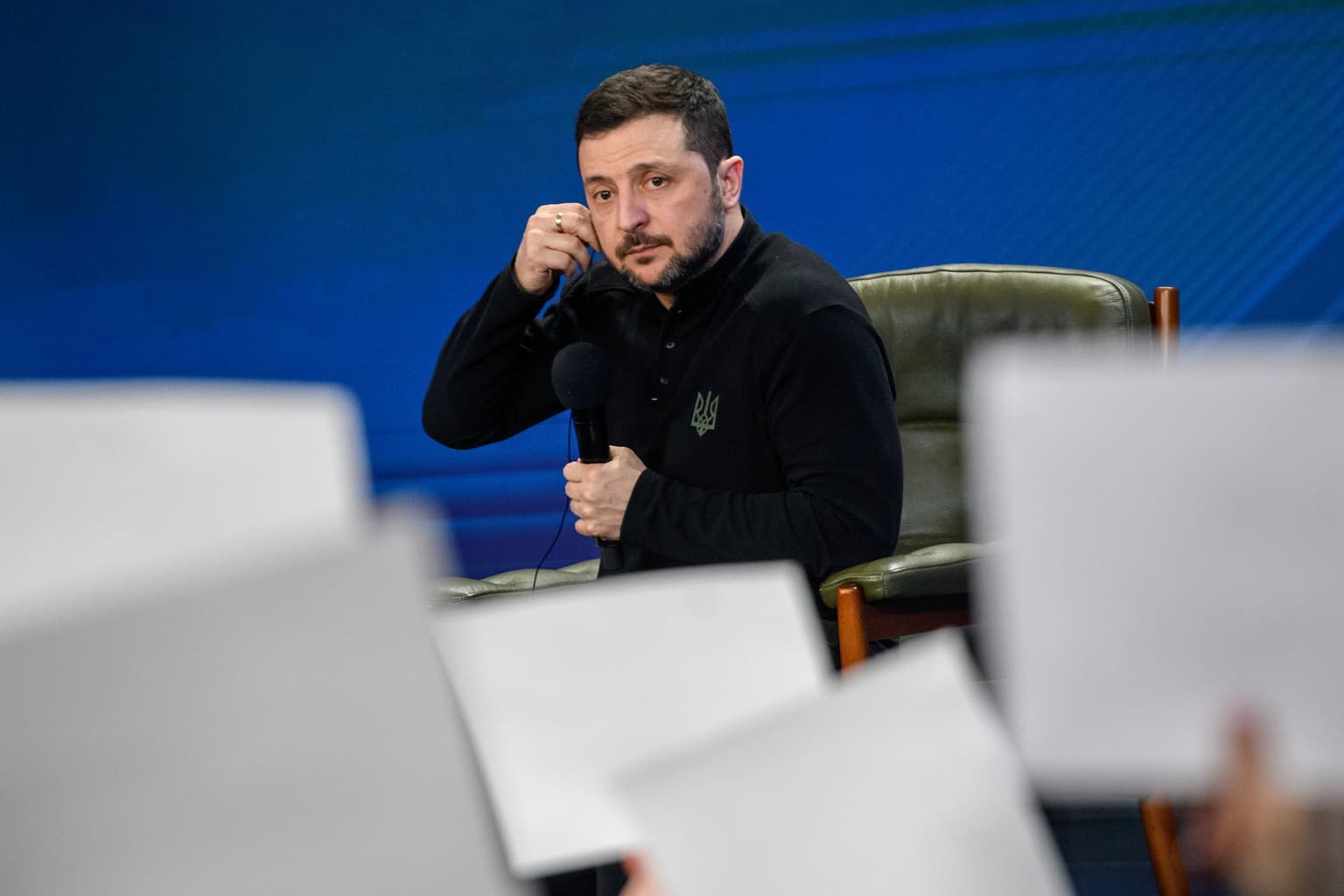
President Volodymyr Zelensky holds a press conference at the forum "Ukraine. Year 2025" in Kyiv, Ukraine, on Feb. 23, 2025. (Maxym Marusenko / NurPhoto / Getty Images)
 on Google
Kateryna Denisova
Political journalist
President Volodymyr Zelensky rarely misses a daily address. Nearly every evening, he sits behind the desk in his office, a wall of military chevrons behind him, and delivers a video monologue to the nation through his social media channels.
What he rarely offers, however, is a dialogue with the Ukrainian people and answers to the most pressing questions.
Zelensky has proved to be an effective communicator on the international stage, but domestic politics has long been his weak point. The president has consistently shied away from addressing politically costly yet urgent issues, including government reshuffles, corruption scandals, and difficult but necessary reforms.
On many sensitive issues, he leaves others to shoulder the responsibility.
Late last year, he shifted responsibility for addressing and dealing with the consequences of a major corruption scandal onto the newly appointed Prime Minister, Yuliia Svyrydenko. The scandal came to haunt Zelensky earlier this year when new revelations tied to his close allies became public.
Zelensky has yet to publicly address the allegations.
Mobilization, perhaps Zelensky's greatest political challenge, is another issue the president hasn't addressed. The president has commented on pay raises for soldiers, yet declined to talk about the politically contentious topic of military draft and rotation.
He has avoided taking a public stance on attacks against draft officers, and after the recent confrontation in Lviv, offered only a WhatsApp voice message to journalists, calling it "a very bad situation."
That reluctance to explain politically sensitive decisions is mirrored in Zelensky's approach to the press.

Don't get me wrong. Zelensky regularly gives interviews to foreign media, bloggers, and prominent public figures. But over the past five years, he has given too few interviews to Ukraine's independent media — I remember a couple to a public broadcaster and one to a radio station.
All this creates the impression of transparency and dialogue without actual substance. In a democracy, leaders are judged not by how often they speak, but by their willingness to answer uncomfortable questions. By that standard, President Zelensky has room for improvement.
From the first days of Russia's full-scale invasion, Ukrainians accepted an unwritten bargain: domestic political disputes should wait until the war was over.
The President's Office, however, appears to have mistaken that wartime consensus for a blank check.
The result is a system in which major political decisions are announced rather than explained. Lawmakers, despite their constitutional role in proposing a candidate for the prime minister's job, learn of the president's choice for this role through social media.
Officials find out they have been appointed or dismissed from a Telegram post.
In a democracy, leaders are judged not by how often they speak, but by their willingness to answer uncomfortable questions.
Zelensky entered office in 2019, saying that he could communicate directly with Ukrainians, bypassing journalists. Although he engaged with the media, including through hours-long press conferences over burgers and coffee, uncomfortable questions about corruption or his close allies have always been met with irritation or dismissive jokes.
Many of those questions have come to haunt him during the full-time war.
Nothing exposed the consequences of unchecked power more clearly than last year's corruption investigation into Zelensky's inner circle. A few months before the corruption probe was made public by law enforcement, Zelensky had signed the law that effectively stripped Ukraine's anti-corruption agencies of their independence, only reversing course after nationwide protests and pressure from Western partners.
Why was the law signed amid major anti-corruption investigations? Ukrainians were left without answers from the president and his team.
Rather than responding with greater transparency, the President's Office chose to shield Zelensky from unwelcome negativity. More than two months have passed since the second corruption probe was made public, and again, no explanations have followed.
Zelensky's last annual press conference was held in early 2025. The next one was scrapped.
When Ukrainians believe their leaders are taking the country in the wrong direction — whether out of miscalculation or malicious intent — they take to the streets. For many, this seems like the only option to be heard.

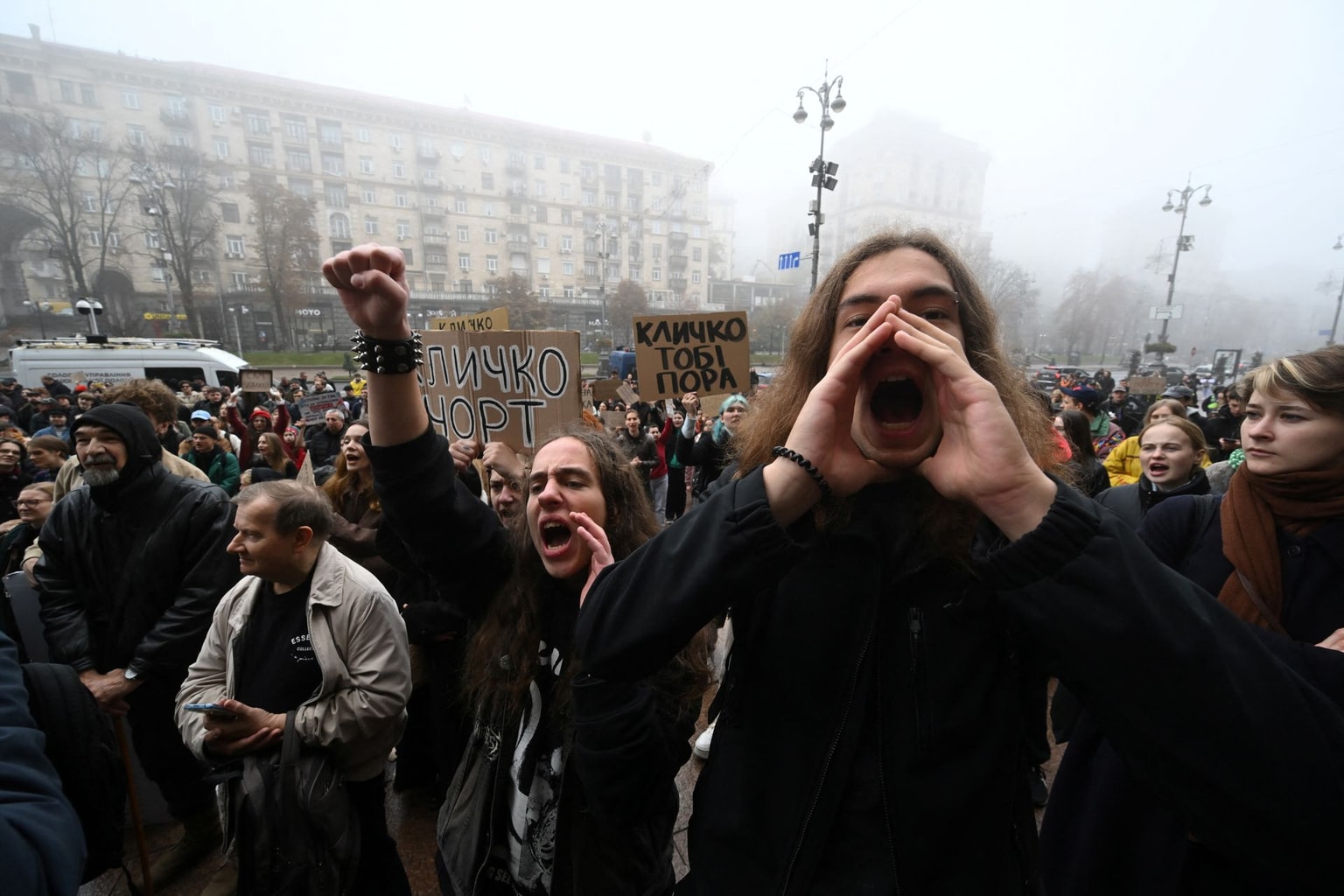
As a politics reporter covering the recent protests calling for the reappointment of Mykhailo Fedorov as the country's defense minister and the dismissal of Commander-in-Chief Oleksandr Syrskyi, one thing stood out to me. Many people were not rallying for or against a certain political figure.
They wanted answers, many of which were written on the cardboard signs people had brought to the streets.
Why had the government been reshuffled? Why wasn't Fedorov reappointed as defense minister? What are the reasons behind recent decisions?
Once again, no answers were offered.
Journalists have been attempting to learn about the reasons behind some of the decisions of high-profile officers. Many of them are also kept in the dark.
Rather than explaining his moves and communicating problems, Zelensky tries to cater to Ukrainians' whims. That may ease political pressure in the short term, but it does nothing to repair the growing rift between the president and the population.
Syrskyi's eventual dismissal came to embody many of the questions the president had chosen not to answer. Instead of explaining the decisions that had plunged his administration into a self-inflicted political crisis, Zelensky took the path of least resistance, conceding one of the public's main demands while continuing to avoid answering difficult questions.

The president's allies maintain that open political confrontation risks undermining national unity during wartime. Yet silence is no solution to the crisis. Ignoring public concerns and refusing to explain consequential decisions may delay political consequences, but it cannot eliminate them.
Got an opinion on anything you've read in the Kyiv Independent so far?
and it may appear in our Letters section.

As long as elections remain impossible because of Russia's ongoing war, the streets appear to have become one of the few places where citizens believe they can still make themselves heard.
President Zelensky says he hears Ukrainians. The question is whether he is willing to answer.
For weeks, demonstrators have gathered outside the President's Office, within earshot of its windows, repeating the same demands: "We need answers." "Admitting a mistake is not a weakness." "The people are the government."
These protests are not asking the president to hand down another decision from above. The crowds outside the President's Office are asking for more than a policy change. They are asking for a president who does more than hear them. They are asking for one who answers.
Editor's note: The opinions expressed in the op-ed section are those of the authors and do not purport to reflect the views of the Kyiv Independent.