We're ready to make any Russian move cost far more than it's worth — NATO military chief in exclusive interview
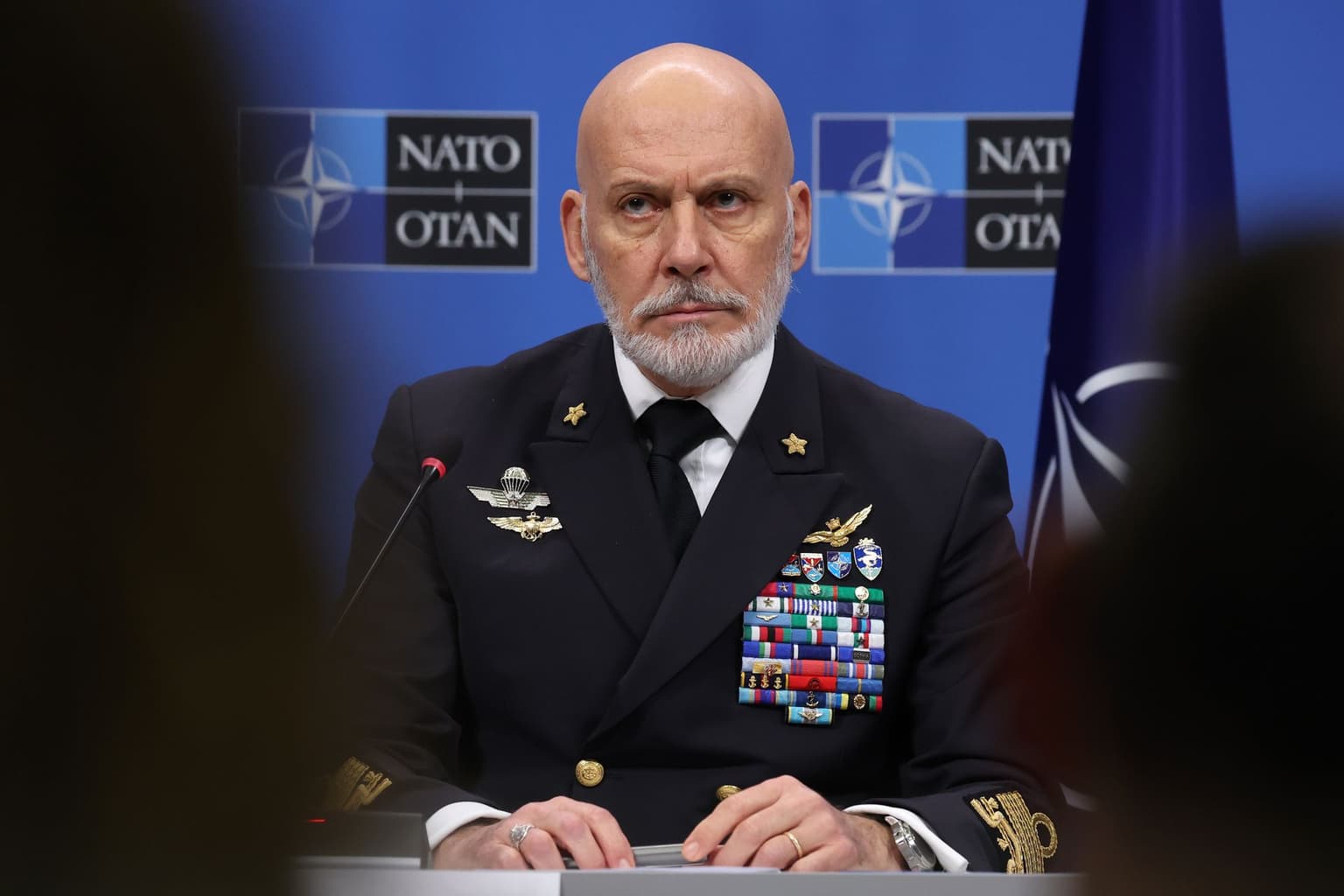
NATO military chief Admiral Giuseppe Cavo Dragone attends the NATO Military Committee Chiefs of Defence session in Brussels, Belgium, on Jan. 22, 2026. (Omar Havana / Getty Images)
 on Google
NATO is facing its deepest identity crisis since the end of the Cold War.
U.S. President Donald Trump's erratic relationship with Europe threatens to tear the alliance apart, and there are fears that the increasingly bellicose Russia may soon test the alliance's eastern frontier. The fast-paced military evolution of the Russia-Ukraine war also threatens NATO's long-maintained technological edge.
Giuseppe Cavo Dragone, an Italian admiral who has served as the chair of the NATO Military Committee — the alliance's highest military post — since January 2025, is confident Europe can weather the storm.
Speaking to the Kyiv Independent on the sidelines of the NATO summit in Ankara on July 7, Cavo Dragone expressed confidence that NATO can tip the scales in the technological arms race with Ukraine's help.
The NATO military chief also assessed Ukraine's path toward the end of the war, NATO's readiness to respond to any hostile moves by Russia, and what will happen if the U.S. scales down its presence in Europe.
Editor's note: The interview has been edited for brevity and clarity.
The Kyiv Independent: There is this point of view that we now sometimes hear in Western capitals that Ukraine is turning the tide in the war. When you look at the situation on the battlefield, do you share this assessment?
Cavo Dragone: Yes, I share this assessment because I have information provided by NATO Headquarters, so it is what we see. Now, Ukraine is gaining something, not losing — the strong reaction from Russia may stem from frustration.
The Kyiv Independent: What is the most realistic path to something that we can define as a Ukrainian victory?
Cavo Dragone: I think that in this, we are going too far ahead, because I really cannot imagine something like simply (Ukraine) regaining territory or Russia giving up. This is something we need to think about very, very cautiously. The very first thing NATO is looking for is a ceasefire — sitting at the table and starting to discuss a long-lasting peace for Ukraine.
The Kyiv Independent: How effectively has NATO been learning the lessons of modern warfare from Ukraine, for example, when it comes to drones?
Cavo Dragone: We are receiving a great deal of information through our JATEC (Joint Analysis, Training, and Education Center), the element we have in Poland, to exploit lessons learned from the field and to articulate training triggered by those lessons. That's something very, very valuable for us.
Drones, mass — it's an issue (for us), along with electronic warfare and speed: speed in adapting, speed in using all the innovation, and having that innovation available on the field. That's something we are learning from the Ukrainian war, from Ukrainian warriors.

The Kyiv Independent: Do you think there are aspects of the war in Ukraine that don't translate well to a potential conflict between NATO and Russia?
Cavo Dragone: Everything that is happening in Ukraine is modern warfare, and modern warfare is something that we need. But again, this is today's war, today's warfare.
Of course, our deterrence must be projected ahead to try to understand what the evolution of the threat will be. NATO has two main threats, which are Russia in the conventional area and terrorist groups in the unconventional area.
But again, we need to project into the future what these threats could become, how they could evolve, and adapt (accordingly). But again, the starting point from the Ukrainian theater is invaluable.
The Kyiv Independent: Since we've seen multiple exercises where Ukrainian drone operators defeated NATO forces, are you worried that this also means that Russia may be more combat-ready when it comes to drone technology than NATO?
Cavo Dragone: There are two aspects of the problem. Russia is depleting much of its stockpile; it will need to rebuild it. They probably also need to recruit more (personnel) in the future, whenever the war is over.
But on the other side, they have a lot of experience, too. And that's something that they will treasure. But we are also getting information on how they fight from our Ukrainian partners, so that's something that's going to balance it out.
Once again, it's a chessboard in which we are playing the game, moving and counter-moving, depending on what's going on in the battlefield.
"We define Russia as a threat."

The Kyiv Independent: Ukraine has shown that cheap, mass-produced systems can sometimes defeat more expensive platforms. But NATO's procurement culture has often been built around this procurement of high-end systems. Is NATO ready to adapt to this new reality?
Cavo Dragone: We are already readapting our capabilities targets for the future to strike the right balance between conventional legacy weapons and new cutting-edge technology weapons, and also cheap, "good-enough" weapons that can be used in this kind of theater. That's another lesson we learned.
The Kyiv Independent: At last year's summit in The Hague, the allies pledged to increase defense spending to 5% of GDP. How would you assess the progress so far? Have member states used this money well to invest in the capabilities needed?
Cavo Dragone: This is year one, and we have 10 years to reach the 5%, that is, 3.5% (for core defense requirements) and 1.5% (for broader security spending). The nations are moving in the right direction, and the industry is also changing a lot to be able to fulfill our requirements. So things are changing. More needs to be done in terms of the speed of procurement.
We are also doing a good job on shared requirements across multiple nations. That's something that gives us production scale and cost reduction, and we are heading in that direction. I think we should be satisfied.
The Kyiv Independent: If we leave equipment aside for now, there is also the question of manpower. Do you think that this may be an even more critical bottleneck — simply finding enough people who are willing to fight for their country?
Cavo Dragone: I think that this could be a bottleneck, but we do have the tools to try to avoid it. Because if part of this 5% is also dedicated to personnel, it will be a driving force in transforming military life in a way that makes it more appealing. This works better in some countries than in others, so we need to try to balance this and make the choice of joining the military more and more appealing. That could be a winning choice.
More nations are already moving in that direction. Some have conscription, others have reserve forces. So, again, the nations are moving in that direction, but more needs to be done.
The Kyiv Independent: We heard from the Dutch prime minister today that the Netherlands is already stretching capacity when it comes to the direct military aid it can provide Ukraine. Do you see this as a broader issue across NATO, where member states are simply running out of stockpiles they can immediately send to Ukraine?
Cavo Dragone: We are deploying a lot of our stockpile in Ukraine, and we'll keep on doing that as much as we can. Investing in the Ukrainian industry can also be a factor, which, honestly, has fewer limits than ours.
I'm just speaking about certification, qualification — they (Ukraine) do that right on the battlefield, while it takes us from one to three years.
This is a long process that we need to fix. But again — (we need to be) helping build in Ukraine, doing joint ventures with the Ukrainians, because they are now security providers too. It seems strange, but they are. I think we're going to support them the best way we can, for as long as it will be necessary.

The Kyiv Independent: There have been repeated warnings from several Western intelligence agencies that Russia may be preparing some sort of hostile operations on the territory of the Baltic nations or Poland. How realistic do you think the scenario is?
Cavo Dragone: It is realistic to the point where we define Russia as a threat. It is a threat because Russia could make this kind of move. But again, it's something we need to be prepared for, and we need to be prepared to give them much more damage than the advantage they could get from this kind of decision.
And we are doing it. I mean, today they would lose a lot, much more than what they could gain just by touching Poland or the Baltic states. And we are ready.
The Kyiv Independent: The U.S. has signaled its intention to reduce its military presence in Europe, while Europe is still ramping up its defense capabilities. Do you think that this provides a window of opportunity for Russia to try to test how well prepared Europe is?
Cavo Dragone: If we do it the smart way — as we are supposed to do and we are planning to do — I don't think so; it will be a smooth transition.
We recognize that the United States needs to divert some attention, some power, some energy somewhere else. It's a multi-theater confrontation situation that we are expecting in the near future. So we are proceeding in that direction, but in coordination among the allies.
We are doing this in a way that the allies can fill the gap that the United States could leave. And that will be a coordinated process that we will handle together.
The Kyiv Independent: What are the most crucial capability gaps that Europe would have to address if the U.S. reduces its presence?
Cavo Dragone: This could be a strategic airlift and deep precision strike capabilities. And we are working on all of them, of course — the precision strikes, electronic warfare, and ISR (Intelligence, Surveillance, and Reconnaissance).
These are precious capabilities that the United States is providing to NATO. If they need to take them away, we will react to that. But these are the ones that are more critical. And we are already working toward being able to fill these kinds of gaps.
Author's note:
Hi, this is Martin, the author of this article.
Ukraine's future continues to depend on the political will of its allies, and it's important to hear directly from the people shaping that support. Work like this is possible only thanks to our supporters.
If you want to see us keep going, please consider joining our community of members. Thank you.