The world is bigger than Europe. Ukraine should build stronger ties with Central Asia
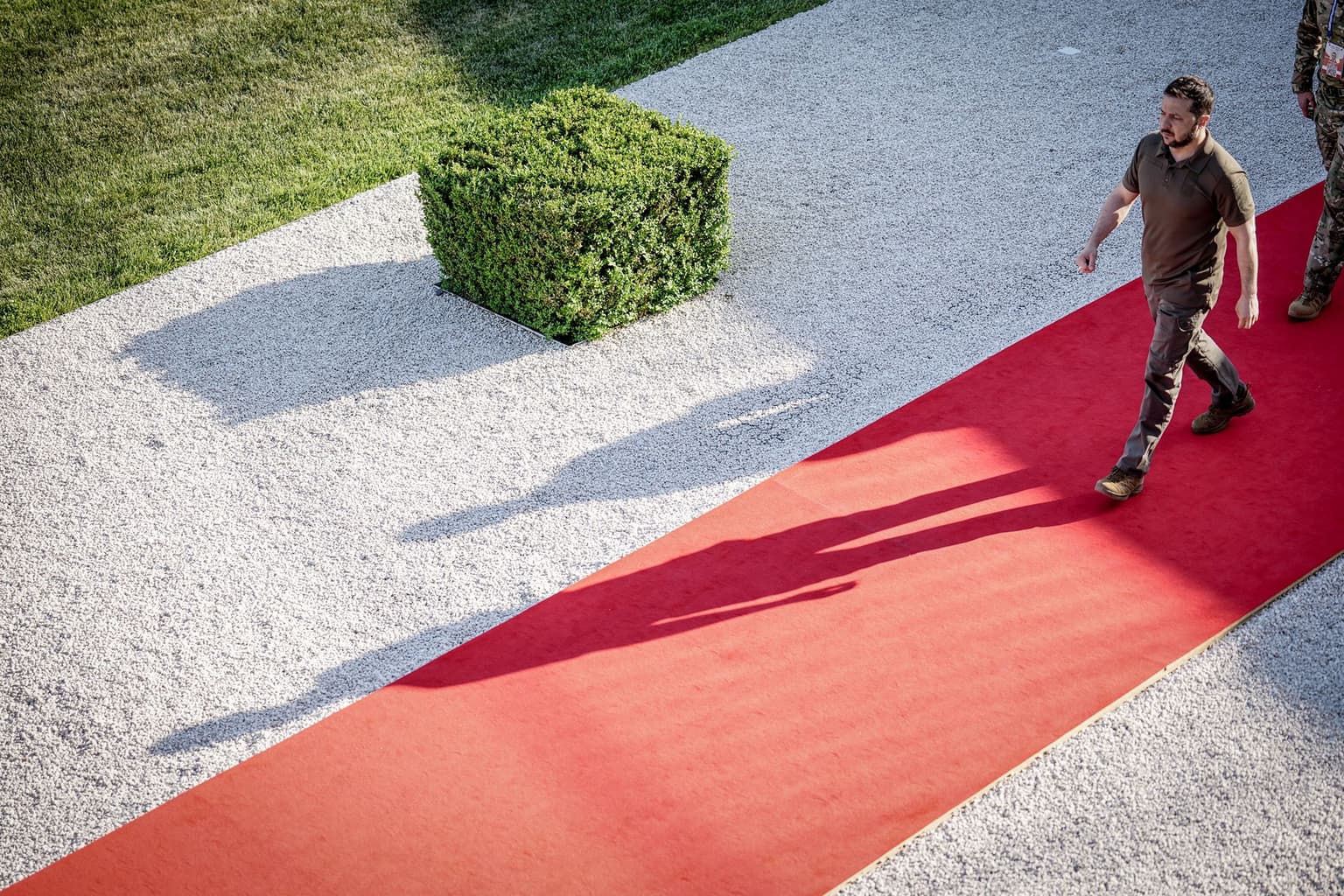
President Volodymyr Zelensky casts a long shadow on the red carpet during the European Political Community summit in Bulboaca, Moldova, on June 1, 2023. (Kay Nietfeld/Picture Alliance via Getty Images)
 on Google
Richard Kraemer
President of the US-Europe Alliance
Russia's full-scale invasion of Ukraine in February 2022 provoked some very real geopolitical soul-searching throughout Central Asian capitals.
Up until then, the economies of five of these states remained oriented towards the largest economy in the region – Russia. The C6 (i.e., Azerbaijan, Kazakhstan, Kyrgyzstan, Tajikistan, Turkmenistan, and Uzbekistan) are taking unprecedented steps to diversify their trade, investment, and labor portfolios, having been shaken by Moscow's brutal rejection of Ukrainian sovereignty.
Moreover, wars and instability to C6's south (Iran) and east (Afghanistan and Pakistan), its economies are further driven westward.
"As Russia’s economy suffers and xenophobia grows, Central Asian laborers are looking for friendly markets in Europe and the Gulf."
Ukraine is uniquely situated to win from the C6's reorientation with these new opportunities. For the sake of its economic growth and greater regional stability, it's high time for deeper private sector cooperation between them.
The speed at which C6 countries have begun to shift away from Moscow reveals the seriousness of an effort that began before the full invasion and is now accelerating rapidly.
Trade is exploding, as reflected by the volume of cargo being transported through the Trans-Caspian International Transport Route (TTIR).
The Middle Corridor (as it is also known) experienced a 62% increase in transport in 2024 alone, reaching 4.5 million metric tons. Rather than Russia, C6 outward investment and related activity have led to Central Asian states engaging directly in Turkish, Serbian, and Gulf economies.
The UAE is now the C6's preferred location for holding companies, regional headquarters, and other financial services.
Finally, as Russia's economy suffers and xenophobia grows, Central Asian laborers are looking for friendly markets in Europe and the Gulf, enhanced with labor agreements recently concluded between, for example, Uzbekistan and several European states.
The C6 turn from the Kremlin is not exclusively driven by policies responding to post-2022 realities. Shifts like Europe's increased reliance on non-Russian gas and oil, the rush for critical minerals, and the need for the infrastructure to transport these materials have brought the spotlight to Central Asia.

Across the Atlantic, U.S. President Donald Trump hosted five regional leaders in November 2025, resulting in mining, logistics, and airline industry deals.
Representative as to how economic relations with America have grown, Kazakh oil and mineral imports to the U.S. have grown from $1.7bn to $4.1bn. Uzbek exports to the U.S. have increased from $50 million in 2021 to $431 million between 2021 and 2024.
Europe has shown an equal, if not greater, interest in engaging C6 economies.
The very first EU-Central Asia Summit, held in April last year, produced a 10-billion-euro (about $11,5 billion) strategic investment-partnership package.
Related agreements include plans to establish the first region-wide framework to cooperate in mineral exploration, mining, and processing.
France has shown its eagerness to seize opportunities in Kazakhstan's nuclear and green energy sectors. With respect to transport infrastructure, the Eurasian Development Bank estimates that the value of transport projects under construction or in the pipeline reached $74 billion just last year.
Ukraine stands to gain by seizing the new opportunities issuing from Central Asia. Politically and culturally, Ukrainians and Central Asians both have a history of Romanov and Soviet rule that affords the mutual empathy borne of a common oppressor.
Accordingly, these nations relate in their respective fights for genuine sovereignty. With respect to post-war Ukraine, Central Asian economies will be able to cost-effectively meet, in part, the country's massive reconstruction material needs (e.g., mineral, chemical, and petroleum products) and migrant labor demands.
Finally, as the TTIR and other trans-Caucasian and Black Sea transport routes come into being or greater use, Ukraine's market size and geographic proximity to and hopeful membership in the European Union make it an attractive shipping route to Central-Eastern Europe markets, as well as the final destination of C6 goods.

To do so, Ukraine's business-oriented civil society (chambers of commerce and business associations) should birth promotional trade and investment initiatives aiming to increase C6-Ukraine commercial activity.
Outreach efforts may be undertaken in tandem with Ukraine's Ministry of Commerce and other business-related government entities, so that state actors can generate avenues for stronger commercial ties with the C6.
The tools are multiple, and groundwork already exists. Free trade agreements, bilateral investment treaties, and double taxation agreements are already in force between Ukraine and all C6 countries.
Relatedly, a foreign investment strategy for Ukraine, published under USAID's auspices, advises Ukraine to adopt best practices in FDI attraction. Post-victory, modalities such as strategic sector targeting, robust investment agencies, and the alignment of investment guarantees across Ukrainian law. Bringing business leaders in tow on presidential and ministerial travels can be further useful.
Central Asia offers feasible opportunities for Ukraine's commerce, finance, and labor sectors. With the war, there are multiple sound arguments against allocating significant resources towards a full push towards economic engagement with the C6. Cultivating such relations, however, can start today. Ukraine's private sector stands to win by pursuing just that.
Editor's note: The opinions expressed in the op-ed section are those of the authors and do not purport to reflect the views of the Kyiv Independent. The views expressed herein are solely those of the author and do not represent any institution with which he is affiliated.