News Feed

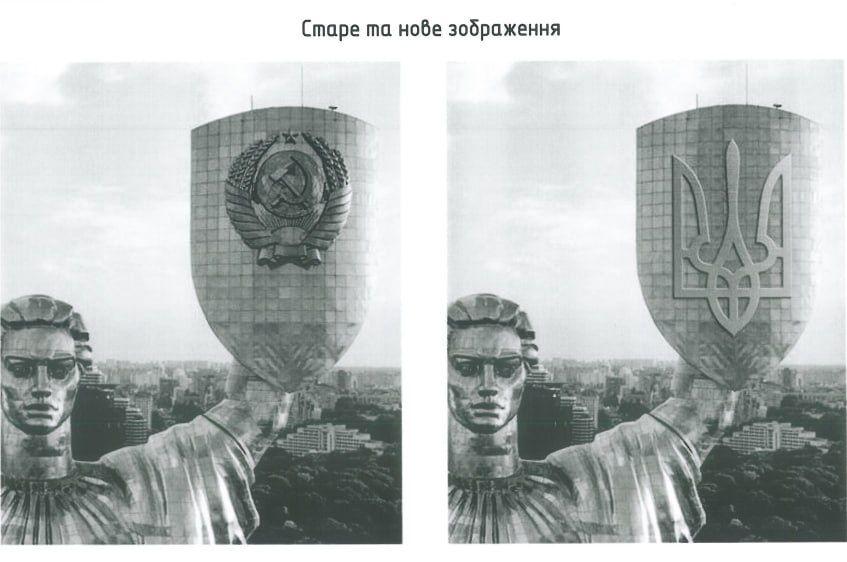
State approves plans to replace Soviet emblem on Motherland Monument with Ukrainian trident

2 min read
State approves plans to replace Soviet emblem on Motherland Monument with Ukrainian trident
The concept of the plans to replace the Soviet emblem on the Motherland statue with the Ukrainian trident. (Source: State Inspection of Architecture and Urban Planning)

The State Inspection of Architecture and Urban Planning announced on July 13 that it issued a permit to replace the Soviet emblem on the Motherland Monument, one of Kyiv's most significant landmarks, with the Ukrainian trident.

As the inspection commented on social media, this change comes as a part of the decommunization process in Ukraine.

The state body noted that the reconstruction was contracted by the National Museum of the History of Ukraine in the Second World War and the main dimensions and layout are agreed on with the Culture Ministry.

The Motherland Monument, also known as "Fatherland Mother" in a direct translation from the Ukrainian original, was built in 1981 during the Soviet era. It depicts a woman holding a sword and a shield emblazoned with the Soviet sickle and hammer symbol.

In April 2015, the Ukrainian parliament outlawed most Soviet and communist symbols, street names, and moments as part of a decommunization process. This prompted discussion on the continued presence of Soviet symbols on Ukraine's tallest statue.

In a survey from 2022, 85% of respondents supported the idea to replace the Soviet emblem with a trident – the Ukrainian coat of arms.

On May 3, 2023, following the full-scale Russian invasion of Ukraine, the parliament voted on a law to remove Soviet and Russian empire monuments left in Ukraine.

Culture Minister Oleksandr Tkachenko announced three days later that the plans to replace the Soviet symbol on the Motherland Monument with a Ukrainian coat of arms are underway.
Avatar
Martin Fornusek

Reporter

Martin Fornusek is a reporter for the Kyiv Independent, specializing in international and regional politics, history, and disinformation. Based in Lviv, Martin often reports on international politics, with a focus on analyzing developments related to Ukraine and Russia. His career in journalism began in 2021 after graduating from Masaryk University in Brno, Czechia, earning a Master's degree in Conflict and Democracy Studies. Martin has been invited to speak on Times Radio, France 24, Czech Television, and Radio Free Europe. He speaks English, Czech, and Ukrainian.

Read more
News Feed
Video

Along the Dnipro River in southern Ukraine, the front line has remained largely static, but fighting continues every day. The Kyiv Independent’s Francis Farrell and Olena Zashko embedded with Ukraine’s forces in Kherson Oblast, following FPV drone and night bomber teams tasked with defending river islands.

Earlier on Jan. 1, Volodymyr Saldo, a Ukrainian politician turned top Russian proxy head of Russian-occupied parts of Kherson Oblast, accused Kyiv of launching three drones at a hotel and a cafe on the Black Sea coast. Saldo claimed that the alleged New Year drone strike on the village of Khorly killed 24 people, including a child, and wounded more than 50.

Ukraine formally joined the European Union's single roaming zone on Jan. 1, allowing Ukrainian citizens to use their mobile phone service across the European bloc without incurring additional charges.

 (Updated:  )

'All memories of my childhood in Pokrovsk seem like a dream, as if it never really happened.'

Show More