Russia weighs options on Armenia ahead of key elections
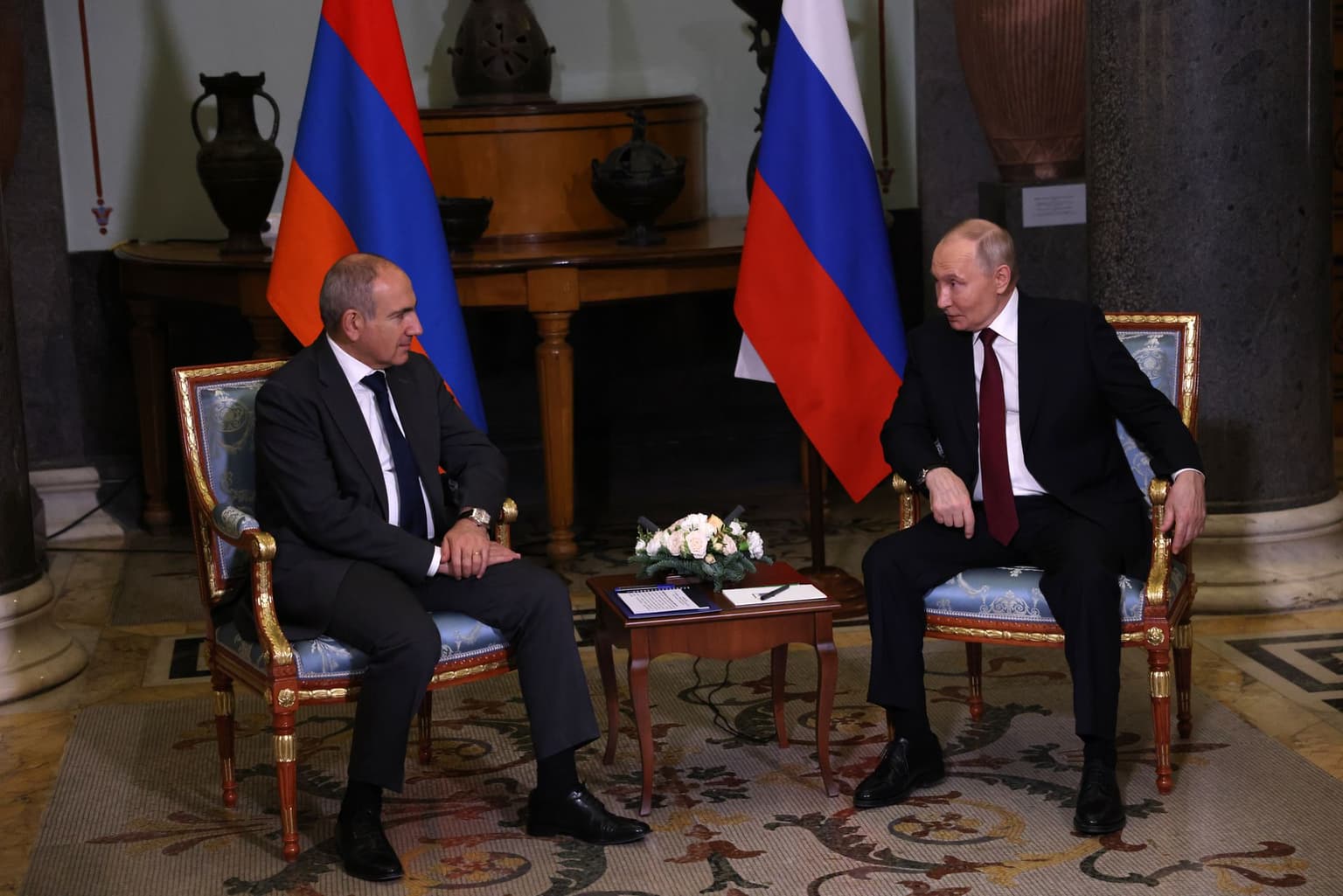
Russian President Vladimir Putin (R) meets with Armenian Prime Minister Nikol Pashinyan (L) in Saint Petersburg, Russia, on Dec. 22, 2025. (Contributor / Getty Images)
 on Google
Emil Avdaliani
Professor of international relations at the European University
Moscow's policy toward Armenia in the run-up to the crucial parliamentary elections in Armenia on June 7 has shifted from mere irritation to practical pressure.
Russia is no longer simply expressing dissatisfaction with Armenia's leadership's attempts to build closer ties with the West, but is actively trying to raise the cost of that turn for Armenian society.
Russia has been clear that closer ties with the EU may bring political symbolism and Western diplomatic support, but remaining inside Russia-led structures brings Armenia cheap gas, market access, labor mobility, and economic stability.
The first and most visible tool Russia uses is economic pressure. Moscow remains Armenia's largest commercial partner, despite the deterioration of relations.
Even after a decline in bilateral trade in 2025, Russia still accounted for more than one-third of Armenia's overall foreign trade and remained its largest export market. This matters because Armenia's post-2022 economic boom was largely built on Russia-linked trade, re-export channels to Russia, and migration-related money transfers into Armenia from Russia nationals who left their country after the war in Ukraine began.
Relatedly, Armenian agricultural goods, dairy products, flowers, brandy, mineral water, and other exports have repeatedly been subject to regulatory scrutiny or restrictions by Russian agencies.
Officially, Moscow frames these measures as sanitary, phytosanitary, or quality-control decisions; however, they coincide with moments of tension in bilateral relations — Armenia's pivot to the European Union, the freezing of its membership in the CSTO, its outreach to the EU, and now the election campaign.
Then there is energy. Armenia's vulnerability here is more profound than just bilateral trade. Russia has long supplied Armenia with gas at preferential prices and has signaled in the pre-election period that the flow of cheap gas is likely to change.
Kremlin officials and Russian-linked media have made the argument that Armenia receives favorable energy terms because it is part of Russia-led integration structures. If Yerevan moves toward the EU, it should not expect the benefits of the Eurasian Economic Union (EAEU) and Russian energy subsidies to continue.

Yet, this multifaceted pressure may have the opposite effect. Heavy-handed coercion risks strengthening the Armenian prime minister Nikol Pashinyan's argument that Armenia must reduce dependence on Moscow precisely because that dependence carries geopolitical risks.
A wider geopolitical perspective too matters here. For Russia, the vote is about whether Armenia remains within Moscow’s post-Soviet security and economic architecture or continues its gradual shift toward the European Union and the United States.
Beyond the economic pressure, Russia has fewer options to stall this development. It remains embroiled in a war in Ukraine, has witnessed difficult relations with Baku since the downing of the Azerbaijani jetliner, and has so far enjoyed only limited interaction with the Georgian government.
For Moscow, maintaining its influence over Armenia is therefore a key objective, allowing Russia to preserve its Soviet-era military perimeter in the South Caucasus through the military base in Armenia's city of Gyumri.
With the incumbent Armenian government likely to remain in power as a result of the upcoming elections, the stakes for Russia will be even higher.
Armenia might double down on its foreign policy diversification efforts. What once was Yerevan's near-exclusive dependence on Moscow will turn into a multi-vectoral foreign policy.
For Moscow, however, this would mean dilution of its geopolitical power. Indeed, losing Armenia would be tantamount to upending Moscow's entire geopolitical approach to the region.
It could, in fact, be more harmful to the Russian interests than what happened after 2008 when Russia invaded Georgia. The latter remained overtly pro-Western, but it nevertheless bordered on Russia and therefore remained highly vulnerable to Moscow's military moves.
With Armenia, the situation is different. It neither shares a border with Russia nor does Moscow have enough leverage over Azerbaijan to push the latter to pressure Armenia.
Moreover, Yerevan has been quite successful in normalizing relations with both Baku and Ankara, and this could partially alleviate the troubles that Russia's economic measures aimed at punishing Armenia could cause.

But for Russia, the problem around Armenia is also about prestige. Moscow knows well that Armenia's European path remains long, uncertain, and will be economically costly.
From visa liberalization to alignment in legislation, infrastructure, and various other standards, Armenia's pivot to the EU will take years if not decades. Moscow also knows that the EAEU, by contrast, provides Armenia with access to a huge market, easier customs access and labor migration, and, most of all, preferential energy supplies.
Moreover, the Kremlin's calculation is that Armenians' fear of losing economic benefits will outweigh the nebulous promises of the European countries on how far the relations with Yerevan could develop.
At the same time, Moscow also knows it may no longer be able to fully restore Armenia's loyalty.
Its immediate objective is to slow Armenia's drift elsewhere, raise the price of a potentially strong Western alignment, and preserve enough leverage to shape Armenia's choices after the election.
This could work in the longer run. After all, the Armenian leadership is expected to pursue a pragmatic foreign policy, and Russia is unlikely to be completely removed from this equation.
Editor's note: The opinions expressed in the op-ed section are those of the authors and do not purport to reflect the views of the Kyiv Independent.