Once a hub in the rear, Pavlohrad is now in Russia's glide bomb crosshairs
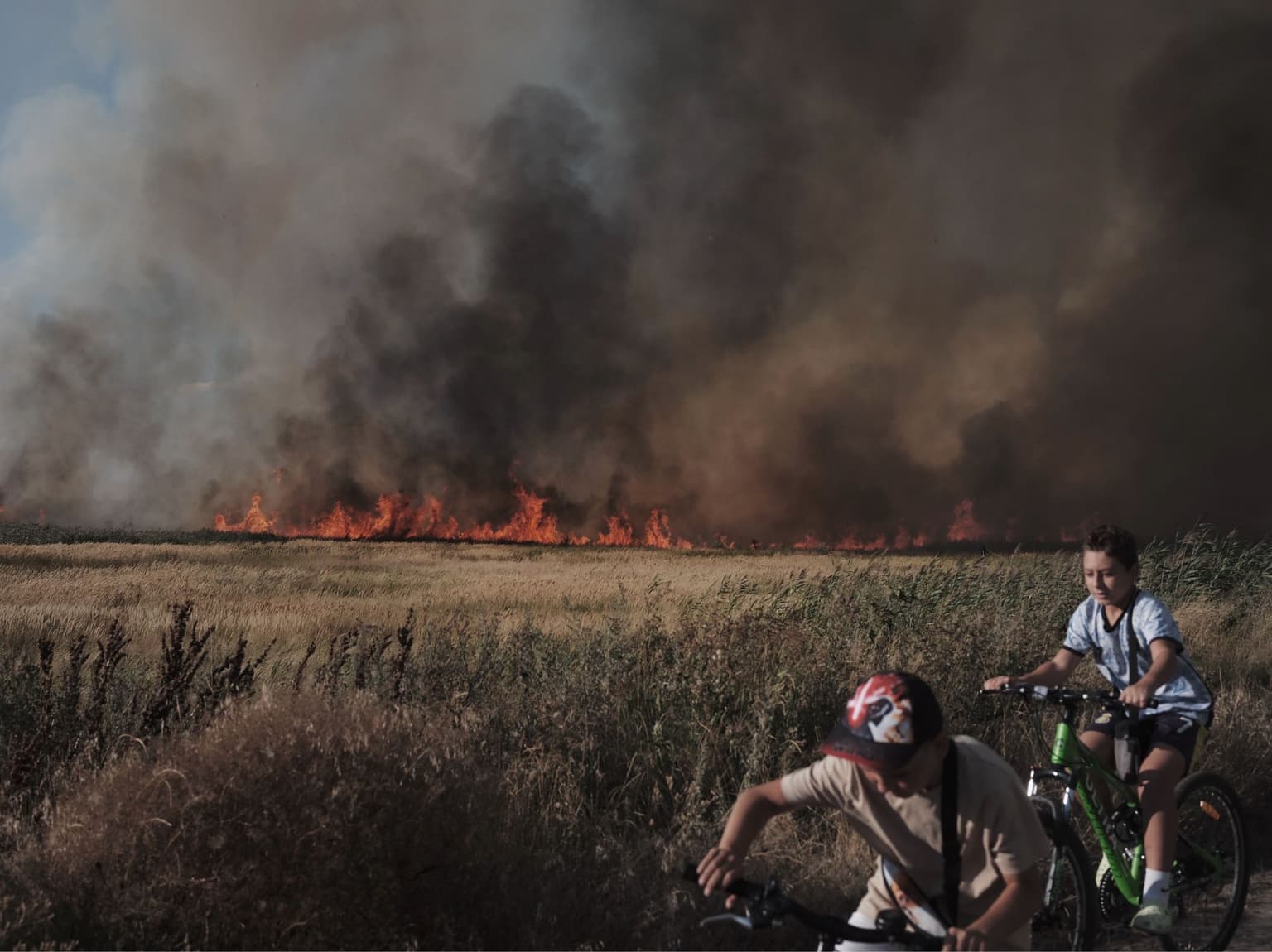
Children on bicycles watch a fire near their home in Pavlohrad, Ukraine, on Aug. 15, 2026. (Lisa Bukreyeva / The Kyiv Independent)
 on Google
PAVLOHRAD, DNIPROPETROVSK OBLAST — When Russia launched its full-scale invasion, the city of Pavlohrad in Dnipropetrovsk Oblast, roughly 75 kilometers (45 miles) from the front line, became a relatively safe haven for those fleeing the war further east.
But as the war drags on and the range of Russian weaponry increases, those living there fear their home now faces the same fate as cities in neighboring Donetsk Oblast, many of which Russia has reduced to rubble.
Just a month ago, on July 20, the first guided aerial bomb (KAB) attacked the city. KABs, while having a shorter range than missiles, are cheaper to produce, launched from aircraft within Russian territory or Russian-occupied territories, and carry warheads up to 1,500 kilograms — enough to level an entire apartment block.
They are almost impossible to shoot down. Air Force spokesman Yurii Ihnat told the Kyiv Independent in July that Dnipropetrovsk Oblast faces the heaviest KAB attacks across all the front-line regions.
On July 23, a Russian daytime KAB attack on Pavlohrad's food processing company killed three people and injured at least 28, local authorities said.
Sergiy Shapoval, a 39-year-old mechanic who works right outside near a gas station — a favorite target of Russian forces — in Pavlohrad, told the Kyiv Independent that the new threat poses an ever-present risk.

"I hear how they fly around the city… I worry that something could fly here," he said, adding there is no shelter at the gas station so there is nowhere to hide.
Shapoval, a native of Palohrad, said he will remain in the city as long as there is work. But recently, as Russia has stepped up attacks on gas stations, the repair shop where he worked has taken a heavy hit financially.
Nearly 90% of his clients are soldiers who have been told not to get their vehicles repaired somewhere so close to a likely Russian target.
Not long ago, he was fully booked. Now, there is barely a line. His boss has begun talking openly about the possibility of closing down.


"We are staying (in Pavlohrad) for now, but there is a possibility we might need to leave," Shapoval said. He also added that his daughter is 10-years-old and it's not clear how schools will cope after the summer holidays with the new threat from KABs.
Another local resident, Kostiantyn, 27, said that, with many jet-powered drones flying into Pahlohrad recently, he has been thinking about a potential evacuation plan. But as of now, high rental prices in other cities prevent him from moving further. Kostiantyn asked not to reveal his surname for security reasons, as he works in the defense sphere.
"I have friends from Pokrovsk, and you see what (Russian troops) are doing there, and it's starting to look similar in Pavlohrad," he said. Pokrovsk, once also a key military hub in Donetsk Oblast, much of which has been razed to the ground by Russian forces.
Mykola Kashtalian, the representative of the Pavlohrad City Council, said as the city is not officially considered a front-line area, so there is currently no forced evacuation. However, he said that city authorities "emphasize and tell people that if someone has made up their mind (to leave), that'sthat’s fine."

"People are already very, very emotionally exhausted," Kashtalian said. "There are rumors circulating amongst the public, and there are more of them suggesting that people should leave.
"There is a certain amount of panic because an information war is still underway, and (Russian) propaganda, amongst other things, is having an impact."
Kashtalian said there have been calm periods in the city recently, but also been times when hundreds of drones flew towards Pavlohrad, along with missiles. Over the past week, there have been six civilian casualties.
He added that people are now taking air raid alerts more seriously, and when one sounds, most go to shelters or take cover at home with at least two walls between them and outside.
read also
City's new face – refugees
Before the start of Russia's full-scale invasion, Pavlohrad had a population of around 100,000. Now, nearly 20,000 are those who left their homes in the front line area and moved to Pavlohrad, according to Kashtalian.
Roman Buhayov, an evacuation worker with the East SOS charitable foundation, told the Kyiv Independent that people are still arriving in Pavlohrad and that it has not lost its strategic importance as a vital evacuation and humanitarian hub for the Dnipropetrovsk, Kharkiv, and Donetsk oblasts.

"Pavlohrad is a very beautiful town, and for me it is associated with salvation," Buhayov said. "It is such a lifeline for those evacuating from front-line areas. Although there are some complications and I don't see the authorities doing much for internally displaced persons."
Inna Dashevska, a 35-year-old speech-language pathologist, relocated with her family from Myrnohrad, a town east of Pokrovsk. Her husband, a miner, along with many others in his profession came to Pavlohrad to work in the city's mine.
Two years ago, she left almost everything behind in Myrnohrad, taking only the most valuable things, including the children's toys. They are afraid that they might need to move again if the war comes even closer.

"It's scary that we'll probably have to move elsewhere, that there is uncertainty, and we would have to move all over again," Dashevska said.
"We'll stay here as long as the mines are still operating and as long as it's still safe to do so."
Dashevska said that recently the safety situation in the city has worsened, and over the last month, "it got very noisy," but it's still better than it was in her hometown.
As she was talking, her daughter Kira was playing in a playground. An air raid alert sounded, and she nervously told her mother they needed to go shelterhome.
"I try not to get (my daughter) worried, not to be nervous myself. I try to calm her down… She goes to kindergarten, where they explain what an air alarm means — that children need to get ready and go to shelter — she's already learned all that."
City's new face – soldiers
For soldiers like 23-year-old Oleg Sidor, who serves with the 108th Battalion of the Da Vinci Wolves, Pavlohrad has changed dramatically over the past six months. He has spent much of that time in the city, where he works in artillery, assault operations, and drone warfare.
"There are attacks every day. Two months ago, KABs couldn't fly here. Now they come almost every day," Sidor said.

The growing presence of soldiers has also made the city a potential target. Sidor said there are now "a lot of soldiers" in Pavlohrad and that Russian forces appear to target large buildings, including shopping malls, believing they may contain military personnel or equipment.
Soldiers can also receive warnings that their safe houses may be targeted. In one case, Sidor said, his comrades learned in advance that their house could be attacked and evacuated before it was hit.
Despite the danger, Sidor and his 25-year-old fiancée, Natalia Kalina, decided to marry. The Kyiv Independent spoke to the couple on the day of their wedding.

Their families from other parts of the country could not attend the ceremony, but several of Sidor's comrades were there. The couple had to wait in a shelter as Russian attacks continued, eventually signing their marriage documents when the situation calmed.
"There were KAB attacks before the ceremony. We were a little worried that the registry office could close," he said.
For Kalina, the war has brought a different kind of anxiety. When Sidor is at the front and loses mobile signal, she does not know whether he simply has no internet or whether something has happened to him. She hoped marriage would make it easier to receive information about him.
"Despite the war, I want to continue living," Kalina said.
For Sidor, the decision to marry also reflects the uncertainty of life at war. "Now is the time to do it," he said. "There might not be a tomorrow."