Is there an alternative to NATO for Ukraine?
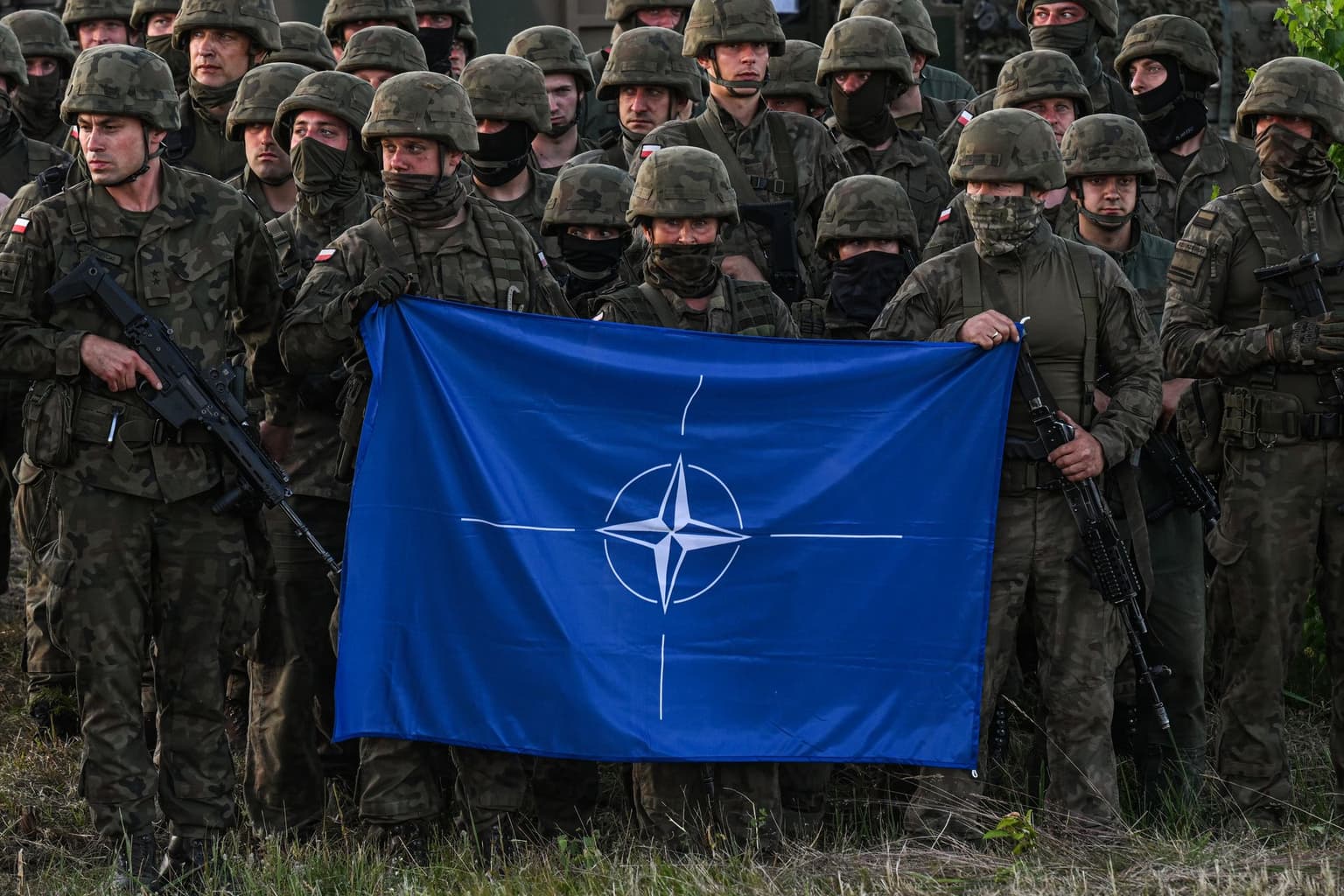
Polish soldiers hold a NATO flag at the Orzysz training ground in Orzysz, Poland, on July 3, 2022. (Omar Marques / Getty Images)
 on Google
Vitaly Portnikov
Ukrainian editor and journalist
Ukrainians seem to have an endless appetite for discussing the possibility of creating alternative military alliances, especially after U.S. President Donald Trump said he does not see Ukraine joining NATO early into his second term in the White House.
"I personally worked to ensure that we adopted NATO standards, and every year, I heard stories about how we were just about to join NATO. Unfortunately, we will never join it," former Commander-in-Chief Valerii Zaluzhnyi said recently, adding that NATO would need "about 12 years" to adapt to the realities of modern technological warfare.
The idea of creating an alternative military alliance for Ukraine in itself is nothing new. For years, we have been telling ourselves and trying to persuade others that because Ukraine has the most experienced and battle-hardened army in Europe today, every country would be eager to enter into a military alliance with us.
I will not remind anyone that the Ukrainian army is still fighting, and no one knows how many more years it will have to withstand Russian aggression. Nor will I point out that, under such circumstances, it is unlikely that any country would enter into a serious military alliance with one that is already at war. But even in peacetime, the United States will retain an advantage that no other country in the world possesses: a nuclear arsenal capable of matching that of Russia.
That is why, in the hard calculus of national security, countries seeking the strongest possible guarantees will still opt for an alliance with the United States rather than one centered on Ukraine.
The theory that a country could be attacked and the United States would fail to come to its defense remains just that — a theory. For NATO to prove incapable of fulfilling its purpose, such an attack would first have to happen, and the United States would then have to abandon its obligations.

However, even in such a scenario, the NATO member at war with Russia could still believe that its alliance with the United States would deter Moscow from using nuclear weapons.
If a NATO member were to enter into a military alliance with Ukraine and stand ready to fight alongside us, it would effectively be calling the credibility of NATO's Article 5 into question. So it would first be worth asking which countries Ukraine is supposedly going to form this alternative military alliance with. And can a country that, despite having a powerful army, is located on the periphery of the continent truly become the center of such an alliance for Europe?
Anyone who claims to know with certainty that Ukraine will never become a member of NATO, or, equally, that it undoubtedly will, places far too much faith in predictions at a time when the world's political and military landscape is changing almost by the day. There is every indication that this period of transformation is only beginning and will continue to unfold for years to come.
We are entering an era of such profound turbulence that any forecast made on Monday may already prove wrong by Tuesday.
One thing, however, will remain unchanged: the existence of security poles.
A country that does not wish, or is unable, to maintain allied relations with the Western security pole, still embodied by the United States and NATO, will inevitably become part of the Eastern security pole. In Ukraine's case, that means becoming part of Russia's territory or, at best, one of its satellites.
Anyone prepared to say that Ukraine will never become a NATO member should first answer one question: how, in that case, will Ukraine avoid becoming part of Russia?
Editor's note: The opinions expressed in the op-ed section are those of the authors and do not purport to reflect the views of the Kyiv Independent.