Exclusive: US fund to make 'big' investment in Ukraine's critical minerals this fall, economy minister says
In an interview, Oleksii Sobolev paints a portrait of an economy which is prepared for an uncertain future — and one from which the world can learn.
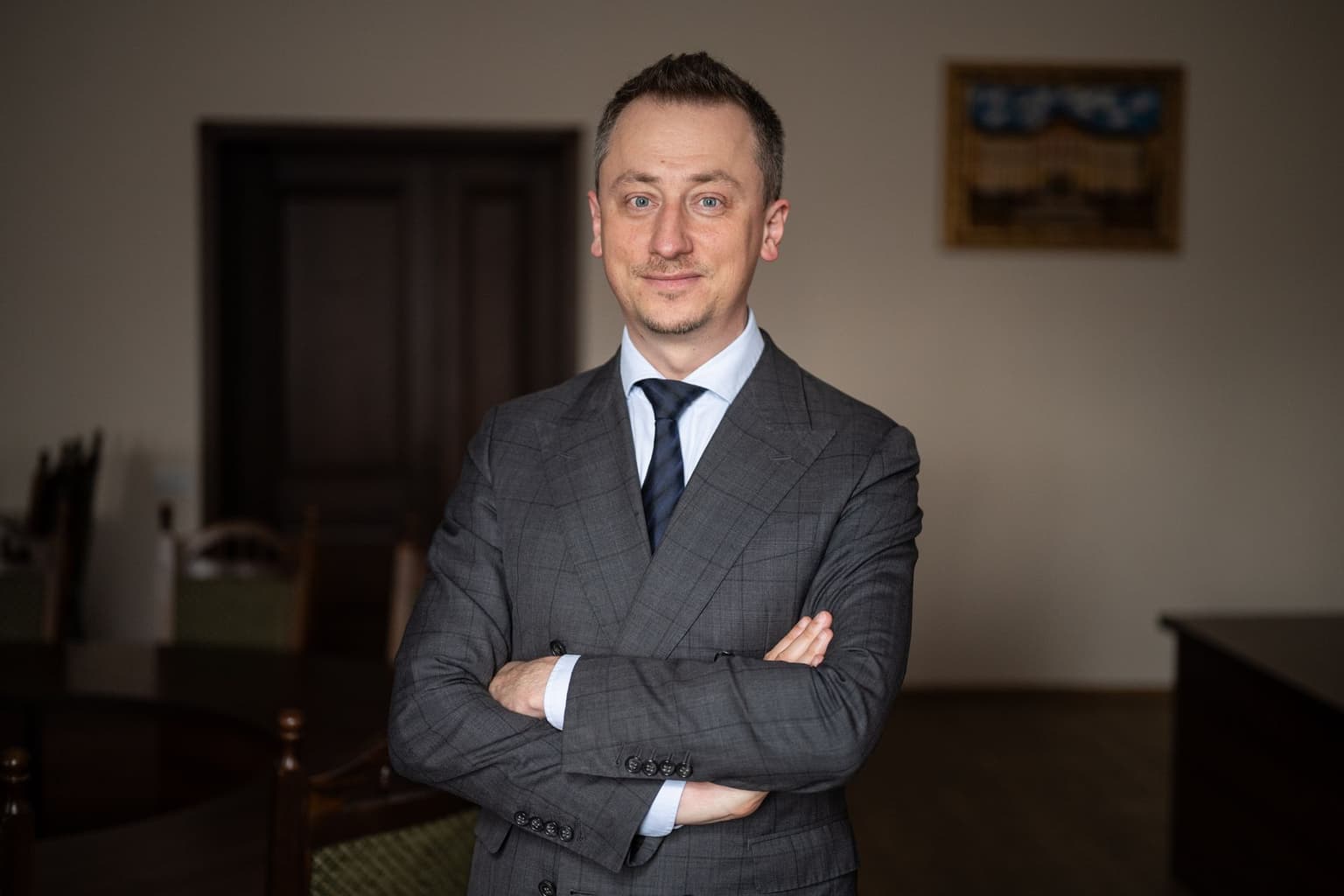
Economy Minister Oleksii Sobolev in Kyiv, Ukraine, on July 3, 2026. (Danylo Antoniuk/The Kyiv Independent)
 on Google
A fund set up by Kyiv and Washington will make its second investment in the fall, this time backing a critical minerals project, Ukraine's economy minister said.
"In the fall we will announce a big investment into critical minerals," Economy Minister Oleksii Sobolev told the Kyiv Independent in an in-depth interview, in which he spoke at length about how Ukraine is a market economy at the cutting edge of learning to live in a more uncertain world.
Sometimes referred to as the "minerals deal," the Ukraine Reconstruction Investment Fund is one of several bilateral investment arrangements that Kyiv has set up since the start of Russia's full-scale invasion. The fund has since broadened beyond minerals, announcing its first investment earlier this year into Sine Engineering, a Ukrainian drone software producer.
Sobolev could not share further details on the deal. Bloomberg reported in April that DTEK, Ukraine's largest private energy firm, was in talks to tap the $150 million in seed capital made available by the fund.
Ukraine has received hundreds of billions of dollars in financial assistance from allies since Russia's full-scale invasion in 2022, which has helped support the military and keep the country's economy afloat.
But the rich portfolio of new instruments and bilateral arrangements that Kyiv has crafted with allies to de-risk investment into the war-torn country is perhaps even more significant, and valuable experience that Sobolev says Ukraine wants to share.
"The funding is usually not the problem. The problem is that the instruments are lacking, because everybody is so used to the old world — which probably won't exist for the next couple of decades," Sobolev said, highlighting new initiatives like the U.S.-Ukraine fund.
"Take our instruments, some of which took years to develop, and use them," he said.
Ukraine launched a similar private-equity-style fund with the European Union in June this year, and has investment agreements with other allies, including France, Switzerland, the Netherlands, and Denmark.
"In these countries there are a lot of companies who would like to participate in Ukraine's market (...) and we're finding different ways of facilitating their entry," he said.
Sobolev's broader philosophy is that, in a challenging business environment like Ukraine, the government's role is to fill the gaps left by the private sector. War risk insurance is one important example, Sobolev said, and a key problem the ministry has spent several years trying to solve.
"What Ukraine has consistently shown is that we are constantly surprising people on the upside."

"A couple of years ago you couldn't get, for example, a Lloyd's quote on lots of things. Now you basically can," Sobolev said, adding that the government is also helping provide insurance to businesses within 100 kilometers of the front line.
While Sobolev said that quotes are still expensive, there should be a "much more massive war risk insurance program" by the end of this year.
But these are not the only lessons that the country's partners are eyeing. As European countries scramble to rearm, companies and governments are looking to learn from, and partner with, Ukraine's innovative and burgeoning mil-tech scene — now the fastest-growing sector in the economy, according to Sobolev.
Bureaucratic hurdles and fragmented procurement have slowed the continent's rearmament drive. And even in the fifth year of Russia's full-scale invasion, despite improvements, Ukraine's financial landscape isn't always as supportive as it could be of the sector.
"I don't think anyone in this new world, where defense is ever-so important, has sufficient ecosystems to support it," he said, pointing out that many development banks are still prohibited from financing defense.
"We think defense is ESG — it protects us," he said.
Sobolev mentioned that Kyiv is working with foreign partners to push big prime financial institutions to finance new and innovative mil-tech companies.
The Kyiv School of Economics estimates that the high-tech segment of Ukraine’s defense sector reached $6.8 billion in 2025, though it says the market is likely much bigger.

Sobolev sees the sector instrumental to the country's future — both as a signal to Moscow that it is strong enough to defend itself, and as a driver of the country's recovery.
"(Defense) is a driver of innovation, a driver of manufacturing growth, and a big sector for exports — we think that there are going to be quite a number of billion-dollar-plus companies that are very competitive abroad," Sobolev said.
Ukrainian Defense Minister Mykhailo Fedorov announced last week that Ukraine would allow its companies to export weapons under a new regime for the first time, a move that the industry has long argued would help them grow to become key global players.

Still, exports, investment funds, and new instruments only go so far against the scale of what's needed.
The World Bank estimates that it will take almost $600 billion to rebuild Ukraine. Sobolev admits that Ukraine will need to triple its current gross domestic product to be able to independently afford to pay for its own security and survive independently as a viable state.
But the incentives are huge.
"I really hope my kids are going to live here because they will feel safe," Sobolev said, visibly emotional.
"How sure am I that we are going to pull it off? Well, you never know. But what Ukraine has consistently shown is that we are constantly surprising people on the upside."